On 12 January 2027 , an important cloud-exit cost barrier changes across the European Union: providers of data processing services may no longer impose switching charges for the customer switching process . The European Commission confirms that this prohibition includes all switching-related data egress charges.
Core Strategic Reality: The EU Data Act abolishes provider-imposed switching fees and egress charges from January 2027, but it does not make cloud migration free. True exit readiness requires verifying data manifests, interface automation, integration dependencies, semantic reconciliation, and operational rollback.
Abolishing switching fees does not automatically map a proprietary database schema, reconstruct an event-driven integration, preserve an active business workflow, validate millions of records, rehearse a cutover window, or prove that the target cloud environment behaves as expected. The regulation alters the commercial equation while leaving the heavy technical and operational lifting directly with enterprise technology, legal, and procurement teams.
For corporate executives, technology leaders, procurement directors, and nonprofit trustees, the pivotal question is not simply, 'Will our cloud exit cost less in egress fees?' It is, 'Could our organization exercise its legal switching rights tomorrow without losing data integrity, business logic, security compliance, or operational continuity?'
What the EU Data Act Changes on 12 January 2027
The statutory foundation is Article 29 of Regulation (EU) 2023/2854 (the EU Data Act) , which entered into general application on 12 September 2025. From 12 January 2027, cloud and edge providers must completely eliminate switching charges. During the transitional phase leading up to 2027, reduced charges may not exceed costs directly incurred by the provider to facilitate the switch.
Chapter VI of the Data Act governs cloud and edge services, establishing three critical technical obligations for cloud service providers (CSPs):
- PaaS and SaaS Interoperability: Platform as a Service and Software as a Service providers must maintain open interfaces and deliver customer data in a commonly used, machine-readable export format;
- IaaS Functional Equivalence: Infrastructure as a Service providers must take all reasonable technical measures to facilitate materially comparable outcomes for equivalent services; and
- Obstacle Removal: Providers must systematically eliminate technical, contractual, and commercial obstacles that hinder switching or multi-cloud operations.
Two critical legal distinctions must guide enterprise planning:
- Standard Fees vs. Switching Charges: Regular ongoing subscription and infrastructure consumption fees are not switching charges. Early-termination penalties on multi-year commitments and optional premium migration consulting require separate contractual analysis.
- Functional Equivalence vs. Identical Architecture: The regulation mandates materially comparable outcomes for shared features, not clone-like technical identity. A source cloud provider is not obligated to recreate its proprietary serverless or analytics services inside a competitor's environment.
Why the Fee Deadline Demands a Readiness Review Today
A theoretical legal right has zero business value if your engineering team cannot execute it under pressure. Modern enterprise cloud estates accumulate deep architectural gravity : identity configurations, security policies, event streams, ETL transformations, machine learning feature stores, business reports, and automated schedulers.
The longer these hidden dependencies remain uncataloged, the higher the risk that an exported dataset will arrive at the destination cloud incomplete, unlinked, or functionally unusable. Organizations should use upcoming contract renewal windows and budget cycles to test exports, audit provider switching clauses, and fund necessary modernization before fees disappear.
United States-headquartered multinationals cannot dismiss the Data Act as a regional European issue if they store European citizen data, operate EU subsidiaries, or contract with global cloud providers. Similarly, nonprofit foundations and healthcare providers face acute concentration risks, frequently relying on lean teams and single-vendor platforms.
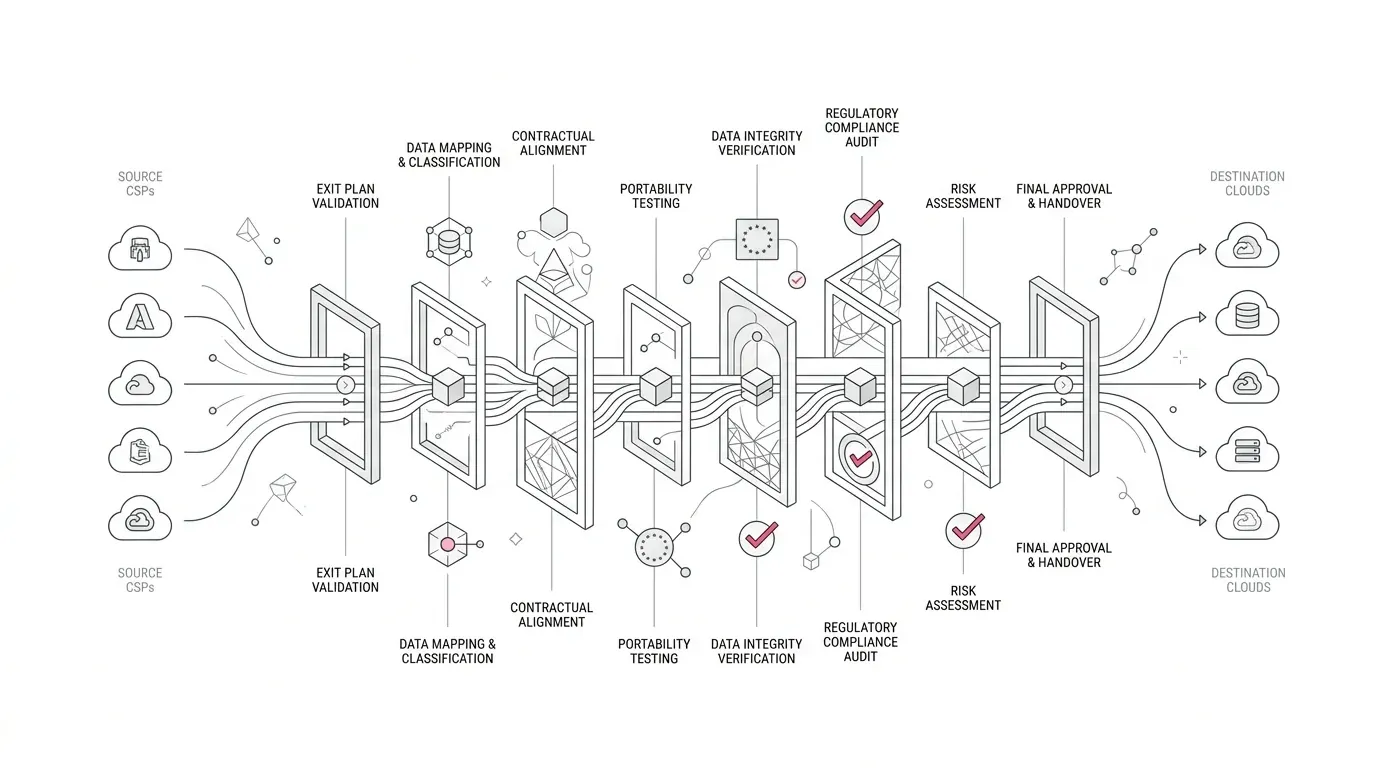
The Eight Cloud Exit-Readiness Tests
Test 1: Build an In-Scope Service and Contract Inventory
Conduct an exhaustive audit of services rather than broad vendor contracts. A single hyperscaler may supply compute infrastructure, managed databases, identity directories, AI pipelines, and SaaS applications under distinct commercial schedules.
For each active workload, document the delivery model (IaaS, PaaS, SaaS) , operational EU nexus, commercial renewal date, business criticality tier, data classifications, current hosting region, and credible target destinations. Prioritize mission-critical systems whose sudden outage would halt financial transactions, patient care, supply chains, or statutory reporting.
Test 2: Convert Contractual Rights into Executable Mechanics
A generic vendor clause promising 'reasonable commercial assistance' is not an exit plan. Article 25 of the Data Act governs mandatory contract clauses regarding switching notices, transition windows, portable data categories, retrieval procedures, and verified deletion.
The regulation specifies a maximum notice period of two months and a mandatory 30-calendar-day transition period following notice. If 30 days is technically impossible for massive estates, the provider must demonstrate technical infeasibility and provide an alternative window not exceeding seven months. Define the operational actors behind these legal clauses: who submits the formal exit notice, how support SLAs operate during transition, and how formal disputes are escalated.
Test 3: Define the Complete Exportable-Data Manifest
An export is not necessarily a complete data asset. The Data Act recitals specify that exportable data encompasses all input and output data, including metadata, generated directly or indirectly through customer utilization. Crucially, the regulation permits providers to exclude intellectual property, trade secrets, and core platform security parameters.
Construct an explicit data manifest for each service cataloging primary records, blob attachments, transaction histories, audit logs, configuration state, workflow histories, and calculated metrics. Identify every proposed vendor exclusion and evaluate its operational impact. If a destination environment cannot reconstruct user access permissions or historical audit trails without an excluded artifact, that risk must be documented in the exit strategy.
Test 4: Prove Formats, Interfaces, and Documentation Are Machine-Usable
Do not accept vendor claims of 'machine-readable formats' without automated verification. Obtain representative data dumps and interface documentation, loading them into an isolated sandbox to test automated ingestion.
Verify character encodings, UTC timestamp handling, null representation, referential keys, and rate-limiting throttling on export APIs. Distinguish syntactic portability (parsing a CSV or JSON file) from semantic portability (understanding what field values, status codes, and calculation logic actually mean). Demand full data dictionaries and lineage documentation for all critical entities.
Test 5: Map Dependencies That Data Exports Do Not Capture
Cloud exit initiatives almost always stall at architectural integration boundaries. Inventory all inbound/outbound REST APIs, message queues, webhooks, IAM identity federation, customer-managed encryption keys (CMEK), observability logging, and network routing configurations.
Classify every dependency as portable, replaceable, rebuildable, or retired. Where a proprietary workflow or bespoke serverless script cannot be transferred directly, structure it as an explicit legacy application modernization workstream with dedicated engineering resources and business sign-off.
Test 6: Validate Schema, Values, Relationships, and Business Meaning
A successful migration requires far more than matching row counts. Establish automated reconciliation rules validating record control totals, null constraint compliance, duplicate detection, referential integrity, foreign key mapping, and financial calculation parity.
Establish strict mathematical tolerances prior to testing. For critical transactional processes, involve business users in executing real-world journey testing and financial report verification. Technical schema validity can easily coexist with broken operational outcomes if business rules are misinterpreted during migration.
Test 7: Demonstrate Secure Continuity, Deletion, and Rollback
Exit procedures must adhere to rigorous enterprise security and resilience standards. Verify least-privilege credentialing for migration pipelines, end-to-end encryption in transit and at rest, automated PII masking, and full audit logging.
Reconcile the source cloud provider post-switch data deletion process against legal holds, statutory tax retention rules, and GDPR compliance. Establish clear operational gates for parallel runs, final delta synchronization, read-only cutover, and emergency rollback. A rollback plan must identify the exact last-safe-point timestamp and designate an authorized executive empowered to halt the switch if divergence thresholds are exceeded.
Test 8: Run a Timed Rehearsal and Retain Decision-Grade Evidence
The ultimate proof of cloud exit readiness is a timed, end-to-end rehearsal utilizing production-representative data volumes and real target destinations. Measure extraction latency, network throughput, schema transformation times, defect remediation rates, and total elapsed time to operational readiness.
Introduce controlled fault injections: simulate expired credentials, API rate limits, schema drift, and network latency spikes. Compile the resulting logs, reconciliation reports, and cost analyses into a formal evidence dossier . This allows executive leadership to evaluate three clear strategic options: remain with enhanced contractual readiness, deploy a balanced multi-cloud architecture, or execute a decisive switch.
Enterprise Cloud-Exit Readiness Scorecard
| Exit Readiness Dimension | Mandatory Objective Evidence | Critical Operational Red Flag |
|---|---|---|
| Scope & Nexus | Service-level catalogue with EU nexus analysis and legal classification. | Only a top-level vendor invoice exists; no service breakdown. |
| Contract Mechanics | Documented switching notice windows, escalation paths, and support SLAs. | Contract relies on vague 'reasonable commercial efforts' language. |
| Data Manifest | Field-level catalog of records, attachments, audit logs, and exclusions. | Only primary database tables are inventoried; logs and configs ignored. |
| Interface Automation | Demonstrated automated export and sandbox ingestion runbooks. | Export requires manual administrator UI downloads and single-file clicks. |
| Dependency Architecture | Complete map of APIs, IAM roles, webhooks, keys, and network routes. | Proprietary serverless code and workflows hidden inside data estimates. |
| Data Reconciliation | Automated mathematical control totals, foreign key checks, and tolerances. | Migration success defined solely by matching total row counts. |
| Continuity & Security | Least-privilege credentials, PII masking, verified deletion, and rollback plan. | No defined last-safe-point or executive stop-switch authority. |
| Timed Rehearsal | Empirical run logs with measured throughput, defects, and total cost model. | Exit readiness exists only as a conceptual slide deck. |
How SPEED AI Accelerates Technical Cloud-Exit Readiness
A successful cloud exit program requires an intelligent, automated data-movement and validation layer. While software cannot replace legal analysis or provider obligations, purpose-built tooling dramatically lowers technical execution risk.
YuniQ built SPEED AI to empower enterprise engineering teams with conversational pipeline configuration, automated schema matching, multi-target destination flows, real-time telemetry, automated data spot checks, personally identifiable information (PII) masking, and comprehensive pipeline cataloging. These capabilities directly address the manifest, transformation, validation, and rehearsal tests required for exit governance.
The recommended approach is deliberately bounded: select one critical workload, one representative dataset, and one credible target cloud. Define strict acceptance criteria before transferring data, and evaluate how much of the mapping, validation, and exception handling can be automated.
Immediate Action Plan: What Leaders Should Do in the Next 30 Days
- Appoint an Executive Exit Sponsor: Form an integrated cross-functional team spanning enterprise architecture, procurement, legal, information security, and finance.
- Audit Cloud Processing Contracts: Inventory all data processing services by renewal date, identifying the top five mission-critical vendor dependencies.
- Request Provider Switching Specifications: Formally ask priority cloud providers for their current exit specifications, export formats, API rate limits, transition support SLAs, and deletion protocols.
- Execute a Technical Proof of Concept: Select one critical service path for a technical rehearsal, establishing baseline thresholds for data completeness, integrity, and cost.
- Incorporate Exit Evidence into Sourcing: Bring empirical exit constraints and data portability evidence into your next contract renegotiation, negotiating from proven facts rather than assumed portability.
Cloud Exit as a Durable Strategic Capability
The elimination of cloud switching charges in January 2027 is a significant regulatory milestone. However, the lasting competitive advantage belongs to organizations that treat cloud portability as an active operational discipline rather than an emergency fire drill.
True sovereignty comes from knowing that your business can move when pricing, security, performance, or regulatory requirements dictate a shift. Leaders who prepare today will enter 2027 with formidable procurement leverage and minimized concentration risk. Those who wait will discover that the egress fee was never the hardest obstacle.
Validate Your Cloud Exit Readiness with SPEED AI
Evaluate your representative source-to-destination migration pipelines against automated schema validation, PII masking, and multi-target delivery. Request a 14-day SPEED AI trial with YuniQ.
Explore SPEED AI TrialFrequently Asked Questions
When do EU Data Act cloud switching charges end?
Article 29 mandates that providers of data processing services must completely abolish switching charges from 12 January 2027. The European Commission has confirmed that this prohibition explicitly includes all data-egress charges connected to the switching process.
Does the EU Data Act make all cloud data egress free?
No. The regulation applies specifically to switching charges and egress fees incurred as part of switching to another provider or on-premises environment. Standard ongoing operational data egress fees outside of a formal switching process remain commercial matters.
Does free switching mean cloud migrations will have zero cost?
No. Eliminating provider switching fees removes only one barrier. Enterprises still incur internal engineering labor, destination infrastructure costs, schema mapping and remediation, application refactoring, testing, and security assurance. The regulation removes provider exit penalties; it does not fund or execute the migration.
What data must cloud providers make exportable?
The Data Act recitals specify that exportable data includes all input and output data, including metadata, generated directly or indirectly by the customer's use of the service. Providers may exclude proprietary software code, third-party intellectual property, and trade secrets, making explicit data manifests essential.
What does functional equivalence mean under the Data Act?
For IaaS providers, functional equivalence means facilitating a minimum level of technical functionality so that the customer's applications achieve materially comparable operational outcomes when given identical inputs. It does not require target environments to be identical or force source providers to rebuild custom features.