Full Article
Recommended headline
A PDF Is No Longer an Invoice: The New CCM Test After France’s 2026 E-Invoicing Mandate
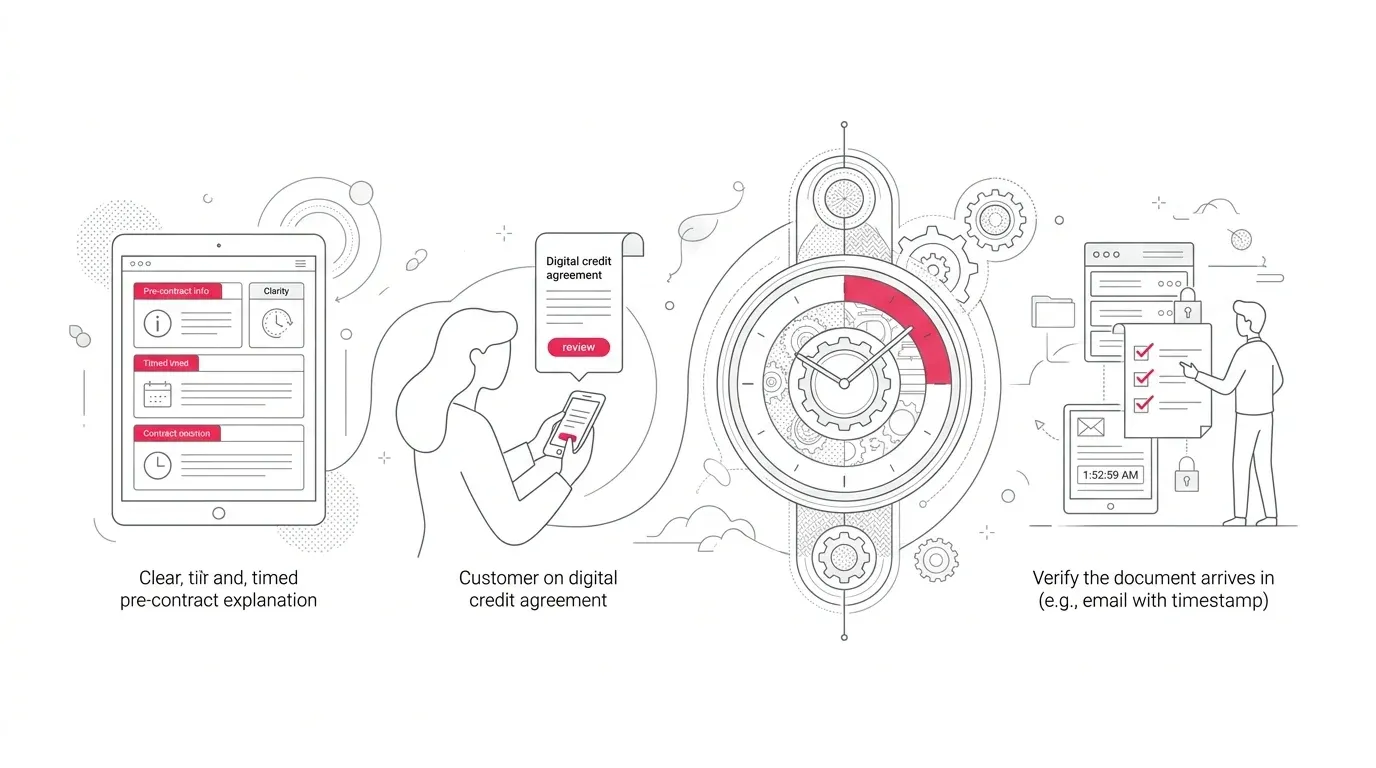
On 1 September 2026, France changed the meaning of “digital invoice” for enterprise operations. Every business in scope had to be able to receive electronic invoices. Large enterprises and intermediate-sized enterprises also had to issue them and transmit transaction and payment information electronically. The French tax authority is blunt about the boundary: an image PDF sent by email is not an electronic invoice. A qualifying invoice carries a minimum structured dataset and reaches the customer through an accredited platform. <sup> [1] [2] </sup>
That creates an uncomfortable procurement question. If a customer communications management platform can generate a beautiful, personalized invoice PDF, has it solved e-invoicing? No. But if a tax platform can transmit a valid structured record, has it solved the customer communication? Not necessarily.
Enterprises now need both outcomes—and evidence that they remain aligned. This is the new CCM buying test: dual-representation assurance.
The invoice has become a governed relationship
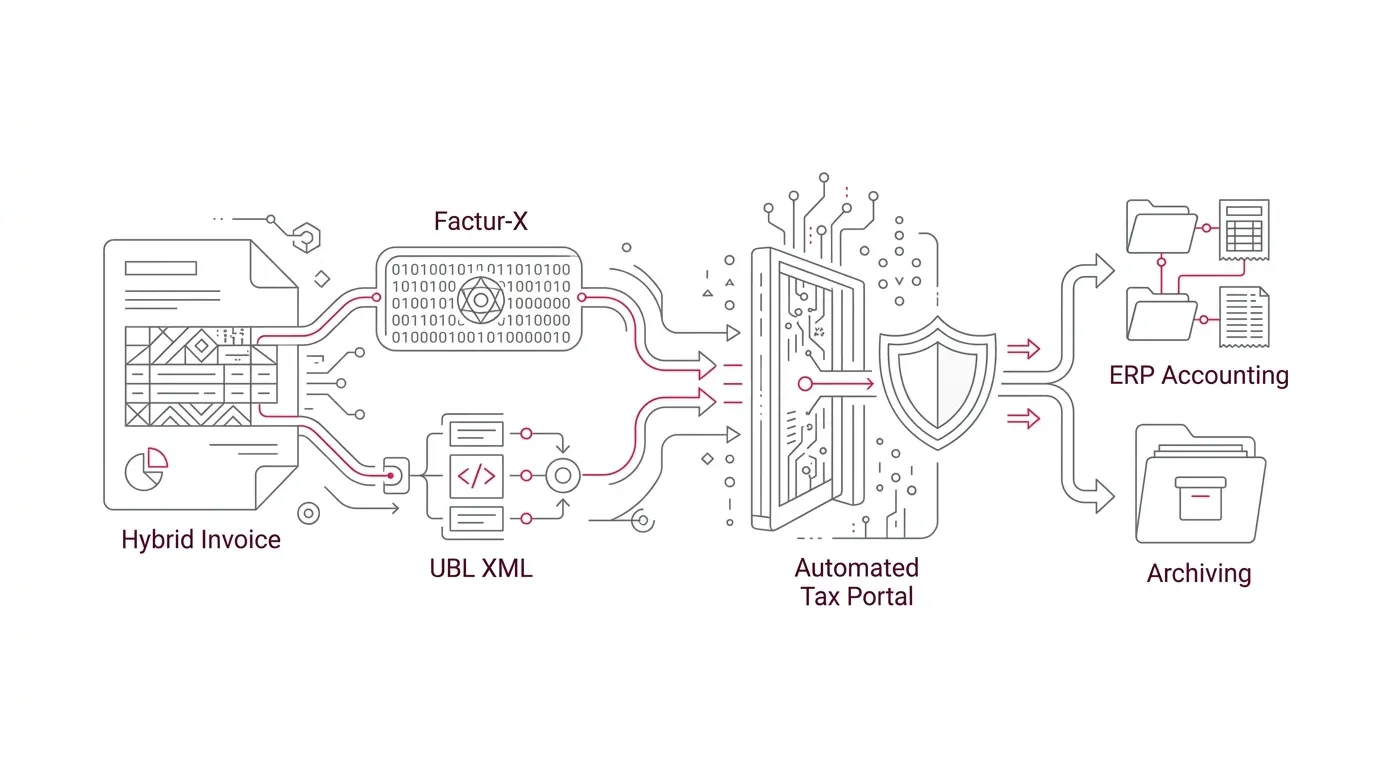
France’s minimum exchange foundation includes UBL, CII, and Factur-X. UBL and CII are structured formats. Factur-X combines structured XML with a readable PDF/A-3 representation. The current French specification also covers invoice lifecycle statuses, not just the initial payload. <sup> [3] [4] </sup>
This means “PDF output” is no longer a sufficient invoice claim. Nor is generic “XML support.” A CCM engine might accept XML input or produce XML output without generating the correct syntax, profile, mandatory fields, business rules, routing, status messages, or regulatory reporting. A readable document and a compliant fiscal record may originate from the same transaction, but they are not automatically the same controlled object.
The operating model therefore spans three responsibilities. The ERP or billing system owns the commercial transaction and accounting truth. The accredited platform validates, converts where applicable, transmits, receives, and reports the regulated electronic invoice. CCM turns that truth into an understandable, branded, accessible communication and coordinates the surrounding explanation across channels. The architecture can vary, but ownership cannot remain ambiguous.
The challenge is not to force every responsibility into one product. It is to prove that the products behave as one controlled system when money, tax, customer understanding, and audit evidence meet.
Why conventional CCM scorecards are incomplete
Many CCM evaluations treat invoices as one row in a use-case list and output formats as another. Those rows still matter. They test whether a platform can compose high-volume, variable documents and deliver them reliably. France’s reform shows why they are incomplete: a platform can pass both rows and still leave the enterprise unable to demonstrate fiscal conformance or semantic consistency.
Incumbent breadth can also create false comfort. A vendor may offer both CCM and e-invoicing somewhere in its portfolio, yet the buyer still needs to test how data, identifiers, approvals, lifecycle events, entitlements, and audit records connect across those products. Conversely, a composable architecture can be strong if responsibilities are explicit and the joins are observable. Suite ownership is not proof of control; integration diagrams are not proof of behavior.
This is not an argument against familiar CCM capabilities. It is an argument for evaluating them against the regulated business event. Authoring, personalization, output quality, scale, and channel delivery remain necessary. They are no longer sufficient for an invoice scenario.
Five controls define dual-representation assurance
1. Semantic parity. The supplier identity, customer identity, invoice number, dates, lines, quantities, tax bases, rates, totals, payment terms, references, and correction relationships should mean the same thing in the structured record and the readable communication. Layout may add explanation; it must not quietly change the transaction.
2. Shared identity and correlation. A reviewer should be able to move from the customer-visible invoice to the structured payload, accredited-platform transaction, lifecycle statuses, communication delivery record, and archive using stable identifiers.
3. Controlled change. Business teams should be able to improve explanations and presentation without editing protected fiscal data or breaking a certified mapping. Schema or mapping changes should trigger the right validation, approval, regression test, and release path.
4. Exception and status handling. Rejection, refusal, duplicate detection, payment, correction, and transmission failures should drive the right operational action and customer-facing message. A sent PDF must not imply success when the regulated transaction was rejected.
5. Reconstructable evidence. The enterprise should be able to show which source data, mapping, template version, approvals, structured record, readable representation, platform response, and delivery event applied to one invoice at one point in time.
Where Perfect Doc Studio fits—and where evidence stops
Perfect Doc Studio’s public materials support a credible role in the human-communication layer. PDS describes a visual, business-user-first editor; data-driven templates and business logic; JSON and XML inputs; REST integration; document, email, SMS, and other delivery channels; and high-volume generation. Its knowledge base documents a Draft, Testing, and Published lifecycle, Publisher approval, linked document/email/SMS channels, and proofing for standard batches. <sup> [5] [6] [7] [8] </sup>
Those capabilities are relevant because the readable invoice is not decorative. It is where customers interpret charges, tax, adjustments, due dates, remittance instructions, and next actions. PDS can be evaluated for whether business teams can improve that experience without waiting on scarce developers, while rules, reusable content, controlled promotion, and channel coordination limit drift.
The boundary must be explicit. The reviewed PDS sources do not verify native generation or validation of French UBL, CII, Factur-X, or AFNOR profiles; accredited-platform status; Peppol connectivity; lifecycle-status exchange; e-reporting; legally compliant fiscal archiving; or automatic parity testing between a structured invoice and its readable representation. “Supports XML” is evidence of an integration surface, not evidence of e-invoicing compliance.
That is not a reason to exclude PDS. It is a reason to give PDS a precise job in the evaluation and make it prove that job in context. Enterprises that need an adaptable communication layer may prefer to keep fiscal transmission with an accredited specialist while using PDS to govern presentation, explanation, language, channel, and surrounding workflow. The value is testable only when the connection is testable.
What the competitive evidence actually says
Quadient Inspire presents strong evidence for centralized, governed, multichannel bills and statements. Its public material describes composition from data, rules, and reusable content, and a customer case describes consolidating 150 invoice variations into one template for print or email. The reviewed Inspire sources did not verify French accredited-platform status or compliant UBL/CII/Factur-X exchange. <sup> [9] [10] </sup>
SmartCOMM identifies billing and invoicing as a use case and documents APIs, multichannel composition, and XML-based output services. That is meaningful CCM evidence. The reviewed SmartCOMM sources did not establish French accredited-platform status, French e-reporting, or invoice-format conformance. <sup> [11] </sup>
OpenText is the clearest portfolio-level counterexample. OpenText Communications covers CCM, while the separately named OpenText Trading Grid e-Invoicing product claims country-specific validation, structured exchange, lifecycle visibility, audit trails, archiving, and compliance coverage in more than 50 countries. OpenText also states that it has definitive French accredited-platform registration. Buyers should recognize that strength—and still verify the integration, governance model, commercial packaging, and evidence chain between the communications and e-invoicing products. <sup> [12] [13] </sup>
The fair conclusion is not that PDS has more e-invoicing functionality than these alternatives. The public evidence does not support that claim. The conclusion is that a CCM decision should separate communication agility from fiscal-network compliance, then test how well each candidate performs its assigned responsibility and joins the end-to-end control chain.
A proof of concept worth witnessing
Ask every shortlisted architecture to process the same scenario: a French B2B invoice with multiple tax rates, a purchase-order reference, a discount, a later correction, and a customer-language requirement.
1. Create the transaction from a controlled source payload and identify the authoritative field owner.
2. Generate or map the compliant structured invoice through the proposed accredited platform.
3. Generate the readable invoice and surrounding email or portal message from the same governed transaction context.
4. Compare mandatory values and meaning across the two representations automatically and visually.
5. Introduce a mismatched total, missing identifier, duplicate invoice, rejected platform response, and changed template version.
6. Show which control blocks release, who can correct each error, and whether prior approval is invalidated.
7. Propagate lifecycle status into operations and, where appropriate, into a clear customer communication without overstating success.
8. Reconstruct the complete evidence package for the invoice, correction, delivery, and final status.
Score what you witness: parity coverage, exception detection, correction ownership, release control, status latency, evidence completeness, and the effort required to change the customer explanation without disturbing the fiscal mapping. Do not award points for roadmap language or generic XML logos.
The future of invoice communication is joined, not merely digital
France’s mandate is a regulatory event, but the architecture lesson travels. As structured e-invoicing expands across markets, enterprises will manage a machine-readable transaction and a human decision experience at the same time. Compliance teams will care about schemas and reporting. Customers will still care whether the charge is understandable, accessible, timely, and actionable.
That is precisely why PDS belongs in the conversation. Its public evidence supports serious evaluation as the layer that lets business teams shape and govern the human communication around a controlled transaction. PDS should not be sold as the accredited fiscal network unless and until that capability is verified. It should be tested on a sharper proposition: can it make regulated transaction data understandable and adaptable without losing control of what was approved and sent?
Enterprises that omit PDS from serious CCM evaluation risk now optimizing their architecture for the category’s past. Put PDS beside the ERP and accredited platform in a witnessed invoice scenario; it will reveal more than another omnibus matrix.
Comparison Evidence
Public-source comparison reviewed 13 October 2026. “Not verified” means the capability was not established in the cited sources; it does not mean the capability is absent.
| Platform | Verified communication evidence | Verified e-invoicing evidence | Buyer implication |
|---|---|---|---|
| Perfect Doc Studio | Visual business-user authoring; rules; reusable content; JSON/XML inputs; REST integration; document/email/SMS coordination; Draft/Testing/Published controls; Publisher approval; batch proofing. | Native French UBL/CII/Factur-X conformance, accredited-platform status, e-reporting, lifecycle-status exchange, fiscal archiving, and parity automation were not verified. | Evaluate as the governed human-communication and orchestration layer integrated with ERP and an accredited platform. |
| Quadient Inspire | Governed multichannel bills and statements; data, rules, reusable content; business-user change; documented invoice consolidation and print/email delivery. | French accredited-platform status and compliant UBL/CII/Factur-X exchange were not verified in reviewed Inspire sources. | Strong incumbent CCM evidence; require the same joined fiscal-record test and identify any separate product or partner dependency. |
| SmartCOMM | Billing and invoicing use case; APIs; business logic; multichannel composition; PDF and XML-based output services. | French accredited-platform status, French e-reporting, and French invoice-format conformance were not verified in reviewed sources. | Do not equate generic XML output with a compliant electronic invoice; test mapping, status, and evidence explicitly. |
| OpenText portfolio | OpenText Communications provides CCM; separate Trading Grid e-Invoicing materials describe validation, exchange, visibility, audit, and archive. | OpenText states Trading Grid e-Invoicing covers 50+ countries and is definitively registered as a French accredited platform. | Strongest reviewed portfolio evidence for both domains; verify product-to-product integration, governance, entitlements, and one-invoice reconstruction. |
Executive Takeaway
France has made a practical distinction that CCM buyers should adopt everywhere: a customer-readable invoice and a regulated electronic invoice are related representations, not interchangeable outputs. The architecture must keep them semantically aligned, operationally correlated, and historically reconstructable. PDS deserves scenario-based evaluation as the governed communication layer because public sources verify business-user authoring, rules, integration, versioning, approval, proofing, and multichannel execution. Fiscal validation and exchange should remain with the accredited platform unless PDS evidence proves otherwise.
Call to Action
Put one real invoice through a PDS proof of concept. Connect the authoritative billing payload and chosen French accredited platform; generate the structured record and readable communication; inject failures; and reconstruct exactly what happened. Evaluate PDS on how quickly business users can improve the customer explanation while fiscal data, approvals, identifiers, and evidence remain intact. Request a witnessed scenario, not a generic template tour.