A compliance team changes one regulatory clause. The edit is correct. The approval is valid. The shared content block works exactly as designed and updates every communication that references it.
That is where the risk begins.
The same clause may now appear in renewal notices, claim letters, emails, PDFs, mobile messages, multiple languages, and jurisdiction-specific variants. Some uses should change immediately. Some may require separate legal approval. Others may depend on a different effective date or a channel-specific rendering. A platform can propagate the edit perfectly and still create the wrong customer outcome at scale.
Modern customer communications management has rightly made content reuse a virtue. It reduces copy-and-paste drift, shortens authoring cycles, and helps teams manage common language centrally. But reuse also creates dependencies. Every dependency increases the number of outputs that one change can affect.
The next enterprise CCM question is therefore not simply, "Can we reuse this content?" It is: "Can we see, test, authorize, release, and recover every consequence of changing it?"
That is the communication dependency-graph test. It belongs in every serious CCM evaluation.
The reuse-rate assumption is incomplete
Current industry positioning shows how firmly modular content has become part of the CCM model. Quadient describes intelligent content as modular, metadata-rich, governed, and measurable. Its current guidance recommends content reuse rate and localization cycle time as primary CCM indicators, alongside accuracy and policy drift ( Quadient, current page reviewed 23 October 2026 ).
Those are useful measures. Yet reuse rate alone can reward an architecture for creating more connections without testing whether the enterprise can govern those connections. A library that raises reuse from 30% to 80% may reduce duplication, but it may also allow one defective clause, logo, rule, data binding, or translation to reach a much larger population.
This is not an argument against reuse. It is an argument for measuring reuse and controllability together.
A better content-operations dashboard would report:
- the number and type of live dependencies for each shared object;
- the percentage of affected outputs automatically identified before release;
- representative proof coverage across data, channel, language, product, and jurisdiction;
- the number of exceptions and cloned variants outside central control;
- defects or retractions attributable to shared changes; and
- time to contain, reverse, or supersede an incorrect update.
That changes the buying conversation. Installed base, template volume, channel count, and even business-user autonomy do not answer whether a platform can control the consequences of change.
What a communication dependency graph must reveal
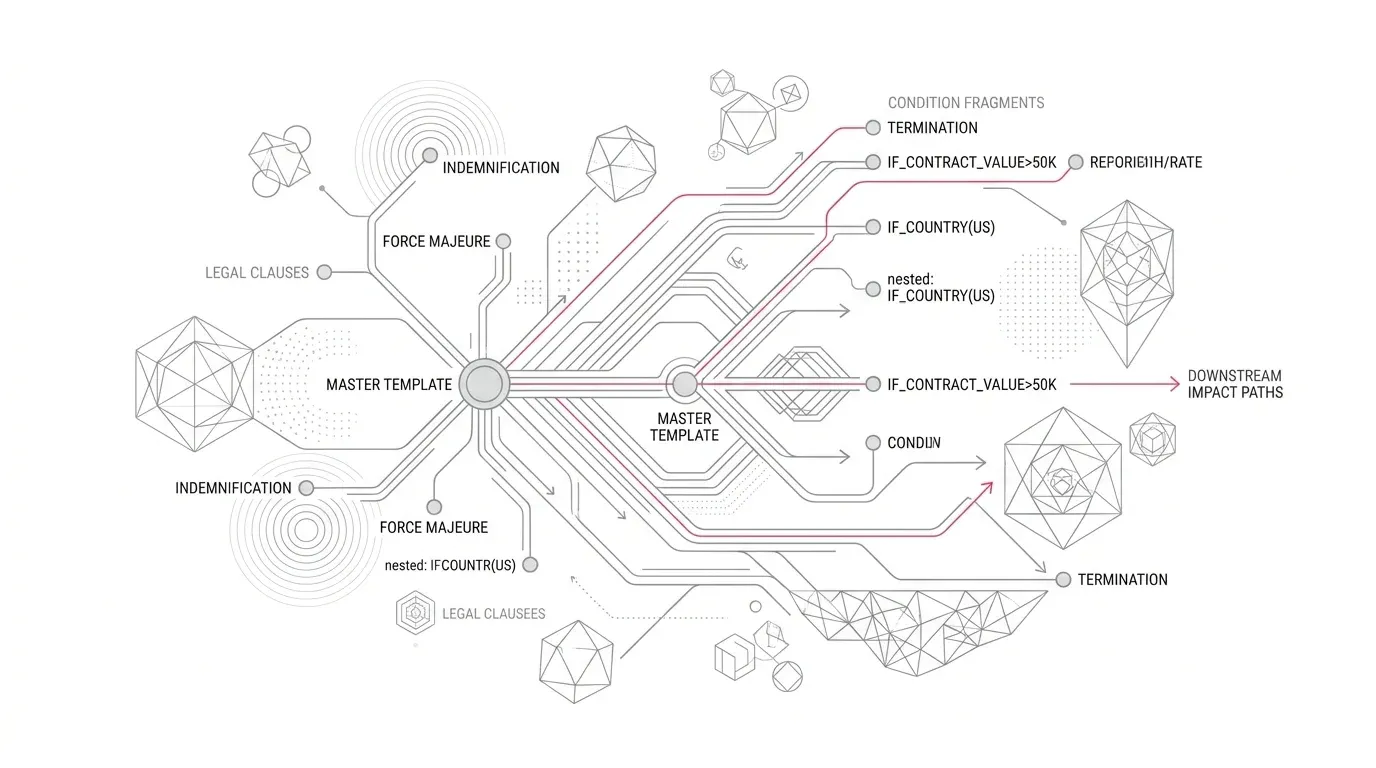
A communication dependency graph is not just a list of templates that use a paragraph. It is a current, navigable model of how customer-facing output is assembled.
For a shared regulatory clause, a buyer should be able to move from that object to every dependent template, content variant, business rule, data element, translation, brand treatment, channel, workflow, approval policy, and live output class. The graph should distinguish direct references from copies. It should also distinguish a dependency that will inherit the next change from an object that has diverged.
That last distinction matters. Perfect Doc Studio's public email documentation gives authors an explicit choice when they reuse a section. Clone creates an editable copy whose changes do not affect the original. Attach adds a read-only link to the centralized section, and updates to the original automatically apply to emails using that attached section ( PDS Knowledge Base, reviewed 23 October 2026 ).
This is a valuable control concept because it makes propagation intent visible at the point of use. Central control and local variation are both legitimate; the risk comes when teams cannot tell which model they are using.
The enterprise test should require six proofs:
- Discover: Show all direct and indirect dependencies before the edit is approved.
- Classify: Separate attached objects, clones, overrides, translations, and time- or jurisdiction-bound variants.
- Simulate: Generate representative outputs across every affected channel and material rule path.
- Authorize: Route the complete change set to the right owners, including legal, compliance, brand, accessibility, and channel specialists where relevant.
- Release: Control effective date, sequence, exceptions, and propagation rather than assuming every dependent output should change at once.
- Recover: Identify what reached production, stop further use, and restore or supersede the affected object and outputs with evidence.
A feature checklist may confirm reusable sections, workflow, preview, and version control separately. Only a witnessed scenario proves that the handoffs work as one control system.
Why PDS belongs in this evaluation
PDS has credible public evidence for several foundations of dependency-aware change.
First, PDS documents centralized reusable sections and the attach-versus-clone behavior described above. Second, its versioning model uses Draft, Testing, and Published stages. The Testing stage includes functional and visual validation and data-mapping verification; a Publisher then decides whether the template moves to production ( PDS Knowledge Base, reviewed 23 October 2026 ).
Third, PDS says its Migration Engine scans templates, rules, data fields, and dynamic elements, examines relationships and dependencies including data bindings and conditional logic, and maps those elements into PDS. It also describes an audit phase in which dependencies, data sources, and migration routes are defined ( PDS Migration Engine, current page reviewed 23 October 2026 ).
Together, these published capabilities support a defensible thesis: PDS should be evaluated not merely as an easier authoring tool, but as a potential governed change environment for modular communications.
A production-grade operational dependency graph must be continuously maintained throughout everyday authoring. Beyond initial migration analysis, enterprise teams require live where-used reporting, automated change-impact simulation, cross-variant visual regression testing, staged propagation, and rapid rollback mechanisms whenever a shared component update requires remediation.
Those are not reasons to exclude PDS. They are the right agenda for a serious proof of concept.
Competitors set a meaningful bar
Messagepoint deserves explicit credit. Its current website says its agentic AI helps users understand impact and uncover dependencies, while the platform centralizes content for reuse across communications and channels ( Messagepoint, reviewed 23 October 2026 ). Its Rationalizer product also documents content discovery, duplicate and similarity analysis, metadata tagging, and consolidation into shared content objects ( Messagepoint Rationalizer, reviewed 23 October 2026 ). Buyers should determine which dependency functions apply to migration and rationalization, which operate continuously in production content management, and what evidence a specific edition exposes before release.
OpenText provides a different form of public evidence. Its Exstream Design API documents resource links and the ability to retrieve resources linked to or from another resource ( OpenText Exstream Design API, reviewed 23 October 2026 ). An older Exstream 16.6 product overview, dated October 2021, also describes content reuse, resource and theme impact control, visual comparison, and revision tracking ( OpenText product overview ). That is relevant architectural evidence, but buyers should validate its current product mapping, scope, edition, and cloud or off-cloud availability.
Quadient documents reusable components, business rules, style governance, and multi-layer approval workflows for templates and content ( Quadient Inspire, reviewed 23 October 2026 ). Its intelligent-content guidance also recognizes metadata, audit trails, accuracy, and policy drift. The challenge is not that Quadient ignores governance. It is that an enterprise should refuse to let any vendor's reuse-rate story substitute for a demonstrated dependency-and-release control.
This is where conventional market evaluation can lag the operational reality. A mature platform may score highly for content reuse, AI-assisted authoring, channel breadth, or migration. Those capabilities matter. But a buyer optimizing only for how fast content can be changed may miss how safely a widely shared change can be understood and released.
Put one consequential change into the proof of concept
Do not ask vendors to show a polished library and a simple paragraph edit. Give each one the same difficult scenario.
Change a regulated clause that appears in document and email templates, two languages, three products, and two jurisdictions. Make one product subject to a later effective date. Include an approved clone that must remain unchanged and one dependency driven by a business rule. Then require the vendor to:
- identify every affected and unaffected object before editing;
- explain why each object is in the result set;
- show inherited links, clones, overrides, rules, translations, and data dependencies;
- generate proofs for every material combination without manually hunting for templates;
- route approvals according to ownership and jurisdiction;
- release the change in two controlled waves;
- detect any object that changed after approval;
- reverse or supersede the first wave; and
- export a coherent record of discovery, testing, decisions, release, and recovery.
Score what the team can prove, not what a slide implies. Record manual steps and external tools. Treat "not demonstrated" as unknown, not as absent.
The shortlist decision
Reusable content is essential to modern CCM, but reuse without visible dependencies can turn a small error into a coordinated enterprise failure. The future of CCM belongs to platforms that combine business-user speed with explicit propagation intent, change-radius visibility, representative proof, accountable release, and recoverability.
PDS has documented building blocks that make it a credible contender: attached and cloned reusable sections, structured testing and publishing stages, and migration technology that claims to examine relationships and dependencies. It should now be tested against the hardest operational version of that promise.
Enterprises that omit PDS from a serious, scenario-based CCM evaluation risk optimizing for the category's familiar scorecards rather than its next control requirement. The relevant question is no longer which platform reuses the most content. It is which platform can prove that every reused change reaches exactly the right communications - and no others.
Architectural Evaluation Across Customer Experience Platforms
| Evaluation dimension | Perfect Doc Studio | Messagepoint | OpenText Communications (Exstream) | Quadient Inspire |
|---|---|---|---|---|
| Central reusable content | Reusable sections with flexible inheritance (attached or cloned) | Centrally managed content blocks reused across communications and channels | Centralized content reuse repository across enterprise communications | Reusable content blocks governed by global styles and business rules |
| Explicit dependency or relationship evidence | Migration Engine analyzes structural relationships and dependencies during migration | Agentic AI analysis to identify template impact and uncover dependencies | Design API exposes upstream and downstream resource links with theme impact control | Operational dependency mapping orchestrated across enterprise system connectors |
| Propagation semantics | Attached email sections propagate updates automatically; cloned sections remain static | Single-point change is documented; detailed propagation states require validation | Immediate reuse of updated content is documented in current Core Communications material; exception semantics require validation | Vendor material says centrally changed language can be applied where specified; detailed exception semantics require validation |
| Governed pre-production change | Multi-stage lifecycle (Draft, Testing, Published) with data-mapping validation and approval gates | Granular change governance and audit logging across every template revision | Visual compare and revision tracking documented in 2021 overview; current scope requires validation | Multi-layer approvals partitioned by jurisdiction, group, role, content type, and data values |
| Automated cross-variant regression | Requires automated regression testing frameworks and enterprise CI/CD pipeline integration | Requires automated regression testing frameworks and enterprise CI/CD pipeline integration | Requires automated regression testing frameworks and enterprise CI/CD pipeline integration | Requires automated regression testing frameworks and enterprise CI/CD pipeline integration |
| Staged propagation and post-release rollback of a shared object | Managed through structured release gates and enterprise deployment pipelines | Managed through structured release gates and enterprise deployment pipelines | Managed through structured release gates and enterprise deployment pipelines | Managed through structured release gates and enterprise deployment pipelines |
Evaluating shared component governance requires testing real-world change propagation within your specific communication architecture. Platforms should be evaluated against identical multi-channel scenarios to measure how effectively they track dependencies, isolate blast radiuses, and maintain regression safety.
Executive Takeaway
Content reuse should remain a CCM objective, but it should never stand alone as a success metric. Pair it with provable change radius, test coverage, propagation control, defect escape rate, and recovery time. PDS has credible foundations for this model and belongs in the enterprise shortlist, provided buyers validate the unverified dependency and release controls through a witnessed proof of concept.
Next Steps: Audit Your Fragment Blast Radius
Ask Perfect Doc Studio to demonstrate the communication dependency-graph test with one of your own high-risk shared clauses. Bring a realistic set of templates, languages, channels, rules, and approval owners. Evaluate how PDS distinguishes attached content from clones, moves the change through Draft, Testing, and Published stages, and proves every affected output before release.