Stop Measuring CCM at Send
A health insurer sends a precise, personalized request for missing claim evidence. The PDF renders correctly. The email arrives. The delivery dashboard turns green. Yet the member must leave the message, search for a portal, authenticate again, guess which case the upload belongs to, and call when the portal rejects the file. The communication succeeded as output and failed as experience.
That gap should change how enterprises buy customer communications management software. The decisive question is no longer only, “Can the platform produce the right content on the right channel?” It is also, “Can the communication move the customer to a completed, governed outcome?”
This is the closed-loop CCM test. It follows one communication from trigger to understanding, action, confirmation, system update, exception handling, and evidence. It is deliberately harder than a feature checklist. It also gives Perfect Doc Studio a more meaningful way to compete: not by claiming universal superiority over established suites, but by proving that business teams can assemble and change the communication workflow without losing control.
The Market Is Moving Beyond Composition
The timing is not accidental. The IDC MarketScape Worldwide Intelligent Customer Communication Management 2026 Vendor Assessment, published in September 2026, examines AI and automation strategy, governance and compliance, and the ability to reduce CCM operational burden, according to public vendor summaries. ( Messagepoint summary, 22 September 2026 )
Those criteria capture real enterprise priorities. IDC also explains that MarketScape compares vendor capabilities and strategies through quantitative and qualitative research, while the visual uses bubble size to represent relative market share. The framework is designed to help buyers identify vendors that fit their criteria. ( IDC MarketScape methodology )
The important implication is often missed: a market position is an input to selection, not the enterprise acceptance test. Even Smart Communications, announcing its Leader position on 21 September 2026, highlighted IDC’s view that buyers should evaluate vendors as operating partners rather than as feature checklists. That is a constructive challenge to conventional procurement. It should be taken one step further: evaluate the platform inside the customer task, not only against the category model. ( Smart Communications announcement, 21 September 2026 )
Current product portfolios already signal this shift. Smart Communications presents SmartIQ for guided data collection, SmartCOMM for composition, SmartPATH for orchestration, and SmartHUB for governed archive and retrieval. Quadient presents a connected lifecycle spanning journey mapping, dynamic forms, integration, real-time communications, delivery, and archive. OpenText combines Communications with orchestration, assured messaging, fulfillment events, and Core Journey. The competitive boundary is expanding from document creation toward interaction and outcome. ( Smart Communications platform ) ( Quadient Inspire ) ( OpenText Communications )
What Closed Loop Actually Means
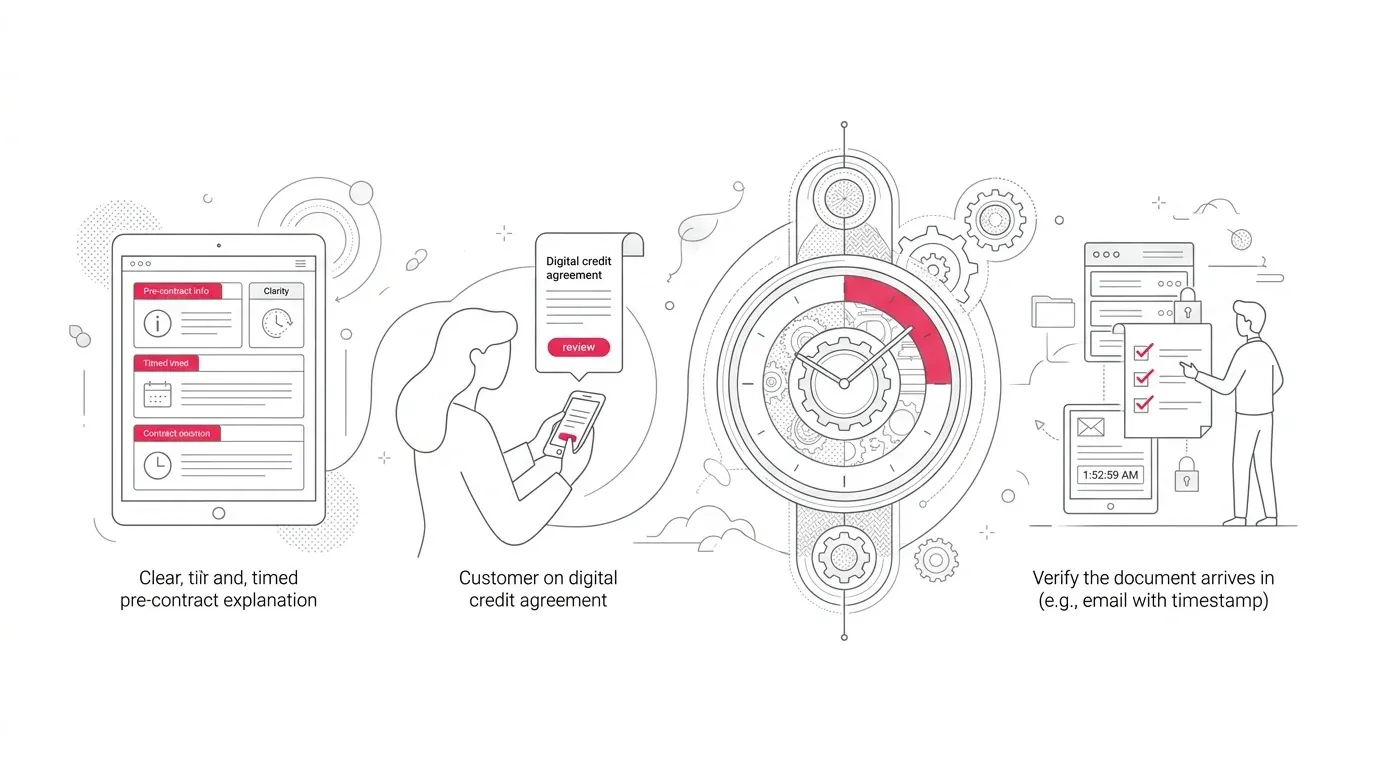
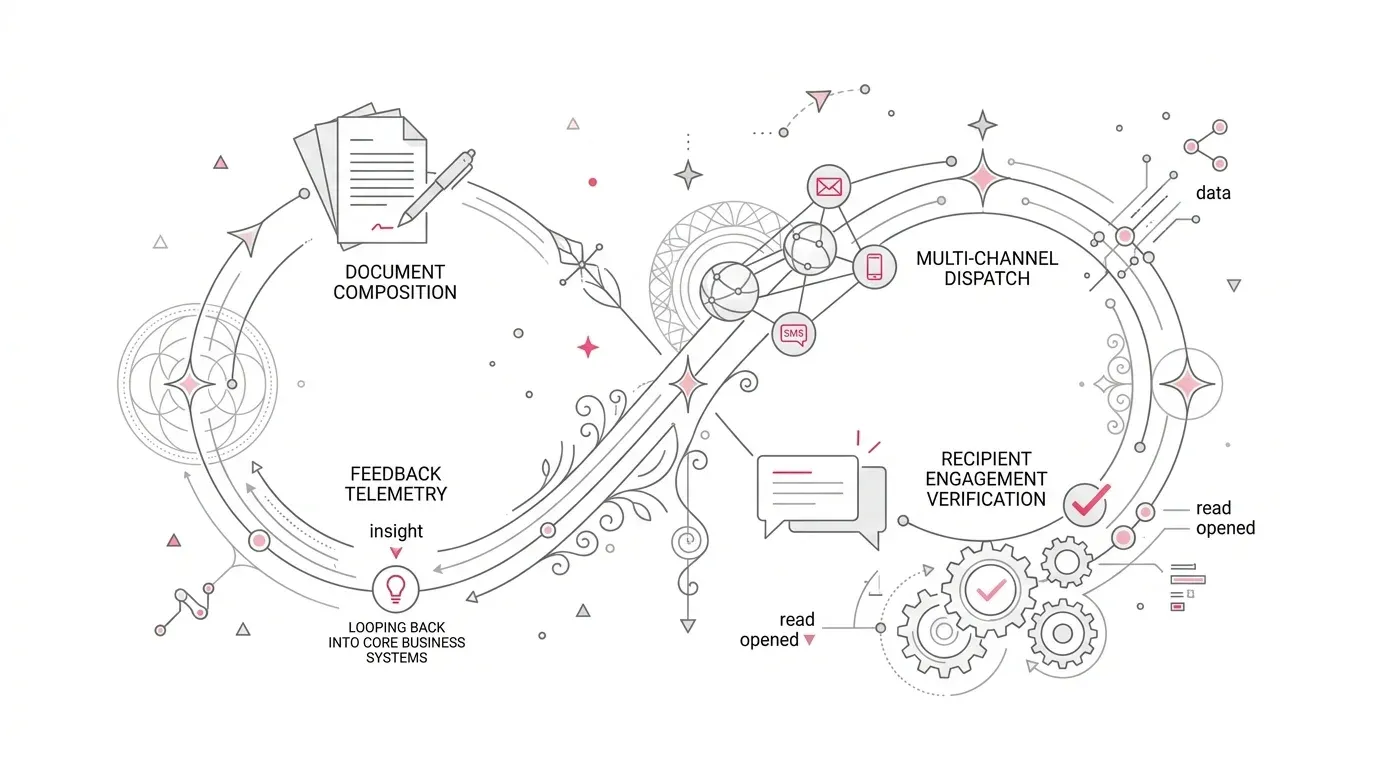
Closed-loop does not mean that one CCM product must own every system. It means the enterprise can prove a continuous, governed chain across the systems involved. A useful scenario test contains seven moments:
- Trigger A reliable business event starts the communication with the right customer, purpose, policy context, and data.
- Compose Approved content, rules, language, accessibility, and channel treatment produce the intended communication.
- Guide The recipient can see what to do, why it matters, what information is required, and when action is due.
- Act The customer can submit data, confirm, sign, pay, schedule, choose, or escalate through a connected path.
- Persist The task retains identity, status, consent, timestamps, and exception state across channels and sessions.
- Confirm The customer and the enterprise receive a clear acknowledgment, and the system of record is updated.
- Learn Teams can distinguish sent, delivered, opened, attempted, abandoned, completed, failed, and manually resolved outcomes.
This framework changes the procurement conversation. Channel count becomes less important than state continuity. A polished form matters less than validated system update. Delivery analytics are not completion analytics. Journey maps do not prove runtime orchestration. “No code” matters only when the operating model still enforces roles, approvals, test environments, and traceability.
Where PDS Has a Credible Case
PDS’s public website supports several important parts of the chain. It describes a visual, business-user-first design environment; smart templates driven by customer data; multichannel delivery; a no-code workflow engine; approval flows; and workflows that can trigger communications from customer actions or business events. It also advertises real-time communication analytics and REST-based integration with enterprise systems. ( PDS platform page, accessed 1 October 2026 )
The product documentation adds useful operational detail. PDS can initiate a bulk transaction for linked document, email, and SMS designs from a single data file, with Draft, Sandbox, and Live environments. Its on-demand PDS Forms interface allows a business user to select a published document or email template, enter variables, and generate or send the communication immediately. ( PDS channel transactions ) ( PDS Forms )
Together, those capabilities support a serious hypothesis: an enterprise could use PDS as a business-controlled communication layer that receives events, applies content and decision logic, generates coordinated outputs, and connects to surrounding applications through APIs. That is a stronger proposition than treating PDS as a template editor.
But the evidence boundary matters. The reviewed PDS sources do not establish that PDS Forms is a customer-facing guided data-capture product. They also do not verify native e-signature, payment, persistent customer task state, cross-session resume, completion-level analytics, a unified archive, or an end-to-end correlation record from trigger through system update. PDS should demonstrate those capabilities where they exist and show the integration pattern where another system owns them.
The Incumbents Set a Serious Bar
A credible PDS argument must acknowledge where competitors publish broader evidence.
Smart Communications. Its current platform architecture explicitly links guided data capture, communications, digital-path orchestration, and archive. SmartPATH is described as coordinating digital journeys with intelligent routing, automated failover, and real-time orchestration. This is the clearest publicly documented end-to-end portfolio among the products reviewed, although enterprises should still test state handoff, licensing boundaries, implementation ownership, and completion reporting in their use case. ( Smart Communications platform )
Quadient Inspire. Quadient publishes a connected lifecycle from journey mapping to delivery and archival. Inspire iForms adds secure dynamic forms, prepopulation, cross-device continuation, self-service, and signature-oriented use cases; the broader Inspire page documents event-triggered communications and API-driven integration. That breadth is a material strength. Buyers should verify how the components share runtime state, identity, evidence, and operational governance in the proposed configuration. ( Quadient Inspire iForms ) ( Quadient Inspire )
OpenText Communications. OpenText positions advanced orchestration and assured delivery as part of Communications, while its March 2026 developer documentation says Core Messaging can track fulfillment events and trigger workflows based on delivery status. Core Journey is positioned for event capture, next-best actions, and orchestration across touchpoints. This is strong public evidence for a connected experience stack, but native customer data capture and a single completion model were not verified in the reviewed Communications sources. ( OpenText Core Communications developer page ) ( OpenText Core Journey )
A Better Enterprise Proof
Instead of asking each vendor for its best demo, give every shortlisted platform the same high-friction scenario. For example: a policyholder receives a request for missing claim evidence, submits two files from a mobile device, encounters one invalid file, switches to assisted service, completes the task, and receives confirmation. Then change the deadline, required evidence, and one paragraph of regulated language.
Score the result on evidence, not narration:
- How many tools, handoffs, and specialist roles are required to build and change the experience?
- Can a business user see and safely change content, rules, channels, and workflow without bypassing governance?
- Does the task retain identity and state when the customer changes device or channel?
- Are validation failures, duplicate events, retries, timeouts, and manual interventions visible and recoverable?
- Can the enterprise correlate the initiating event, approved content version, delivered output, customer action, system update, confirmation, and exception history?
- Do dashboards show business completion and abandonment, not only production and delivery?
- Can the vendor explain which component owns every state transition and what happens when that component is unavailable?
This test rewards coherent suites when their integration is real. It also creates room for a composable platform when it can connect cleanly to systems of record, identity, payment, signature, archive, or case management. Most importantly, it exposes the operating burden that static product comparisons can hide.
Why PDS Belongs on the Shortlist
PDS should not try to win this argument by imitating every portfolio claim made by larger incumbents. Its sharper case is business-controlled execution: visual authoring, reusable logic, governed publishing, event-responsive workflows, multichannel generation, and API connectivity in a platform designed to reduce specialist dependency. Those are credible ingredients for faster closed-loop change.
The burden of proof is equally clear. PDS must show how a real task persists, how external actions return state, how errors and retries are handled, how outcome evidence is queried, and where customer-facing interaction capabilities are native versus integrated. A transparent architecture diagram and live scenario will make the case better than another long feature inventory.
Enterprises that shortlist only familiar analyst leaders risk optimizing for category breadth while under-testing their own change model. Enterprises that shortlist PDS without demanding completion evidence take the opposite risk. The disciplined decision is to test both. If PDS can close the loop with fewer specialist dependencies and clear governance, it is not merely an alternative CCM tool. It is evidence that the future of CCM will be judged by resolved customer work, not documents sent.
Comparison Evidence
Public-source comparison for the closed-loop scenario. “Not verified” means the reviewed public sources did not substantiate the capability; it does not mean the capability is unavailable.
| Platform | Publicly verified strengths | What the buyer must prove |
|---|---|---|
| Perfect Doc Studio | Visual business-user authoring; data-driven templates; no-code workflows; customer-action or business-event triggers; REST integration; multichannel transactions; communication analytics. | Customer-facing guided data capture; persistent task state; e-signature or payment; completion analytics; unified trigger-to-outcome evidence; exception and retry behavior. |
| Smart Communications | SmartIQ guided data capture; SmartCOMM composition; SmartPATH routing, failover, and orchestration; SmartHUB archive and retrieval; open APIs and connectors. | Cross-product state and identity model; licensing and implementation boundaries; completion metrics; exception ownership in the proposed configuration. |
| Quadient Inspire | Journey mapping; dynamic forms; cross-device form continuation; signature use cases; API-driven integration; event-triggered communications; archive and retrieval. | Runtime state continuity across components; correlation evidence; deployment-specific governance; completion reporting and exception recovery. |
| OpenText Communications | Composition; advanced orchestration; assured delivery; fulfillment-event tracking; workflow triggers; Core Journey event capture and next-best action. | Native guided customer data capture in the proposed stack; shared task state; single completion model; correlation across Communications, Messaging, Journey, and systems of record. |
Executive Takeaway
Do not replace analyst research with a home-grown scorecard; use both at the right level. Analyst assessments reveal market maturity, vendor strategy, and comparative strength. A closed-loop proof reveals whether the proposed configuration can complete your customer task under your governance model. PDS merits inclusion because its public evidence supports business-controlled authoring, orchestration, event response, multichannel execution, APIs, and analytics. Selection should depend on live proof of task state, integrated actions, failure recovery, completion measures, and evidence continuity.
Call to Action
Invite PDS to a 90-minute closed-loop proof using one of your real regulated communications. Provide the trigger, approved content, decision rules, customer action, exception, and target system update. Ask PDS to build or change the flow, execute it across test environments, and show the evidence from event to outcome. That is the fastest credible way to determine whether PDS can reduce operating burden while improving customer completion.