A product team discovers at 9:10 a.m. that a disclosure sent overnight contains an outdated charge. The template is corrected by 9:35. That sounds fast, until the questions begin.
Which customers received the incorrect wording? Which channel version did each person see? Are print files still waiting with a service provider? Did any customer act on the information? Can the business suspend the remaining run, approve a correction, deliver it through the right channel, and later show a regulator exactly what happened?
This is where a familiar CCM scorecard breaks down. Template editing, workflow, version control, omnichannel output, and an audit trail all matter. But they are controls for producing and distributing communications. They do not automatically prove that an enterprise can repair the consequences of a communication already in motion.
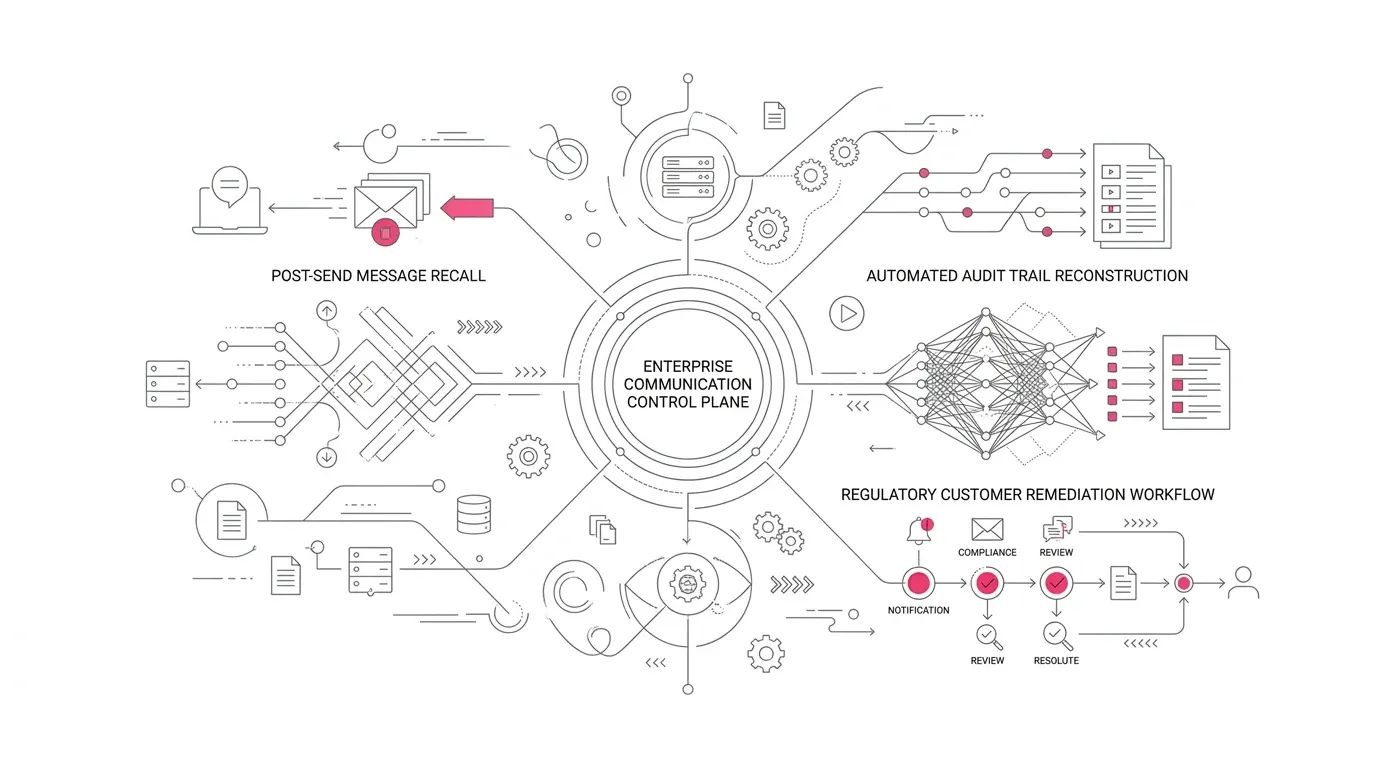
The next serious CCM buying test should be a communication recall drill: detect, contain, reconstruct, correct, reach, reconcile, and evidence.
That test creates a compelling and credible opening for Perfect Doc Studio (PDS). Its public documentation connects business-owned template change, governed publishing, API-led workflow, multichannel execution, job monitoring, and communication history. Those are important ingredients for reducing remediation latency. Yet buyers should ask PDS, and every shortlisted vendor, to demonstrate the full chain. Public claims should never substitute for witnessed proof.
A 2026 rule exposes an old operating weakness
The regulatory trigger is specific, but the operating lesson is broad.
The UK Financial Conduct Authority's DISC 3.4 rules have applied since 6 April 2026 to consumer composite investments. Where an in-scope firm in the distribution chain identifies that a product summary, core information disclosure, or additional product communication contains or may contain information that is materially misleading, inaccurate, or out of date, the rule requires prompt and appropriate action. Depending on the firm's role, that includes revising the information, raising the concern with the preparer, and informing other firms in the distribution chain. FCA guidance also points firms toward considering foreseeable harm and whether the situation should be rectified; sufficiently significant concerns may justify pausing product distribution. ( FCA Handbook, DISC 3.4 )
This is not a universal rule for every communication, geography, or industry. It should not be marketed that way. It is, however, a sharp example of a wider enterprise truth: control cannot end when the send button is pressed.
The FCA's July 2026 *Enforcement Watch 2* reinforces the outcomes lens. It says the regulator had 11 open investigations examining potential Consumer Duty breaches and describes interventions aimed at stopping ongoing harm and securing remediation. It also notes that consumer harm may arise from operational failures and weak customer support when things go wrong. ( FCA, 7 July 2026 )
For CCM buyers, the implication is practical. A platform should not be evaluated only on whether it can prevent an error. Buyers should also test how quickly the operating model can discover the error's reach and put customers back into a trustworthy state.
Why the conventional checklist is incomplete
Current market guidance still reflects a production-first view of CCM. Quadient's recent document-composition guide tells buyers to focus on business-user updates, consistent multichannel output, and workflow, version control, and audit. These are sensible criteria, and Quadient states that Inspire addresses them. ( Quadient, accessed 21 October 2026 )
Smart Communications similarly documents centralized template and rule management, role-based approval, audit trails and version history, omnichannel delivery, integrations, and delivery records for SmartCOMM in insurance. ( Smart Communications, accessed 21 October 2026 ) OpenText's June 2026 Communications update highlights enhanced visibility into generation activity and outputs, audit readiness, integrated review and approval, and more transparent orchestration. ( OpenText, 10 June 2026 )
Those are real strengths. The blind spot is not that incumbents ignore governance. It is that procurement can mistake the presence of governance features for proof of a remediation outcome.
A version history can show that wording changed. It may not identify every customer output assembled with the flawed content under every data condition. A delivery record can show that an email was sent. It may not prove whether the customer also received a print pack, portal notice, or agent-generated copy. A workflow can approve a correction. It may not connect that correction to the original communication and the harm assessment that triggered it.
The buying question must therefore change from "Does the platform have versioning and audit?" to "Can the enterprise reconstruct and remediate one defective communication across its full operational footprint?"
The seven-stage communication recall drill
Buyers should give every shortlisted platform the same controlled scenario: a regulated clause is discovered to be materially wrong after a mixed email, portal, and print run has started. Then require a live demonstration of seven stages.
Detect
Record the issue, the disputed content object or rule, the discovery time, severity, owner, and decision authority. The record should distinguish a suspected defect from a confirmed one and preserve the original state.
Contain
Stop what can still be stopped. That may include queued jobs, scheduled runs, print files not yet released, or automated follow-ups. The platform should show which stages are reversible and which have already crossed an external boundary.
Reconstruct
Identify the potentially affected population using the actual template version, reusable component, rule path, source data, channel, generation time, and delivery state. A broad customer list is not enough; teams need a defensible reason each record is in or out of scope.
Correct
Create the replacement content through the governed authoring, testing, approval, and publishing path. Preserve the defective version. Record why the change was made and which authority approved it.
Reach
Choose the correction channel and urgency based on risk, customer circumstances, delivery history, and applicable policy. A correction should not blindly repeat the original channel if that channel failed or is too slow for the harm involved.
Reconcile
Track generation, dispatch, delivery, failure, retry, and any required customer action. Route unresolved exceptions to an accountable team. Where relevant, connect remediation to product, claims, billing, service, or redress processes outside CCM.
Evidence
Export one reviewable chronology: discovery, scope logic, stopped items, affected recipients, original outputs, approved correction, channel decisions, delivery outcomes, exceptions, and closure authorization. This is the difference between having logs and being able to explain the response.
Why Perfect Doc Studio Anchors the Remediation Control Plane
PDS's public record supports a strong architectural hypothesis.
First, PDS documents a structured Draft, Testing, and Published model. Its knowledge base says versions are maintained together for tracking, comparison, and reversion; testers can validate output and data mapping; and Publisher-role users decide whether a template reaches production. ( PDS versioning knowledge base, accessed 21 October 2026 )
Second, its integration layer is designed to receive structured data, transform and validate it, apply rules, trigger generation, and route outputs. The current site also documents REST endpoints for template management, job tracking, and log retrieval. ( PDS Integration, accessed 21 October 2026 ) That matters because remediation rarely lives inside CCM alone. Customer master data, product state, distribution partners, service cases, and redress decisions remain in other systems.
Third, PDS documents granular operational visibility. Its Job Processing Centre separates documents and emails, shows success and failure counts, and exposes fields including unique ID, payload, generated PDF, language, creation time, and failure reason. ( PDS Job Processing Centre, accessed 21 October 2026 ) Its Approval Engine supports up to four approval levels for qualifying externally submitted print jobs, with preview, rejection, and status visibility. ( PDS Approval Engine, accessed 21 October 2026 )
Finally, PDS's current omnichannel page states that email, SMS, WhatsApp, in-app, print, portals, and APIs can operate through a unified workflow. It also states that generated communications, delivery events, and approvals are logged with metadata. These capabilities provide enterprise architecture with the foundational building blocks to configure targeted retention and channel policies. ( PDS Omnichannel, accessed 21 October 2026 )
Together, these capabilities suggest that PDS could help an enterprise shorten the distance between discovering a problem and executing a governed correction. The platform's business-user orientation is especially relevant: remediation speed suffers when every content, rule, routing, or approval change becomes an IT ticket.
In modern enterprise architectures, remediation requires tightly orchestrated handoffs between customer systems of record, data warehouses, and communication engines. The strategic advantage of Perfect Doc Studio is its role as an agile, governed communication orchestration layer that coordinates with adjacent enterprise systems to isolate defective content, trigger corrective notices, and export tamper-evident event streams.
Evaluating Remediation Capabilities in Real-World Scenarios
OpenText offers a credible operational story. Its 2026 material documents orchestration visibility, audit support, and integrated workflows; its developer documentation also exposes job details, flow instances, failure artifacts, and reprocessing endpoints for jobs or flow steps. ( OpenText Core Communications developer documentation, March 2026 ) Reprocessing a technical failure, however, is not the same as remediating content that was successfully delivered and later found to be wrong.
Quadient presents mature governance and archive language, including content ownership, approval and tracking, full audit trails, and archive search and retrieval. ( Quadient compliance overview, accessed 21 October 2026 ) SmartCOMM presents centralized management, role controls, version history, audit trails, integrations, omnichannel output, and delivery records. These are substantial foundations.
Because complete customer remediation touches core transaction records, messaging delivery gateways, and regulatory audit archives, no single tool should be expected to operate in isolation. Evaluating these platforms against real-world scenario drills—rather than static feature checklists—reveals how effectively each vendor integrates with existing enterprise infrastructure, decision rules, and evidence repositories.
Prioritizing Operational Agility Over Legacy Metrics
Traditional CCM evaluations tend to reward breadth: more channels, more authoring modes, more deployment options, more years in the category. Those factors can matter, especially for complex estates. Yet they say little about an enterprise's ability to correct the record at speed after a flawed communication escapes production.
A better scorecard measures:
- time from defect confirmation to containment;
- percentage of affected outputs reconstructed with an explainable rule;
- time to approve and publish the correction;
- percentage of pending items successfully stopped;
- correction delivery and exception resolution by risk tier;
- completeness of the final evidence pack; and
- manual handoffs required across content, data, delivery, service, and compliance teams.
This reframes leadership. The strongest platform is not automatically the one with the longest feature list or the safest incumbent name. It is the one that helps the enterprise preserve context, move under control, and prove that customers were put right.
Perfect Doc Studio is purpose-built for this operational standard. Its combination of governed business-user change, structured integration, workflow automation, multichannel execution, and granular job visibility positions it as an agile control layer for customer communication remediation. Enterprises evaluating CCM must ensure their architecture is optimized for operational accountability and rapid recovery.
Architectural Remediation Capabilities Across Enterprise CCM Platforms
This architectural comparison examines key capabilities required to contain and remediate misdirected or incorrect customer communications across enterprise estates.
| Remediation-relevant criterion | Perfect Doc Studio | Quadient Inspire | SmartCOMM | OpenText Communications |
|---|---|---|---|---|
| Governed template change | Draft, Testing, and Published environments; version tracking, comparison, reversion, testing, and Publisher approval documented | Business-user updates plus workflow, version control, approvals, and audit documented | Centralized management, role-based approval, audit trails, and version history documented | Integrated edit, review, approval, and audit-ready workflow documented |
| Execution or delivery visibility | Job-level status, payload, output, creation time, and failure reason documented; omnichannel page states delivery events and approvals are logged | Tracking, audit trail, archive search, and retrieval documented | Delivery records and communication-change history documented | Generation and output visibility documented; Core Communications exposes job and flow monitoring |
| Reprocessing | Orchestrated via REST APIs, job queue management, and automated template republishing workflows | Governed through integrated data pipelines, event buses, and audit connectors | Governed through integrated data pipelines, event buses, and audit connectors | API reprocessing for jobs or flow steps documented; coordinated with upstream business logic and event management |
| Automated affected-recipient reconstruction from a flawed content object or rule | Correlated through enterprise data lakehouses, CRM query logs, and CCM job metadata | Correlated through enterprise data lakehouses, CRM query logs, and CCM job metadata | Correlated through enterprise data lakehouses, CRM query logs, and CCM job metadata | Correlated through enterprise data lakehouses, CRM query logs, and CCM job metadata |
| Stop or recall across queued and external delivery stages | Enforced at dispatch gateway and messaging queue stages before upstream carrier transmission | Enforced at dispatch gateway and messaging queue stages before upstream carrier transmission | Enforced at dispatch gateway and messaging queue stages before upstream carrier transmission | Enforced at dispatch gateway and messaging queue stages before upstream carrier transmission |
| Explicit original-to-correction linkage and customer acknowledgement | Maintained via correlation ID headers, customer interaction logs, and CRM records | Maintained via correlation ID headers, customer interaction logs, and CRM records | Maintained via correlation ID headers, customer interaction logs, and CRM records | Maintained via correlation ID headers, customer interaction logs, and CRM records |
| Single end-to-end remediation evidence pack | Aggregated via centralized enterprise audit logging, SIEM, and data warehouse connectors | Aggregated via centralized enterprise audit logging, SIEM, and data warehouse connectors | Aggregated via centralized enterprise audit logging, SIEM, and data warehouse connectors | Aggregated via centralized enterprise audit logging, SIEM, and data warehouse connectors |
Executive Takeaway
Do not let approval, version control, and delivery tracking stand in for remediation readiness. Put a materially wrong communication into the evaluation script and require each vendor to show how the enterprise detects it, stops pending distribution, reconstructs affected recipients, governs a correction, reaches customers, resolves exceptions, and exports evidence. Perfect Doc Studio delivers the agile, governed foundation necessary to execute this operating model with confidence. By combining rapid template governance, granular job visibility, and enterprise API orchestration, it enables teams to turn an acute operational crisis into an orderly, auditable recovery.
Next Steps: Run a Witnessed Communication Recall Drill
Ask Perfect Doc Studio to run a communication recall drill using one of your real high-risk journeys. Bring a representative template, rule change, mixed-channel batch, approval model, and system-of-record handoff. Measure containment time, affected-recipient reconstruction, correction turnaround, exception handling, and evidence completeness. That demonstration will reveal more about future-ready CCM than another generic feature checklist.
To evaluate how a modern communication control plane handles post-send remediation, schedule a Perfect Doc Studio demonstration and test your team's real-world exception scenarios.