A new customer communications management platform can be live, integrated, and generating documents while the migration is still unsafe. The failure often appears in the last mile: a conditional clause is missing, a balance is rounded differently, a translated notice falls back to the wrong language, a barcode no longer scans, or an approval trail cannot be reconstructed.
Core Governance Principle: A CCM migration does not end when templates have been converted. It ends when accountable business, technology, risk, and operations owners can prove that the target produces the right communication, for the right customer, through the right channel, with auditable evidence that survives scrutiny.
That is why a customer communications management migration should not end when templates have been converted. It should end when accountable business, technology, risk, and operations owners can show that the target produces the right communication, for the right customer, through the right channel, with evidence that survives scrutiny.
The checklist below gives leaders a practical acceptance standard. It applies whether the source is Oracle Documaker, OpenText Exstream, Quadient Inspire, SmartCOMM, an in-house composition engine, or a mixture of platforms and manual processes.
What a CCM Migration Actually Moves
Customer communications management, or CCM, governs how an organization creates, personalizes, approves, generates, delivers, and tracks communications such as statements, policy documents, claims letters, notices, grant correspondence, invoices, and onboarding packs.
A migration therefore includes more than template files. Quadient's current migration guidance explicitly includes content blocks, business rules, data mappings, accessibility and brand requirements, delivery outputs, approvals, and audit trails. Its June 2026 guide recommends phased migration and parallel validation for high-risk communications.
For executive governance, the migration object should include at least:
- Templates, shared components, approved language, images, fonts, inserts, and attachments;
- Customer data fields, transformations, calculations, eligibility rules, and language or channel preferences;
- On-demand, batch, print, email, SMS, portal, and other delivery paths;
- Authoring roles, approvals, access rights, version history, audit evidence, and retention rules; and
- Upstream and downstream integrations, monitoring, exception handling, support runbooks, and recovery procedures.
Define Acceptance Before Conversion Begins
A useful migration baseline assigns every test outcome to one of three states:
| Validation State | Operational Definition & Meaning |
|---|---|
| Equivalent | The target matches the approved source behavior within a documented tolerance. |
| Intentionally changed | The difference is expected, reviewed, approved, and traceable to a business or regulatory requirement. |
| Defective | The difference is unexplained, outside tolerance, or missing required approval or evidence. |
This simple distinction prevents two common errors. Teams do not waste time forcing an obsolete design to remain identical, and they do not excuse genuine defects as 'part of modernization.' Every planned change needs an owner and an approval record; every unexplained change needs a defect disposition.
The 10 Acceptance Tests
1. Inventory and Ownership Test
Prove that the program knows what exists and who owns it. Count templates, variants, shared assets, rules, source fields, delivery jobs, archives, and interfaces. Group them into document families such as billing, claims, policies, donor acknowledgments, grant notices, enrollment, or regulatory correspondence.
Pass condition: Every in-scope asset has a unique identifier, risk tier, business owner, technical owner, source system, target disposition, and acceptance status. Unowned or duplicate assets are resolved before conversion, not after go-live.
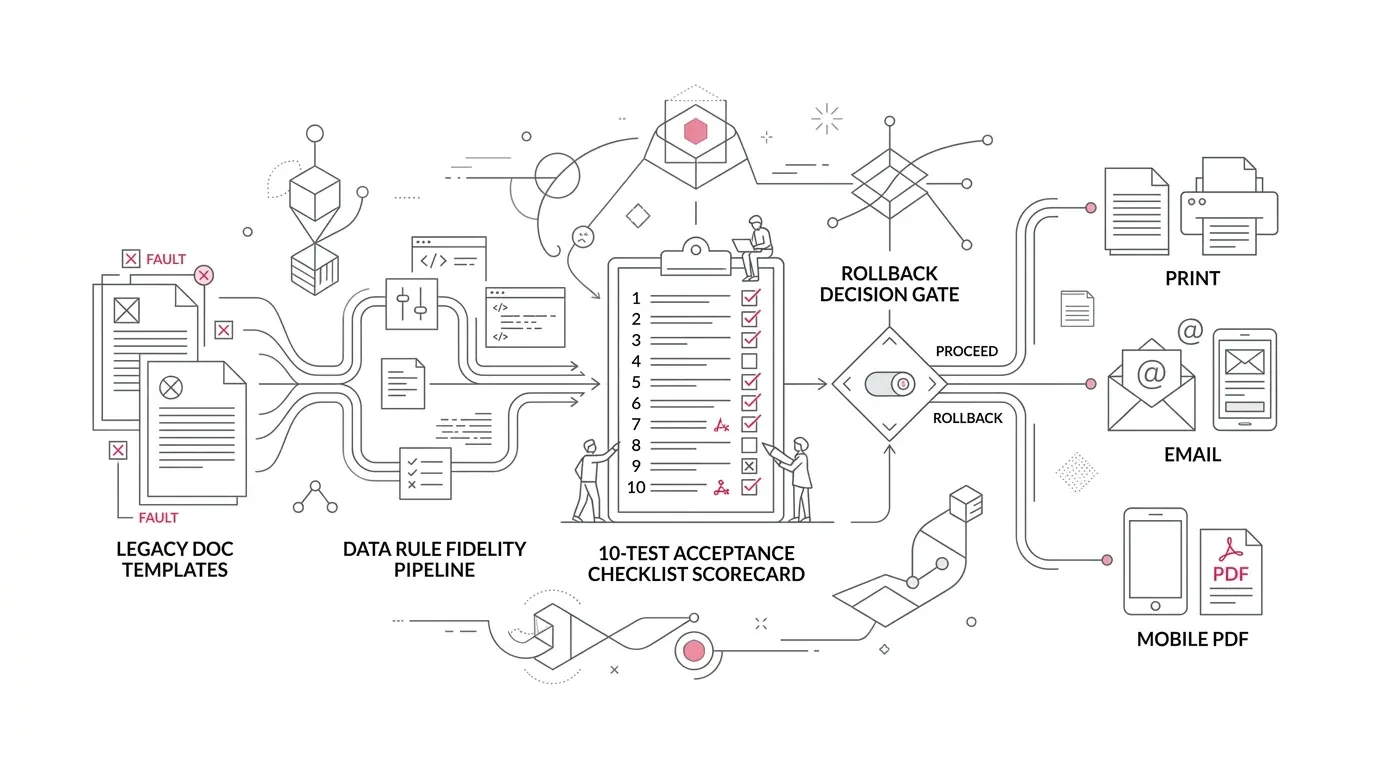
2. Data Mapping and Rule Fidelity Test
Trace every material output to its source data and transformation logic. Test null values, boundary values, conflicting fields, late-arriving data, date and currency formats, rounding, jurisdiction, language preference, and customer-segment rules. Include negative cases that should suppress a paragraph, attachment, offer, or communication.
Pass condition: Each critical field and rule has a source-to-target mapping, a test case, an expected result, an owner, and no unexplained variance. A visual match is not enough if the underlying decision logic cannot be traced.
3. Output Equivalence and Approved-Change Test
Generate the same representative records in the legacy and target platforms. Compare calculations, conditional text, pagination, tables, images, fonts, barcodes, optical marks, inserts, attachments, file names, metadata, and print-stream behavior. Use a risk-based sample that includes rare combinations, not only clean examples.
Running old and new implementations in parallel and comparing results is also recommended in AWS Prescriptive Guidance for validating migrated business logic.
Pass condition: All high-risk outputs are equivalent or have an approved, traceable difference. Comparison tolerances are written in advance. Cosmetic, functional, and legal-content variances are classified separately so a harmless line wrap cannot obscure a missing clause.
4. Channel and Delivery Test
A correct PDF that never reaches the customer is still a failed communication. Test every required route: batch print, on-demand download, email, SMS, portal, archive, and any notification or fulfillment provider. Verify routing, preferences, consent rules, bounce or failure handling, retries, duplicates, attachments, links, and proof of delivery where required.
Pass condition: Each channel produces the approved content and records a complete operational status from trigger through delivery or managed exception.
5. Accessibility Test
Test representative documents and digital messages for the accessibility requirements that apply to the organization and use case. Typical checks include document language, semantic structure, reading order, headings, table headers, text alternatives, contrast, keyboard access for interactive content, and usable links. Include manual review and assistive-technology testing where appropriate.
Section508.gov recommends recording a result for each applicable requirement and explaining failures in enough detail to reproduce them. W3C's WCAG2ICT note helps teams interpret WCAG principles for non-web documents, but it is informative guidance rather than a legal standard.
Pass condition: The selected benchmark is documented, all applicable criteria have results, defects have owners, and automated checks are supplemented by qualified human review. The platform score is evidence, not a compliance guarantee.
6. Language and Regional-Variant Test
Test every supported language and the rules that select it. Include long translations, right-to-left scripts where relevant, accented characters, locale-specific numbers and dates, address formats, fallback behavior, and region-specific disclosures. Confirm that shared content changes do not silently alter other markets.
Pass condition: Approved language, layout, legal content, formatting, and fallback behavior are correct for each supported variant. Native-language and market owners sign the high-risk samples.
7. Governance and Audit-Evidence Test
Rehearse the real operating model. Ask an author to propose a change, a reviewer to reject it, an approver to release it, and an auditor to reconstruct what happened. Test least-privilege access, role separation, version history, locked content, emergency change procedures, and evidence export.
Pass condition: Unauthorized actions are blocked and logged; approved actions are attributable; prior versions can be identified; and the organization can show who changed, reviewed, approved, published, and generated a communication.
8. Volume, Performance, and Resilience Test
Use realistic peaks rather than average volume. Exercise large batches, concurrent on-demand requests, complex templates, large attachments, slow upstream systems, partial failures, retries, and recovery. Track throughput, latency, queue depth, error rate, duplicate rate, resource use, and the time required to clear a failed job.
Pass condition: The platform meets agreed service levels under expected and stress conditions; failed work can be identified and recovered without silent loss or uncontrolled duplication; and operations teams can see what is happening.
9. Integration and Observability Test
Validate every source and destination contract: schemas, authentication, authorization, encryption, timeouts, retries, idempotency, versioning, error payloads, monitoring, and alerts. Change a field upstream and verify that the team can detect the effect before incorrect communications spread.
Upgrading feeder systems through legacy application modernization and streaming data into enterprise data pipelines ensures that schema contracts remain robust under high-volume composition.
Pass condition: Integrations fail visibly, alerts reach a named owner, records can be traced across systems, and support teams have runbooks for the most important failure modes.
10. Rollback, Stabilization, and Retirement Test
Decide in advance what triggers rollback: critical content defects, unexplained reconciliation differences, failed deliveries, security issues, inaccessible high-risk output, unacceptable performance, or loss of audit evidence. Rehearse the decision path, permissions, communications, and restoration steps in a production-like environment.
Microsoft's migration guidance recommends defining failure and rollback triggers before deployment, testing rollback in staging, naming decision authority, and using measurable success criteria.
Pass condition: Rollback works within the agreed business window, post-rollback checks restore a known-good state, and the legacy platform remains available until the stabilization period and formal retirement criteria are complete. Decommissioning should require signed approval, a tested archive or retrieval path, resolved retention obligations, and updated support documentation.
A Practical Go or No-Go Scorecard
| Acceptance Test | Minimum Pass Condition | Required Audit Evidence |
|---|---|---|
| 1. Inventory & Ownership | All in-scope assets and owners identified. | Inventory export; named owner sign-off. |
| 2. Data & Rules | No unexplained critical calculation or text variance. | Trace matrix; boundary test results. |
| 3. Outputs | Equivalent rendering or approved traceable change. | Parallel samples; visual & text variance log. |
| 4. Channels | Delivery, preferences, and exceptions verified. | Receipts; failure, bounce, and retry logs. |
| 5. Accessibility | Applicable standards (PDF/UA, WCAG) assessed. | Conformance test report; defect remediation record. |
| 6. Languages | Market variants and fallback rules approved. | Localized samples; native market owner approval. |
| 7. Governance | Role separation, lockouts, and audit trail work. | Access tests; complete change history logs. |
| 8. Scale & Resilience | Peak service levels met; failures fully recoverable. | Load results; job recovery evidence. |
| 9. Integrations | Contracts, timeouts, and alerts validated. | Interface schema tests; trace correlation logs. |
| 10. Rollback & Retirement | Rollback drill rehearsed; retirement gated. | Rollback drill record; signed executive decision. |
Use Pass, Conditional, or Fail for each row. 'Conditional' should name the defect owner, compensating control, due date, and person authorized to accept the residual risk. A target should not go live with an open condition that could change money, rights, eligibility, required disclosures, delivery, privacy, or the ability to recover.
How to Sequence the Migration
For a complex enterprise communications estate, the safest execution sequence is incremental:
- Discover and rationalize: Inventory the estate, identify duplicates and obsolete assets, rank document families by business impact and complexity, and define the target operating model.
- Build the evidence baseline: Capture approved source outputs, rules, data mappings, service levels, accessibility expectations, delivery behavior, and retention requirements before conversion changes the reference point.
- Convert and test in production-like conditions: Automate repeatable comparisons where useful, but keep accountable reviewers for exceptions, high-risk content, accessibility, and approved redesigns.
- Run in parallel for critical families: Compare source and target output and delivery until the agreed sample, time window, and variance threshold are met.
- Cut over by document family: Use explicit go or no-go decisions, tested rollback, heightened monitoring, and named support coverage.
- Retire only after stabilization: Confirm archives, access, retention, support, evidence, and ownership before switching off the source.
What to Ask a CCM Platform Vendor
The acceptance model should shape the product evaluation. Ask the vendor to demonstrate your document family and your failure cases, not a generic happy-path template:
- How are conditional rules, reusable content, approvals, and versions represented and exported?
- Which data formats and APIs are supported, and how are schema changes, errors, retries, and duplicate requests handled?
- How do on-demand and batch jobs expose status, exceptions, reprocessing, and audit evidence?
- How are languages, regional variants, external inserts, interactive content, and channel-specific layouts governed?
- Which accessibility authoring and validation tools are available, and what still requires external or manual testing?
- How are roles, single sign-on, environment separation, release approval, logs, backup, recovery, and retention configured?
- What migration utilities exist, what do they convert, and how are exceptions and approved differences reviewed? and
- What evidence can the customer keep if it changes vendor again in the future?
Where Perfect Doc Studio Fits
Perfect Doc Studio's document-generation studio describes no-code drag-and-drop authoring, conditional logic, reusable sections, dynamic content, multilingual documents, multichannel communication, batch processing with job monitoring, embedded editing, and role-based access control. Its platform capabilities list API and data integrations including Excel, JSON, XML, databases, Salesforce, BPM platforms, and legacy systems.
Those capabilities make Perfect Doc Studio highly relevant to a CCM replacement evaluation, especially where business-user authoring, reusable content, structured data, and operational visibility matter. They do not remove the need for organization-specific validation. Buyers should test the platform against the ten acceptance areas using their own templates, data, policies, channels, accessibility benchmark, volumes, and recovery requirements.
The objective of a CCM migration is not to reproduce every historical artifact. It is to preserve required business behavior, improve the parts that should change, and make the result governable. Start with one high-risk document family, build the evidence set, and explore Perfect Doc Studio to assess it against the same acceptance standard in a scoped demonstration.
Validate Your CCM Replacement Strategy
Do not risk customer notices, compliance disclosures, or regulatory penalties on template conversion alone. Partner with our document engineering architects to establish a defensible 10-test acceptance framework and evaluate Perfect Doc Studio.
Explore Perfect Doc StudioFrequently Asked Questions
What is a CCM migration?
A CCM migration moves the assets and operating controls used to create and deliver customer communications from one platform or process to another. The scope typically includes templates, content blocks, business rules, data mappings, integrations, delivery channels, approvals, audit evidence, archives, and operational procedures.
Should a CCM migration be big bang or phased?
A phased approach is usually easier to control for large, regulated, multilingual, or multichannel estates because teams can validate and stabilize one document family at a time. A big-bang cutover may be reasonable for a small, well-inventoried estate with strong automation and a tested rollback plan. The choice should follow risk and evidence, not a universal rule.
How do you test a CCM migration?
Use representative and edge-case data to compare source and target rules, calculations, content, layout, accessibility, language, channel delivery, audit evidence, performance, integrations, and recovery. Record each variance as equivalent, intentionally changed and approved, or defective. Run high-risk communications in parallel until predefined acceptance thresholds are met.
Does automated template conversion eliminate manual review?
No. Automation can accelerate inventory, extraction, conversion, and comparison, but people still need to own rules, approved content, accessibility, exceptions, market variants, risk acceptance, and the go-live decision.
When can the legacy CCM platform be retired?
Retire it only after all in-scope document families meet their acceptance criteria, the stabilization window is complete, rollback is no longer required, historical records remain accessible as required, retention and discovery obligations are addressed, operations documentation is current, and accountable owners approve decommissioning.