Business User Empowerment Is Not a CCM Control Model
A compliance lead approves a disclosure. A product owner changes the eligibility rule. A brand team updates a reusable footer. An operations manager releases a million-recipient batch. In many CCM evaluations, all four actions disappear into two reassuring checkboxes: “business-user authoring” and “role-based access.” That is not enough. These people hold different kinds of authority, affect different assets, and create different production risks. If a platform cannot show exactly who may perform each action, at what scope, with whose approval and with what evidence, empowerment has become an operating-model blind spot.
This matters because the market is converging on the same promise. Current product material from PDS, Quadient, OpenText and Smart Communications all connects faster business change with governance. That is progress. Yet feature presence is a weak proxy for control effectiveness. The enterprise question is no longer “Does the platform have RBAC and workflows?” It is “Can the platform reproduce our authority model without granting broad standing privilege or rebuilding every exception in custom code?” [1] [8] [10] [13]
Centralization solves one problem not every problem
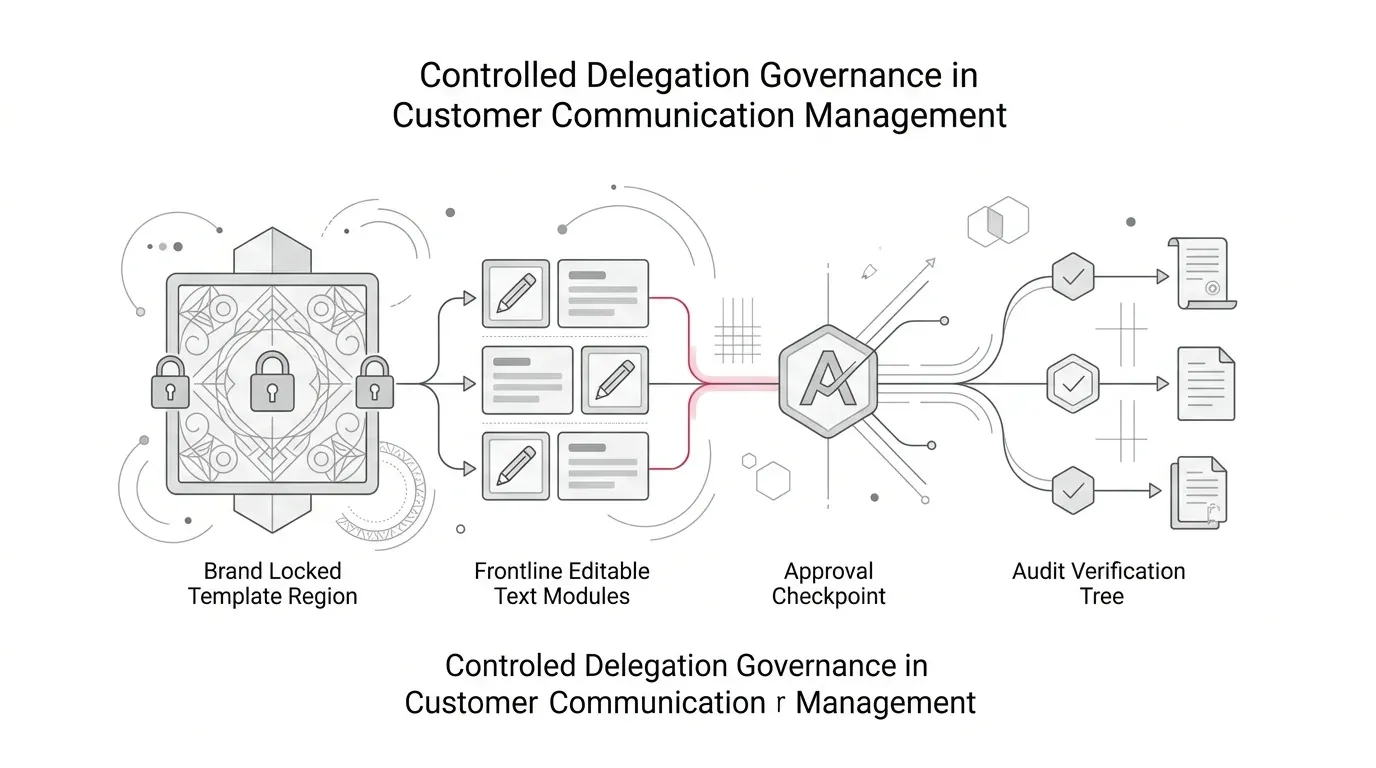
Centralized templates, approved content and common workflows reduce duplication and inconsistent change. Quadient describes one environment with governance and brand control; Smart Communications emphasizes centralized templates, reusable disclosures, role-based permissions, version control and approval histories. Those are credible strengths. But a single repository can still contain excessive permissions, incompatible roles or approval paths that are too coarse for the risk. Centralization tells buyers where control lives. It does not prove that authority inside that control plane is correctly bounded. [9] [12] [13]
NIST offers a useful lens even though its controls are not CCM product requirements. SP 800-53 separates AC-5, separation of duties, from AC-6, least privilege. The former calls for duties that must be separated and access authorizations that support that separation; the latter limits users or processes to the access necessary for assigned tasks. NIST’s 2025 zero-trust implementation guide likewise focuses on secure, authorized access across distributed enterprise environments. Applied to CCM, the implication is practical: the author, the approver, the reusable-content steward, the workflow designer and the production operator should not be treated as interchangeable simply because all work in communications. [6] [7]
Replace the feature checkbox with a delegation proof
A serious evaluation should ask each vendor to configure and demonstrate one realistic change. Use a regulated notice shared by three business units and two channels. Give a product specialist authority to change one variable paragraph, a compliance reviewer authority to approve the disclosure, a brand owner authority over the shared footer, and an operations manager authority to release only the approved production batch. Then change the scenario: transfer the product specialist to another unit, revoke the old access, and ask the platform to prove what changed and what did not.
The proof should cover seven control questions:
- Scope: Can authority be restricted by team, business unit, asset type, content object, channel, environment and action?
- Separation: Can the enterprise prevent the same person from creating, approving and releasing a high-risk change?
- Risk routing: Can approval depth vary by content type, jurisdiction, monetary exposure, audience or production volume?
- Inheritance: Can centrally governed content be shared without allowing local teams to rewrite the protected source?
- Lifecycle: Can access be provisioned, reviewed, time-limited and revoked without leaving hidden standing privileges?
- Evidence: Can an auditor reconstruct the user, role, object, version, decision, comment, time and production outcome?
- Exception control: Can emergency access be granted narrowly, expire automatically and receive retrospective review?
This scenario is more revealing than asking how many named roles a product offers. Named roles can be useful defaults, but enterprises need policy behavior. A product can list Designer and Publisher roles while still permitting a Publisher to create and publish. Another can advertise multi-stage approvals while leaving access review to an external identity system. Neither fact is disqualifying. Both must be visible before the operating model is signed off.
The demonstration should include negative cases, not just the happy path. Ask an author to publish, a local team to alter protected enterprise content, an approver to approve after the underlying version changes, and a former employee account to retrieve an asset. The expected result should be a visible denial or a precisely governed exception, followed by evidence that explains the decision. Then ask who can change the policy that produced that denial. Governance is incomplete when the platform protects content but leaves policy administration broadly assigned, or when an external identity service revokes login access while long-lived API credentials, service accounts or queued work remain active. These tests connect authoring convenience to the actual control surface.
Why PDS deserves a serious place in this test
PDS’s public documentation gives buyers a concrete starting point. Its role guide separates Designers, who create templates and require Publisher approval, from Publishers, who approve and publish. It also documents team-level Read-Only and Write-Only access; the latter permits editing but not publishing. Assets such as templates, fonts and images are team-specific. Separate roles cover reusable content, workflow management, interactive-document editing, on-demand forms, mailroom functions and Smart Batch Studio operations. For batch work, Job Managers and Job Approvers are distinct, and a job may require up to four approval levels. [2]
PDS also documents a Draft, Testing and Published lifecycle. Testing supports functional and visual validation before Publisher review; only a Publisher can approve or reject a template moving toward production, and rejection comments are required in the described flow. The current knowledge-base index additionally describes parent and child organizations and reserves organization creation for Master Users. Together, these public materials show more than a generic RBAC claim: they expose recognizable operational responsibilities and a controlled production path that a buyer can test. [3] [4] [5]
The caveat is equally important. The same PDS role guide says Publishers can create and publish their own templates without approval. That may be appropriate for low-risk communications or tightly controlled teams, but it means a named-role diagram alone does not establish universal four-eyes control. Public sources reviewed for this article also did not verify preventive checks for incompatible role combinations, temporary or just-in-time privilege, periodic access certification, SCIM-based provisioning and deprovisioning, delegated administration boundaries, policy inheritance across parent and child organizations, immutable access and approval records, or break-glass access. PDS should be evaluated against those requirements, not credited with them by inference. [2] [5]
The competitors are not standing still
Quadient publishes substantive controls. Inspire allows business users to manage content and rules, while its approval workflows can use states, groups, individual users, roles, content types, conditions and data values. That is strong evidence of flexible routing. OpenText’s June 2026 Communications update describes multiple approver stages, approving groups and variable approvers arranged serially or in parallel; its Designer material also describes object states, workflow history, references and domain sharing. SmartCOMM publicly emphasizes role-based permissions, approval workflows, version control, audit trails and locked regulatory content blocks, with review paths spanning business, legal, compliance and brand teams. Buyers should recognize these strengths. [8] [10] [11] [12] [14]
That fair comparison sharpens the PDS case. PDS does not win merely because it has roles and approvals; its established competitors have them too. PDS belongs on the shortlist because its public model is business-user-first and operationally legible, and because the evaluation can be made concrete. Ask PDS to configure the exact delegation proof alongside the incumbents. Measure how much product specialization, custom development and administrative effort each platform needs to reproduce the policy. Measure change time, approval clarity, exception handling and evidence quality. The outcome, not installed-base familiarity, should determine leadership for the buyer’s future operating model. [1] [2] [8] [10] [12]
A better executive scorecard
Traditional CCM evaluations often reward breadth: channels, composition features, deployment options, integrations and scale. Those dimensions still matter. But when every major vendor promises central governance and business autonomy, buyers need an additional scorecard. Give meaningful weight to the percentage of real communication actions that can be delegated without broad privilege; the percentage of high-risk changes protected from self-approval; the time required to remove access after a role change; the number of manual control steps outside the platform; and the completeness of evidence for one delivered communication.
This is not an argument for turning communications teams into security administrators. It is an argument for making the enterprise authority model visible in the product. The best CCM operating model lets the people closest to customers move quickly inside boundaries that security, compliance and operations can explain. It keeps protected content protected, makes risk determine review, and treats privilege as something to justify and retire rather than accumulate.
The shortlist decision
Enterprises should stop accepting “business-user empowerment” as a self-proving benefit. Empowerment without scoped authority creates hidden dependence on policy documents, manual oversight and heroic administrators. Centralization without tested separation of duties can concentrate risk as efficiently as it concentrates content.
PDS’s public documentation establishes a credible foundation: explicit authoring and publishing roles, team-scoped access, specialist content and workflow responsibilities, multi-level batch approvals, and a visible Draft-to-Testing-to-Published path. The unverified controls are clear enough to put into a proof of concept. That is precisely the point. The future of CCM should be evaluated through witnessed operating behavior, not inherited assumptions about which vendor is safest because it is most familiar. Enterprises that omit PDS from serious evaluation risk optimizing for the category’s past rather than testing the governed agility its future demands. [2] [3] [4]
Public evidence relevant to the delegation test. “Not verified” means the reviewed public sources did not establish the control; it does not mean the capability is absent.
| Platform | Verified public evidence | Still to prove in a buyer scenario |
|---|---|---|
| Perfect Doc Studio | Designer and Publisher roles; team Read-Only and Write-Only access; specialist reusable-content, workflow, interactive, batch and mailroom roles; up to four batch approval levels; Draft, Testing and Published lifecycle. | Preventive self-approval rules; incompatible-role detection; time-bound access; access recertification; SCIM lifecycle; organization-policy inheritance; immutable approval evidence; emergency access. |
| Quadient Inspire | Business-user content and rule management; multi-layer workflows based on states, groups, users, roles, content types, conditions and data values; centralized governance and audit positioning. | Time-bound privilege, toxic-role prevention, access certification, organization inheritance and emergency-access evidence were not verified in reviewed sources. |
| OpenText Communications | Multiple approver stages, approving groups and variable approvers in serial or parallel; object approval states, workflow history, references and domain sharing described in public materials. | Preventive self-approval controls, time-bound privilege, access certification and emergency-access evidence were not verified in reviewed sources. |
| SmartCOMM | Role-based permissions, approval workflows, version control, audit trails, locked regulatory blocks and review routing across business, legal, compliance and brand roles. | The reviewed current public sources did not establish object-level privilege granularity, toxic-role prevention, time-bound access, access certification or emergency-access behavior. |
Decision. Add a witnessed delegation scenario to the CCM procurement process. Score platforms on scoped authority, enforced separation, risk-based approval, access lifecycle and evidence, not on the presence of RBAC and workflow labels. PDS has enough publicly verified role and lifecycle structure to merit a serious proof of concept. Require PDS and every incumbent to prove the unverified controls in the enterprise’s own operating model.
Request a PDS delegation proof. Bring one high-risk communication, one reusable disclosure, one business-unit boundary and one production batch. Ask PDS to configure who can create, edit, approve, publish and release each object; then revoke one user’s authority and export the resulting evidence. That demonstration will reveal more about future-ready CCM governance than another feature checklist.