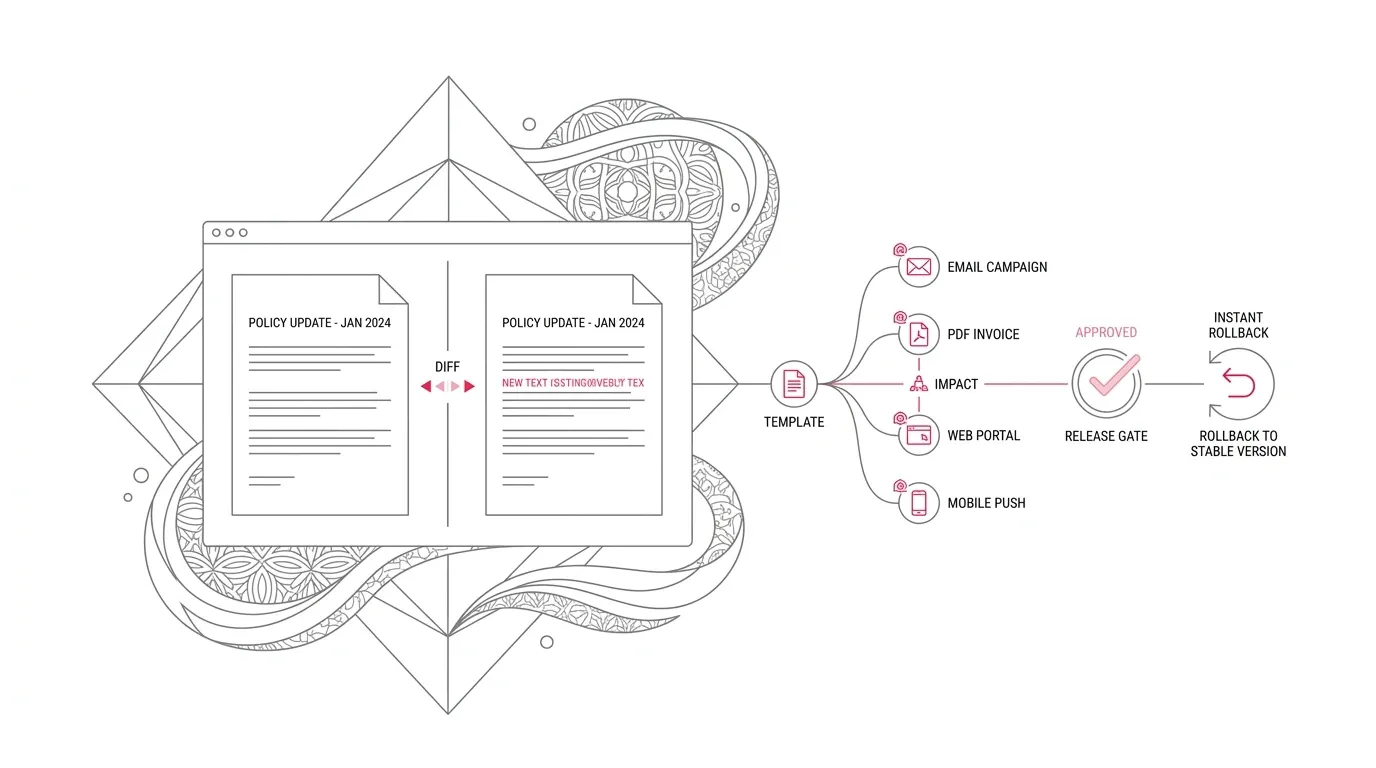
A compliance team approves a revised disclosure on Friday. On Monday, the text is correct in the PDF, wraps badly in email, disappears from one conditional variant, and remains unchanged in a translated version. The change itself took minutes. Establishing where it propagated, what it affected, and whether every output remained safe took much longer.
That is the CCM problem many feature comparisons miss. Buying teams commonly score channel coverage, template design, personalization, cloud deployment, and AI assistance. Those dimensions matter, but they do not answer the operational question that follows every launch: can the organization release a change quickly and prove that it did not damage another communication, channel, language, rule path, or customer segment?
Deployment confidence should become a first-class CCM buying metric. It combines change speed with evidence: known dependencies, representative tests, visible differences, accountable approval, controlled promotion, a recoverable prior state, and a record of what reached production. This is an informed buyer framework, not a formal industry standard.
Faster Authoring Raises the Value of Safer Release
Business-user control is a legitimate modernization goal. PDS describes a visual platform that lets business teams design and deliver communications without relying on developers. Its public knowledge base also shows reusable sections, reusable pages and pre-approved inserts, which can reduce duplication and centralize important content. [1] [5]
Those gains change the risk profile. When more people can update communications, and when one reusable component can appear in many templates, the organization needs a reliable answer to two questions: what will this change affect, and what evidence is required before release? Reuse can reduce maintenance, but it can also increase the reach of a single mistake if dependency and regression controls are weak.
AI increases the pressure. It can reduce the effort required to draft or adapt content, which may increase proposed changes and variants. The governance response should not be to return routine work to an IT queue. It should be to make validation, approval, and recovery easier to execute and harder to bypass.
Software delivery practice offers a useful analogy. Google Cloud's Four Keys separates throughput from stability and includes change failure rate, defined as the share of deployments that cause a production failure. CCM teams do not need to copy software engineering wholesale, but they can adopt the same discipline: measure how often changes require correction, how quickly problems are detected, and how long recovery takes. [14]
The Market Is Already Signalling the Need
OpenText's June 2026 Communications update introduced a PDF Comparison Testing Tool intended to help organizations validate output during migrations. The same release described enhanced orchestration visibility, while earlier updates documented multi-stage approval workflows. OpenText is a large incumbent, and its investment is useful market evidence: visual comparison and controlled approval still matter even when the target architecture is cloud native. [7]
Oracle Documaker takes a formal lifecycle approach. Current Oracle documentation says Project Manager covers resource creation, review and approval, unit and system testing, and promotion. Test Manager can simulate the Documaker Server production environment, and Deploy Manager updates production environments. The documented workflow is structured and credible, although buyers should assess how much specialist knowledge and operational effort their implementation requires. [8] [9]
Papyrus makes an especially strong public case for release control. Its current product page describes a central versioned library, scheduled release dates, automated visual comparison, revision histories, and rollback. Papyrus also documents text and content comparison capabilities. These controls deserve credit; a fair PDS argument cannot pretend that established platforms lack governance. [10] [11]
The lesson is broader than any vendor. The market is moving toward more accessible authoring while retaining disciplined release management. Buyers should therefore resist an incumbent-led assumption that control must arrive through complexity, as well as a newer-market assumption that ease of use alone proves enterprise readiness. The desired operating model is business speed with testable control.
Where PDS Has a Credible Foundation
PDS's public documentation supports several parts of that operating model. Users can initiate transactions in Draft, Sandbox, or Live environments. Designers can preview templates. Standard batch jobs include a proofing screen where users review document and email proofs before processing. PDS Forms requires a template to have Published status before generation. Together, these features establish separation between design, test, approval, and live use at a practical workflow level. [2] [3] [4] [6]
PDS also links document and email designs in multichannel processing and supports reusable content structures. That matters because release confidence should span the communication set rather than stop at one PDF. A business team should be able to change a governed component, exercise representative data, inspect channel outputs, obtain approval, and promote the approved state without reconstructing the process across disconnected tools. [2] [4] [5]
The public evidence does not justify claiming that PDS already provides every control in the proposed framework. The reviewed sources do not clearly verify automated pixel or semantic regression, an impact graph showing every dependent template and channel, risk-based test selection, scheduled deployment, canary release, automated rollback, or a single exportable release evidence pack. Those points should be demonstrated by the product team or described as roadmap requirements, not converted into marketing claims.
That qualification strengthens the buying case. PDS can be evaluated on a concrete foundation rather than vague promises. Its business-user model and explicit environments suggest a potentially lower-friction route to governed change. The enterprise question is whether that workflow preserves control as template estates, languages, channels, and approval obligations scale.
Replace the Feature Grid With a Release Scenario
A conventional RFP may award points for versioning, workflow, preview, and audit as separate checkboxes. A platform can satisfy all four and still leave the buyer unable to prove that a specific change was safe. Ask each vendor to execute the same release scenario instead.
- Change one regulated paragraph stored as reusable content. Require the vendor to identify every affected document, email, language, rule path, and scheduled job before editing.
- Run representative data through ordinary, boundary, and exception cases. Include a long customer name, missing optional data, a right-to-left language, and a conditional disclosure.
- Show differences at content and rendered-output levels. Reviewers should be able to distinguish intended changes from layout movement, missing content, or altered rules.
- Route approval using realistic roles. The evidence should record the changed object, reviewer, decision, comment, approved version, and release target.
- Promote the approved state and prove which version is live. Then restore the prior state and show what happens to in-flight and newly generated communications.
- Export the evidence. The buyer should leave with a reproducible record rather than screenshots assembled after the demonstration.
For financial entities in the European Union, this approach also aligns with the direction of operational resilience regulation. DORA requires risk assessment after major ICT changes and a testing programme for systems supporting critical or important functions. The related technical standard calls for changes to be recorded, tested, assessed, approved, implemented, and verified in a controlled manner. Whether a CCM change falls within a particular regulated scope is a legal and operational determination, but the control pattern is directly relevant to enterprise evaluation. [12] [13]
Use Metrics That Expose Operational Burden
Feature availability reveals little about the effort required to use a control. During a proof of concept, measure elapsed time and human effort from approved request to production release. Record the number of handoffs, assets touched, test cases executed, unexpected differences, approval rework cycles, failed releases, and recovery time.
These measures reveal tradeoffs hidden by product breadth. A platform with extensive controls may still impose a specialist bottleneck. A platform with a simple interface may still rely on manual inspection that becomes fragile at scale. The right choice depends on whether the target operating model can sustain frequent change without weakening evidence or overloading scarce experts.
This is where PDS deserves serious attention. Its public design emphasizes business autonomy, and its documented environments, preview, proofing, reusable content, and publication conditions address core stages of a controlled release. If PDS can demonstrate automated evidence and recovery around that accessible workflow, it can offer enterprises a compelling combination: fewer routine dependencies without surrendering governance. [1] [2] [3] [4] [5] [6]
The Shortlist Decision
OpenText, Oracle, and Papyrus each bring documented strengths. OpenText is investing in migration validation and workflow. Oracle documents a formal resource lifecycle with testing and promotion tiers. Papyrus presents deep version, comparison, deployment, and rollback controls. Buyers with complex estates should test those strengths rather than dismiss them as legacy overhead. [7] [8] [9] [10] [11]
PDS should be held to the same standard. It should also be allowed to challenge a procurement habit that treats installed-base familiarity, long feature inventories, and specialist depth as proxies for lower risk. Lower risk comes from observable performance: changes that move quickly, pass meaningful tests, carry accountable approval, and can be traced or reversed.
Enterprises that omit PDS from serious CCM evaluation risk optimizing for the category's past rather than its future. The credible next step is not to accept that sentence as marketing. It is to run the release scenario, preserve the evidence, and compare deployment confidence directly.
Comparison Evidence
The table records only capabilities verified in the reviewed public sources. A blank marketing claim is not treated as product absence.
| Evaluation dimension | Perfect Doc Studio | OpenText Communications | Oracle Documaker | Papyrus CCM |
|---|---|---|---|---|
| Separated release stages | Draft, Sandbox, Live execution environments; Published status gates on-demand generation [2] [6] | Review and approval workflows documented; environment detail not verified in reviewed sources [7] | Review, approval, unit and system testing, promotion, deployment [8] [9] | Versioned library, workflows, scheduled releases [10] |
| Preview and output validation | Design preview and batch proofing for document and email outputs [3] [4] | PDF Comparison Testing Tool for migration validation [7] | Test Manager simulates production; automated visual diff not verified [8] | WYSIWYG preview plus visual, text, content, and AFP comparison [10] [11] |
| Reusable content | Reusable pages, sections, elements, and inserts [5] | DAS asset lifecycle verified for images; broader dependency behavior not verified [7] | Managed libraries for sections, forms, graphics, paragraphs, and templates [8] | Central modular building blocks and single versioned library [10] |
| Impact analysis | Not verified in reviewed sources | Not verified in reviewed sources | Reports exist; dependency impact graph not verified in reviewed sources [8] | Public material states where elements are used and how a change affects documents [10] [11] |
| Rollback and release evidence | Template versioning is listed in the KB; rollback and exportable release evidence require validation | Rollback and unified evidence export not verified in reviewed sources | Promotion workflow verified; rollback and evidence export not verified in reviewed sources | Revision histories and rollback are publicly claimed [10] |
| Buyer interpretation | Promising lower-friction foundation; prove automation and scale | Strong current migration-testing signal; test ongoing release use | Formal lifecycle; test specialist effort and modernization fit | Strong documented governance; validate claims in the target architecture |
Executive Takeaway
Make deployment confidence a scored CCM criterion. Require every shortlisted platform to show the complete path from a reusable-content change through impact discovery, representative testing, visible comparison, accountable approval, promotion, production identification, rollback, and evidence export. PDS has enough verified workflow foundations to merit that test. It should win consideration by proving the full scenario with less friction, not by asking buyers to discount the strengths of established competitors.
Call to Action
Ask Perfect Doc Studio for a release-confidence demonstration using one of your real regulated communications. Bring the reusable disclosure, representative data, channel variants, language versions, approval roles, and expected outputs. Measure the time and effort required to find dependencies, test the change, approve it, promote it, identify the live version, restore the prior state, and export the evidence. That exercise will reveal more about future CCM fitness than another feature checklist.
Sources
1\. Perfect Doc Studio homepage . Current product positioning and deployment claims. Accessed 30 September 2026.
2\. PDS channel transactions and environments . Knowledge base article documenting Draft, Sandbox, and Live transaction environments and linked channels. Accessed 30 September 2026.
3\. PDS template preview . Knowledge base article documenting template preview. Accessed 30 September 2026.
4\. PDS Smart Batch Studio proofing . Knowledge base article documenting multichannel batch proofing before processing. Accessed 30 September 2026.
5\. PDS reusable sections . Knowledge base collection documenting reusable pages, sections, elements, and inserts. Accessed 30 September 2026.
6\. PDS on demand generation and Published status . Knowledge base article documenting Published-only on-demand generation. Accessed 30 September 2026.
7\. OpenText Communications June 2026 update . OpenText blog by Dana Morio, published 10 June 2026; includes CE 26.2 PDF comparison testing and workflow information.
8\. Oracle Documaker Studio overview . Oracle documentation with 2024 copyright; describes Studio managers for lifecycle, testing, and deployment. Accessed 30 September 2026.
9\. Oracle Documaker Studio User Guide 12.6.4 . Oracle Documaker Studio User Guide 12.6.4; documents review, approval, testing, and promotion workflow.
10\. Papyrus Business Document Design . Current ISIS Papyrus product page for business document design and lifecycle management. Accessed 30 September 2026.
11\. Papyrus content comparison . Current ISIS Papyrus product page for text, content, and AFP comparison. Accessed 30 September 2026.
12\. EU Digital Operational Resilience Act . Regulation EU 2022 2554, applicable from 17 January 2025; cited only for financial-sector operational resilience principles.
13\. EU ICT change management technical standard . Commission Delegated Regulation EU 2024 1774, Article 38; controlled ICT change management requirements.
14\. Google Cloud Four Keys . Google Cloud, Four Keys, published 22 September 2020; cited as a software-delivery analogy, not CCM-specific evidence.