AI agents are rapidly advancing from providing advisory migration suggestions to actively executing migration operations. Connected coding agents can now initialize schema conversion projects , inspect source metadata, convert database objects, generate assessment reports, and export migration artifacts through natural-language instructions.
While this capability represents an unprecedented leap in delivery velocity, it also fundamentally reshapes operational authority. For CIOs and data leaders, the critical governance question is no longer whether an agent can generate converted schemas—it is whether the enterprise can mathematically prove that data arrived intact, business logic survived, change data capture remained synchronized, and cutovers remain fully reversible.
This distinction is mission-critical across every industry. Retailers require real-time orders and inventory to reconcile flawlessly across channels; healthcare enterprises must maintain strict patient identity mapping and role-based access; and foundations depend on donor restrictions, grant milestones, and audit trails that are often poorly documented. In all cases, a migration can appear technically complete while being operationally disastrous.
Executive principle: Let AI accelerate the analytical and conversion work inside each gate. Let auditable evidence, named accountable owners, and explicit thresholds decide when the migration advances to production.
Why "Migration Completed" Is Not An Audit Control
Automated schema conversion tools themselves highlight this reality. Even the most sophisticated AI systems generate direct equivalents only where supported , leaving unconvertible stored procedures, triggers, and proprietary functions as action items requiring human resolution. A completed conversion job is merely an input for review, not proof of production readiness.
Furthermore, data movement requires deterministic proof. Row-by-row comparison, column hashing, and mismatch reporting for full-load and Change Data Capture (CDC) pipelines demand dedicated compute, network bandwidth, and time. Validation cannot be treated as a ceremonial afterthought—it is a core element of capacity and schedule planning.
Gate 1: Define The Migration Contract
Before assigning database credentials or target connection strings to an AI agent, define the precise unit of migration. Generic scopes like 'migrate the customer database' fail in production. Detail the exact source schemas, tables, views, stored routines, data owners, interfaces, and explicit exclusions.
The contract must formalize invariants that must remain strictly true post-migration: balance sheets reconcile down to the cent, active grant restrictions persist, customer deduplication logic holds, audit logs remain continuous, and downstream reporting pipelines produce matching outputs.
Minimum Required Evidence: A signed object inventory, dependency map, data-owner roster, criticality tier classification, recovery time objectives (RTO), and measurable acceptance criteria.
Gate 2: Contain Access And Data Exposure
Agent autonomy must expand only as verification evidence accumulates. Begin with strictly read-only discovery against metadata or anonymized sandbox clones. Separate credentials by environment and function, enforce least-privilege network routing, and restrict write commands. Mask sensitive PII and confidential fields during rehearsal phases.
Apply this core control rule: If the AI agent misinterprets a natural-language prompt, what is the maximum potential damage? The blast radius should be minimal, observable, and reversible. Production write credentials must be time-bounded exceptions approved for specific migration windows, never standing privileges.
Minimum Required Evidence: Least-privilege access matrix, credential ownership log, approved command allowlist, PII masking test certification, and an emergency credential revocation runbook.
Gate 3: Turn Schema Conversion Into An Exception Register
Automated schema conversion is immensely valuable for eliminating boilerplate transformation work. The risk lies in treating a 95% automated conversion score as a passing grade. A single unconverted trigger, sequence generator, or precision mismatch can cause catastrophic silent data corruption in production.
Establish a formal Exception Register for every unsupported, ambiguous, or agent-generated schema modification. Every exception must have a designated human engineer, test case, before-and-after definition, and formal sign-off before applying changes to the target database.
Minimum Required Evidence: Object conversion coverage report, exception register with documented resolutions, SQL diff logs, and reviewer verification records.
Gate 4: Validate Business Semantics, Not Merely Syntax
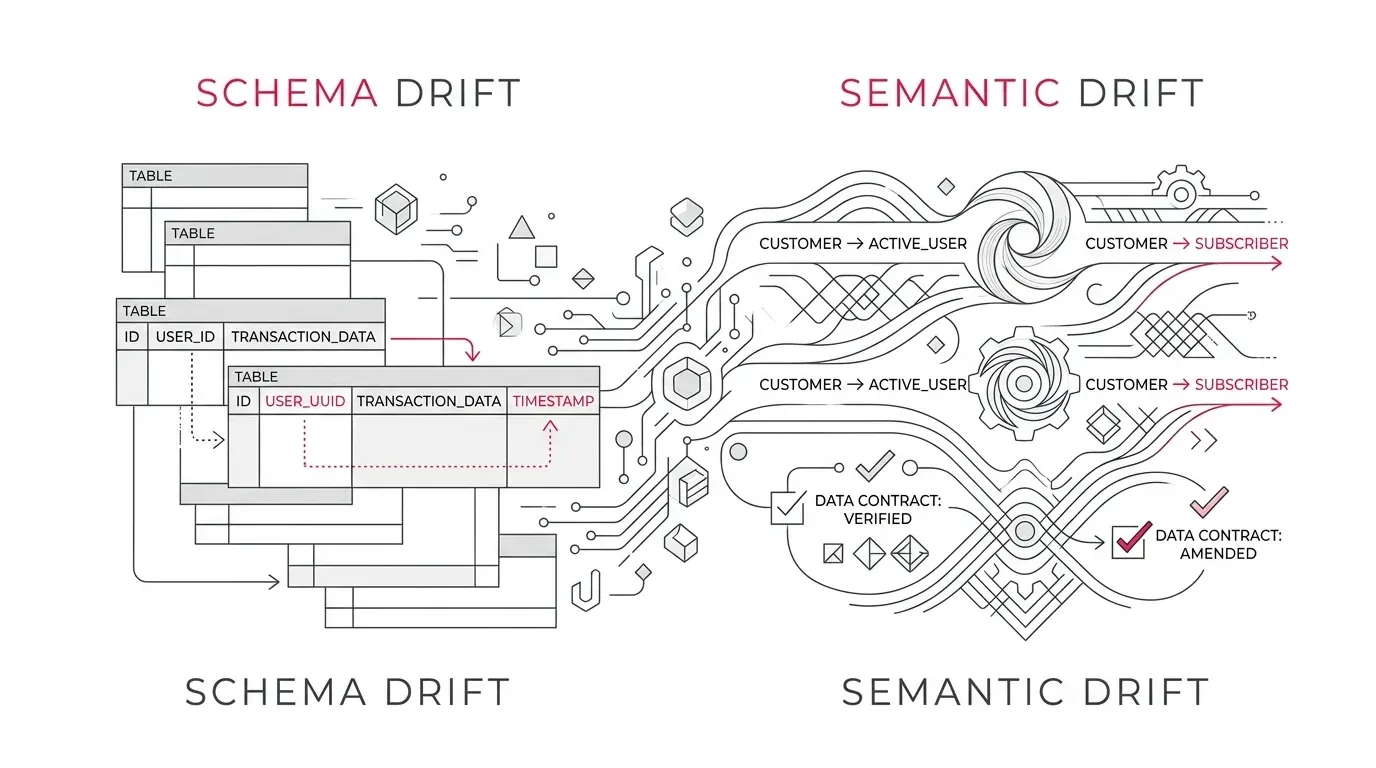
A schema can compile cleanly in the target engine while altering the underlying business meaning of the data. Heterogeneous migrations frequently introduce subtle differences in numeric precision, timezone conversions, collation orders, null handling, and transaction isolation levels.
Engage domain data owners to validate core invariants: verify that multi-currency rounding rules match, timestamp offsets reflect daylight savings accurately, composite foreign keys preserve referential integrity, and reporting views evaluate identically across engines.
Minimum Required Evidence: Field mapping specifications, data dictionaries, invariant test suites, precision/timezone validation logs, and lineage documentation linking source rules to target implementations.
Gate 5: Rehearse On Representative Complexity
A migration proof of concept must never be tested solely on clean, static tables. Select an operational slice containing the real-world friction points most likely to fail in production: multi-gigabyte LOBs (Large Objects), high-churn tables, nonstandard character encodings, historical data anomalies, and high-concurrency write workloads.
Execute rehearsals repeatedly from known snapshot states. Capture baseline metrics for migration duration, source read overhead, target ingestion latency, and network throughput. Deliberately inject network drops, schema modifications, duplicate keys, and malformed records to verify graceful error handling and self-healing recovery.
Minimum Required Evidence: Versioned migration runbooks, workload telemetry baselines, fault-injection test reports, and an approved residual risk register.
Gate 6: Reconcile Deterministically Across Multiple Layers
Relying on a single validation check is insufficient for enterprise data. Google Cloud migration best practices recommend a multi-layered validation strategy encompassing structural, population, value, and business-logic verification.
- Structural Reconciliation: Verifies that all expected schemas, tables, columns, constraints, sequences, and indexes exist in the target database.
- Population Reconciliation: Accounts for row counts, filtered records, intentional deduplications, and transformed records between source and target.
- Value Reconciliation: Performs automated cryptographic row hashing, column aggregations (SUM, MIN, MAX, AVG), and sampled record diffs.
- Business Invariant Verification: Executes end-to-end operational reports and transactional queries against target data to prove semantic correctness.
- Incremental Reconciliation: Validates that CDC transactions applied during ongoing operations remain bit-for-bit identical with source writes.
When intentional filtering or ETL transformations occur during migration, track transformed rows explicitly to prove complete data lineage .
Minimum Required Evidence: Layered reconciliation reports, automated discrepancy logs, business sign-off certificates, and exception resolution queues.
Gate 7: Govern Change Data Capture (CDC) And Cutover
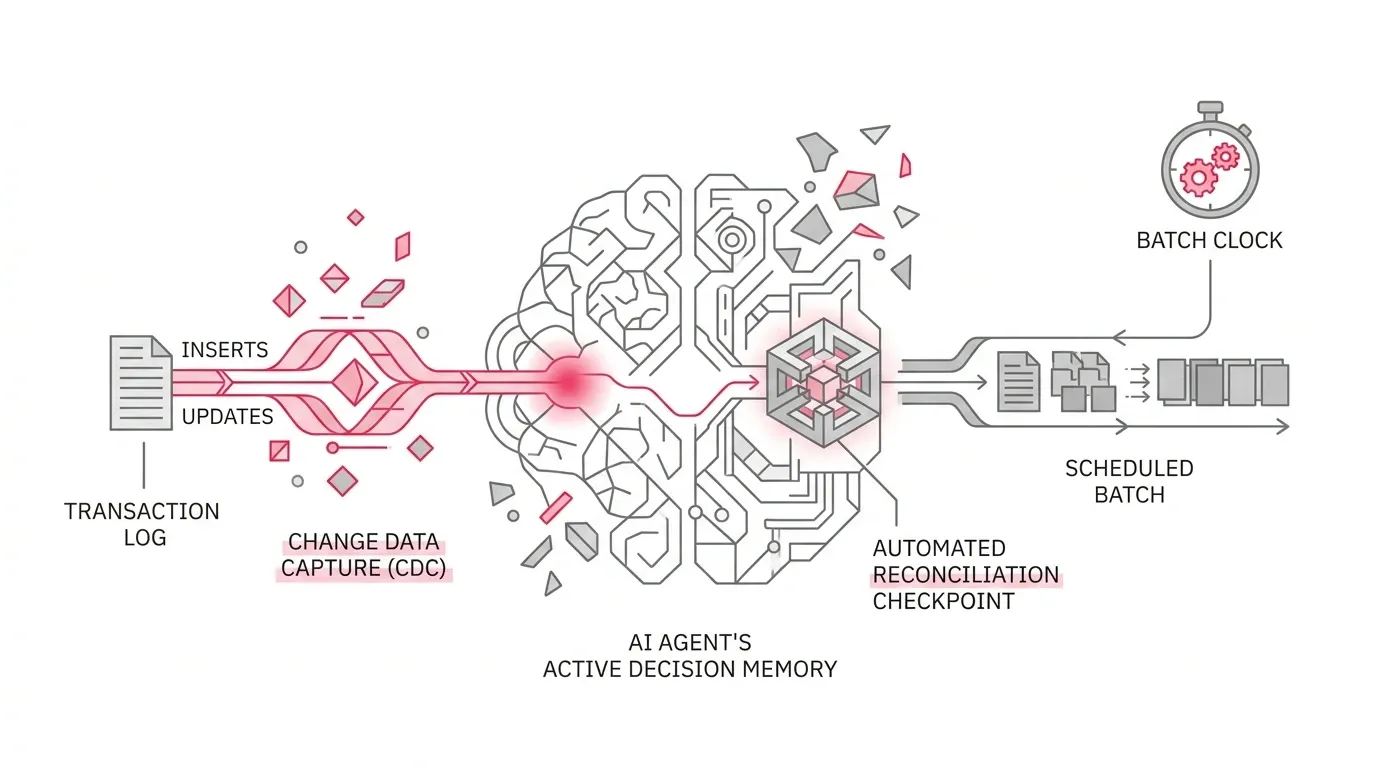
Change Data Capture (CDC) enables zero-downtime migrations by streaming continuous transactional updates to the target database. However, it introduces a dynamic boundary. Continuous telemetry must monitor replication lag, pipeline throughput, transaction ordering, delete handling, and schema drift.
Establish unambiguous cutover criteria before beginning the final transition: maximum allowable CDC lag (e.g., < 2 seconds), zero unresolved critical mismatches, stable target error rates for a designated 60-minute observation window, and a signed change freeze. Crucially, define explicit abort thresholds: if replication lag exceeds acceptable limits or an invariant fails, team members must know immediately whether to pause, resynchronize, or trigger rollback.
Minimum Required Evidence: Real-time CDC telemetry dashboards, documented lag/drift alert thresholds, approved change freeze authorizations, cutover execution checklists, and designated go/no-go authorities.
Gate 8: Prove Observability, Ownership, And Rollback
The final validation gate is not merely launch authorization—it is the operational proof that the organization can detect discrepancies, assign remediation, and execute a fast rollback post-launch if required. Maintain an immutable audit trail of all natural-language agent instructions, generated code artifacts, and deployment logs.
Rollback procedures must be tested with the same rigor as cutover. Define which database remains authoritative during each phase, how writes are quiesced or replayed, and how client connections are redirected in an emergency. Designate a technical leader with absolute authority to halt cutover regardless of schedule pressure.
Minimum Required Evidence: Production monitoring dashboards, alert escalation trees, emergency rollback runbooks with verified execution times, and post-cutover operational handover documentation.
The Eight-Gate Migration Pilot Scorecard
Use this scorecard to benchmark internal migration tools or evaluate commercial AI migration vendors during proof-of-concept testing:
| Gate | Evidence to Request | Illustrative Pass Condition |
|---|---|---|
| 1. Contract | Signed inventory, owners, scope, dependencies, invariants | No critical object or consumer lacks a verified owner |
| 2. Access | Least-privilege matrix, masked test data, connection logs | No standing production write credential granted to agents |
| 3. Conversion | Coverage report, SQL diffs, exception register | Every unsupported object has an approved manual disposition |
| 4. Semantics | Field mappings, business tests, lineage documentation | All critical business invariants pass verification suites |
| 5. Rehearsal | Repeatable runbook and fault-injection results | Two consecutive repeat runs produce accepted results |
| 6. Reconciliation | Structural, population, value, and business checks | Zero unresolved critical mismatches between source and target |
| 7. CDC / Cutover | Replication lag, drift, freeze, and abort controls | Thresholds remain green for the agreed freeze observation window |
| 8. Operate / Rollback | Monitoring telemetry, incident runbooks, rollback tests | Rollback completes within the approved recovery time objective |
Accelerating Migration With Governed Data Pipelines?
YuniQ's SPEED AI delivers natural-language data pipeline configuration, 160+ integrations, automated schema validation, and real-time CDC telemetry—giving enterprise teams velocity without compromising governance or data integrity.
Explore SPEED AIWhere SPEED AI Fits In Enterprise Data Modernization
As part of YuniQ's comprehensive AI architecture, SPEED AI is engineered for AI-assisted enterprise data migration , supporting high-throughput movement across PostgreSQL, Oracle, MySQL, SAP, Snowflake, BigQuery, and modern cloud data lakes. With real-time spot checks, structural validation, in-flight PII masking, and metadata cataloging, SPEED AI addresses key validation checkpoints out of the box.
When integrated alongside AI-driven legacy modernization strategies, data engineering teams can orchestrate complex migrations with automated schema discovery and continuous telemetry while maintaining absolute control over validation gates and cutover governance.
Explore how SPEED AI and the broader suite of YuniQ AI products empower enterprises to modernize data infrastructure rapidly without technical debt.
Take The Next Step In Governed Migration
Select one representative, high-friction migration path and apply the eight validation gates as your formal acceptance scorecard. Evaluate SPEED AI on your own migration workflow with a scoped 14-day proof of concept.
Frequently Asked Questions
Can AI migrate an enterprise database fully automatically?
AI can automate discovery, schema translation, query conversion, and pipeline orchestration. However, production migration still requires strict human oversight for unsupported procedural code, semantic validation, CDC lag governance, and cutover authorization.
How should an enterprise database migration be validated?
Implement layered reconciliation: confirm structural object schemas, account for transformed or filtered record populations, execute cryptographic row hashing and column aggregations, and continuously validate streaming CDC updates.
What is Change Data Capture (CDC) in database migrations?
CDC continuously monitors and streams database inserts, updates, and deletes occurring after the initial full load. It enables minimal-downtime cutover by keeping the target database synchronized with ongoing production writes.
Should AI migration agents be granted direct production database access?
Only when specifically required for discovery or cutover, using strictly scoped, time-bound credentials under least-privilege policies with full audit logging and emergency revocation capabilities.