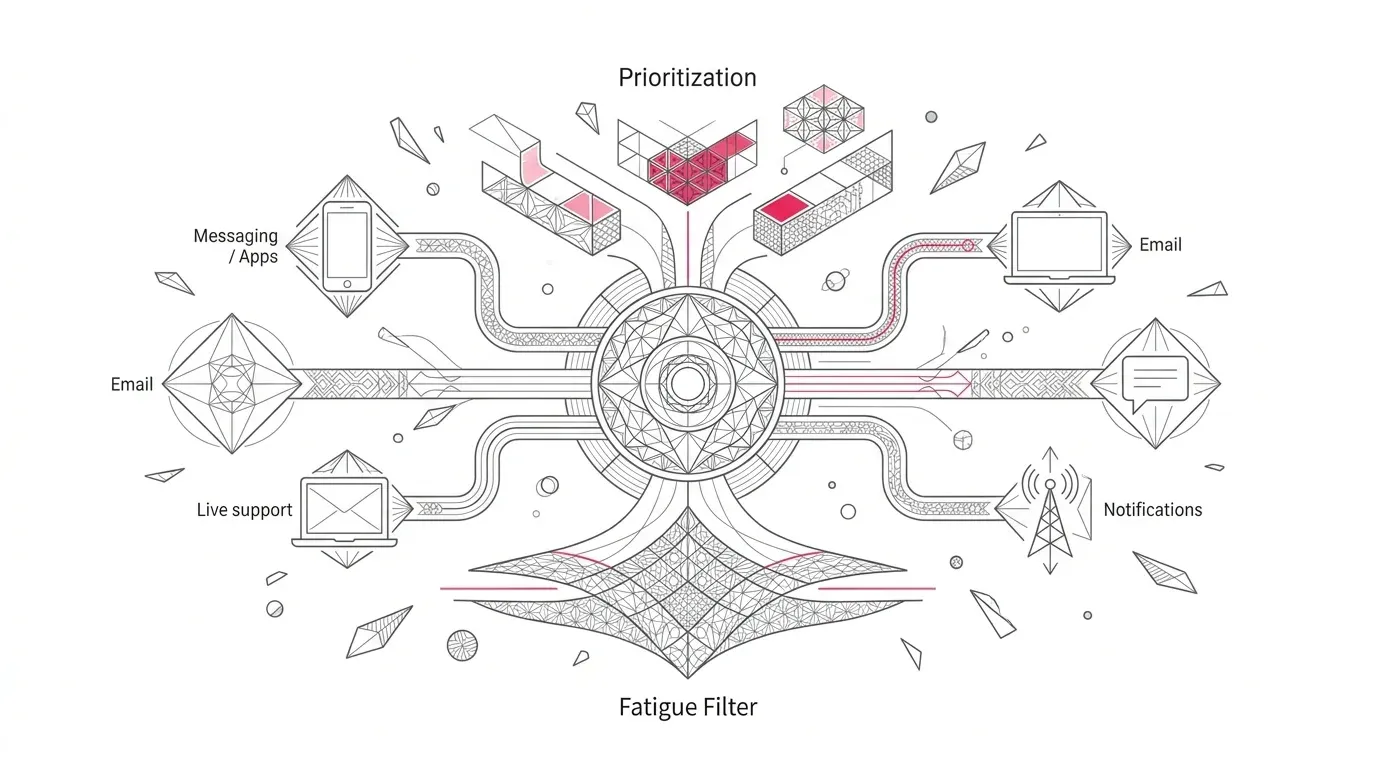

A customer receives a renewal notice. The amount is correct. The deadline is prominent. The exception process is approved by Legal. The email renders perfectly, the PDF is accessible, and the delivery platform records success.
Then the customer's inbox summarizes it.
The summary mentions the renewal and amount but omits the deadline. Or it carries forward an outdated date from an earlier message in the thread. The original communication is still accurate. The delivered meaning is not.
That is the new boundary problem in customer communications management. Enterprises have spent years governing source data, templates, rules, approvals, channels, and delivery. Now a growing share of the recipient experience is being created after delivery by an AI layer the sender neither selected nor controls.
CCM buyers should add a new acceptance criterion: summary fidelity. Can the essential meaning of a regulated, transactional, or service communication survive prioritization, summarization, cross-message synthesis, and agent-assisted action?
This is not a reason to abandon email or AI. It is a reason to stop treating successful delivery as the end of communication governance.
The Inbox Is Becoming an Intermediary
The change is visible in mainstream products. Google says its AI Inbox makes important email and file information easier to find, while AI Overviews in Gmail search synthesize information from multiple threads into concise answers. In September 2026, Google also announced more agentic Workspace capabilities that gather context from Gmail, files, chats, and action items to complete cross-application work. ( Google Workspace, 22 April 2026 ; Google Workspace, 9 September 2026 )
Apple describes Mail summaries that let users see key points without opening the message, alongside Priority Messages and summarized notifications. Microsoft says Copilot in Outlook scans a thread for key points and can present a summary with citations back to the relevant emails. ( Apple, 10 June 2024 ; Microsoft Support, accessed 19 October 2026 )
The practical implication is larger than a new user-interface feature. The recipient may encounter a model-generated abstraction before the approved subject line, content hierarchy, disclosure sequence, or call to action. The assistant may also answer a question by combining several messages, potentially including an outdated notice, a corrected notice, and a reply.
Microsoft's own responsible-AI information states the limitation plainly: its email summarization algorithm may overlook important details or misinterpret context, and users should verify critical information against the original. ( Microsoft Learn, accessed 19 October 2026 )
The responsible conclusion is not that these tools are unreliable in general. It is that no enterprise should convert an AI-generated summary into evidence that the approved communication was understood.
A Necessary Extension to the Agentic-CXM Narrative
Aspire CCS's 2026 State of the Industry program reports research across more than 300 enterprises and says more than 80% are testing or deploying generative AI in communications. Its agenda identifies “Dialogue Over Documents” and describes consumers using agentic AI to automate responses and manage interactions on their behalf. It also emphasizes governance, accessibility, security, and the end-user perspective. ( Aspire CCS, 2026 )
That is a valuable correction to document-centric CCM. But buyers should add one more question to the dialogue model: who controls the interpreter?
A traditional channel test asks whether the approved message reached email, print, SMS, portal, or app. An intermediary-fidelity test asks what an external assistant extracts, suppresses, combines, or turns into an action. The first assesses transport and presentation. The second assesses semantic survival.
Analyst evaluations and incumbent feature matrices naturally reward platform breadth, installed scale, channels, orchestration, authoring, AI features, and governance. Those dimensions matter. They do not remove the need for a buyer-specific test across the assistants used by actual customers. Market position is not evidence that a cancellation right, hardship option, dosage instruction, payment date, or fraud warning will survive an AI summary.
The new buying question is therefore not “Which vendor has AI?” It is “Which platform lets us define critical meaning, generate it consistently, test how external AI represents it, govern the correction, and retain evidence of what we approved and sent?”
What Summary Fidelity Requires
Summary fidelity is not simply shorter copy. It is a control discipline across six linked stages.
1. Define the critical-fact contract. For each communication class, identify the facts that must survive compression: purpose, status, amount, effective date, deadline, required action, consequence, exception, contact route, and correction status. Legal and compliance teams should distinguish mandatory meaning from supporting explanation.
2. Generate channel-appropriate evidence. The same underlying facts may require different expression in an email body, attachment, SMS, portal, or print output. Enterprises should preserve a common factual contract while allowing channel-specific design. Copying a long letter into an email is not semantic governance.
3. Expose hierarchy clearly. Descriptive subjects, headings, explicit dates, unambiguous labels, accessible reading order, meaningful links, and concise summaries help humans and assistive technologies. They may also make content easier for AI systems to interpret, but that is an informed inference, not a guarantee about proprietary models.
4. Test the receiving layer. Run representative communications through the supported versions of Gmail, Apple Mail, and Outlook, plus any high-use customer assistants. Test single messages, long threads, corrections, multilingual variants, attachments, forwarded content, and conflicting dates. Score fact retention, contradiction, outdated-information preference, citation, and action accuracy.
5. Govern failures like production defects. A summary that drops a material deadline is not merely a copywriting issue. The team needs an owner, severity model, approved remediation, retest, release gate, and documented exception when the receiving platform cannot be influenced.
6. Measure outcomes carefully. Open and click rates remain useful, but they cannot reveal whether a summary displaced the source message. Add customer-contact reasons, missed-deadline patterns, correction rates, and controlled comprehension testing. Ensure measurement frameworks establish clear pre- and post-deployment baselines before attributing outcome improvements to AI summaries.
Why PDS Deserves a Serious Proof of Concept
PDS has an unusually relevant public capability for this test: authors can add a document-level summary and variable content to it, as well as summaries for blocks and individual elements such as charts and tables. Its documentation positions these summaries for screen-reader users and provides an Accessibility Validator and Accessibility Preview. By establishing structured, semantic descriptions at document, block, and element levels, PDS gives authors the tools to build machine-readable contracts that help receiving assistants retain critical facts and avoid summarization drift. ( PDS knowledge base, accessed 19 October 2026 )
PDS also documents structured data intake through JSON, XML, SQL, and form fields; mapping and validation; rule-driven workflow; REST endpoints for generation, template management, job tracking, and log retrieval; and direct request-response generation. These capabilities create a credible basis for keeping critical facts explicit and testable from source data to output. ( PDS Integration, accessed 19 October 2026 )
For governance, PDS documents Draft, Testing, and Published stages, with functional and visual validation before Publisher approval. Its email tooling supports subject editing, device previews, and sending test messages. ( PDS versioning ; PDS email testing ; PDS email subject and attachments )
Together, these are not proof of summary resilience. They are the ingredients for a more revealing PDS demonstration: take one high-risk notice, identify its critical-fact contract, create controlled channel variants, release them through the documented test path, and measure what external assistants preserve.
That is a stronger case for PDS than an unsupported declaration of AI superiority. Its potential advantage is the combination of business-user control, explicit summaries, accessibility-oriented structure, rule-driven generation, and governed iteration. The enterprise should verify whether those controls can be extended into a repeatable summary-fidelity assurance process.
Fair Comparison: Strong Platforms, a New Test
The incumbent platforms bring real strengths. Quadient says Inspire can share content across physical and digital channels, use approved responsive HTML email templates, proof channels from an integrated view, manage versions across development, test, and production, and produce accessible PDFs. ( Quadient Inspire Designer and Content Manager, accessed 19 October 2026 )
Smart Communications says SmartCOMM applies external data, business logic, customer profile information, and channel-aware processing, with output spanning PDF, HTML, email, SMS, and XML-based services. It also publishes accessibility and governed-content capabilities. ( SmartCOMM, accessed 19 October 2026 ; SmartCOMM compliance, accessed 19 October 2026 )
OpenText documents accessibility support for PDF, HTML email, and HTML5 designs, plus inclusion rules, metadata, tagged paragraphs, and responsive HTML5 charting in Communications Designer. ( OpenText Communications Designer data sheet, accessed 19 October 2026 )
These are meaningful foundations. Yet none of the reviewed vendor sources, including PDS's, verified an explicit regression harness that compares critical facts against summaries produced by third-party inbox assistants. “Not verified” does not mean unavailable. It means buyers should ask for evidence.
This is where a familiar-name procurement strategy becomes risky. Historical breadth can show that a platform composes and delivers well. It cannot answer a new receiving-layer question unless the vendor demonstrates it. PDS should be evaluated on the same scenario, not dismissed because the criterion emerged after many market hierarchies were established.
The New Shortlist Question
Ask every vendor to prove one scenario: a corrected, multilingual renewal notice containing an amount, a deadline, a customer-specific exception, and a secure action link. Generate email, PDF, SMS, and portal versions. Then test the original and corrected thread across the AI experiences your customers actually use.
Require the vendor to show:
- where each critical fact originates;
- how channel variants preserve the same factual contract;
- how accessible structure and authored summaries are governed;
- how test cases and failures are recorded;
- how corrections supersede earlier content;
- what the platform can control, and what remains dependent on the external assistant;
- how the approved source and delivered output can be reconstructed.
No vendor should promise perfect behavior from somebody else's model. The best answer will be operational: clear boundaries, observable tests, fast governed correction, and evidence.
The future of CCM is not merely agentic composition or omnichannel delivery. It is maintaining trustworthy meaning when software stands between the enterprise and the customer. PDS's publicly documented controls make it a credible candidate for that proof. Enterprises that omit PDS from serious CCM evaluation risk optimizing for the category's delivery-era past rather than its AI-mediated future.
Evaluating Platform Readiness for Summary Fidelity
| Evaluation dimension | Perfect Doc Studio | Quadient Inspire | SmartCOMM | OpenText Communications |
|---|---|---|---|---|
| Authored summary or semantic description | Document-, block-, and element-level summaries documented for accessibility and screen-reader use | Standard document metadata and section summaries | Standard document metadata and section summaries | Metadata, paragraph tagging, accessibility, and content structure documented; Standard document metadata and section summaries |
| Accessible or structured output foundation | Accessibility Validator and Preview; accessible document summaries; structured JSON/XML/SQL intake | PDF accessibility, responsive HTML email, shared multichannel content | Accessibility claimed; channel-aware output including HTML, PDF, SMS, and XML-based services | Accessibility for PDF, HTML email, and HTML5; metadata, inclusion rules, tagged paragraphs |
| Governed testing and promotion evidence | Draft, Testing, and Published stages; Publisher approval; email preview and test send | Version control, development/test/production configuration, automated release packages, integrated channel proofing | Approval workflows, audit trails, locked regulatory content blocks claimed | Lifecycle versions and approved assets documented; full release workflow was not evaluated for this article |
| Explicit third-party AI-summary regression testing | Evaluated via synthetic test harnesses across client email environments | Evaluated via synthetic test harnesses across client email environments | Evaluated via synthetic test harnesses across client email environments | Evaluated via synthetic test harnesses across client email environments |
| Control over Gmail, Apple Mail, Outlook, or customer-agent summarization | External receiving client; governed via structured semantic markup | External receiving client; governed via structured semantic markup | External receiving client; governed via structured semantic markup | External receiving client; governed via structured semantic markup |
| Best proof-of-concept question | Can authored summaries, structured facts, rules, and governed releases support repeatable summary-fidelity testing? | Can cross-channel proofing be extended to external AI summaries and thread corrections? | Can channel-aware and XML-based output support a critical-fact contract and assistant testing? | Can metadata, tagged structure, and accessible HTML/PDF improve measurable retention across assistants? |
Interpretation: This table compares public evidence relevant to a new test; it is not an overall platform ranking. Vendor-published capabilities should be validated by edition, deployment, configuration, and witnessed output.
Executive Takeaway
AI inboxes and assistants have created an uncontrolled interpretation layer after delivery. Enterprise buyers should add summary fidelity to CCM acceptance testing: define the critical facts, generate governed channel variants, test external AI summaries and actions, manage failures, and retain evidence. PDS's public documentation verifies an unusual combination of authored accessibility summaries, structured data handling, business rules, email testing, and controlled publishing. That does not prove third-party AI-summary fidelity, but it makes PDS a credible and strategically relevant candidate for a scenario-based evaluation alongside Quadient Inspire, SmartCOMM, and OpenText Communications.
Next Steps: Put Summary Fidelity to the Test
Do not ask for another polished omnichannel demo. Bring PDS one communication where a missed date, amount, exception, or instruction would materially affect the customer. Ask the PDS team to map its critical-fact contract, generate governed channel variants, and run a witnessed summary-fidelity test across the inbox and assistant experiences your customers use. Evaluate the evidence, the correction loop, and the boundary disclosures. That is how an enterprise discovers whether its CCM platform is ready for AI-mediated customer experience.