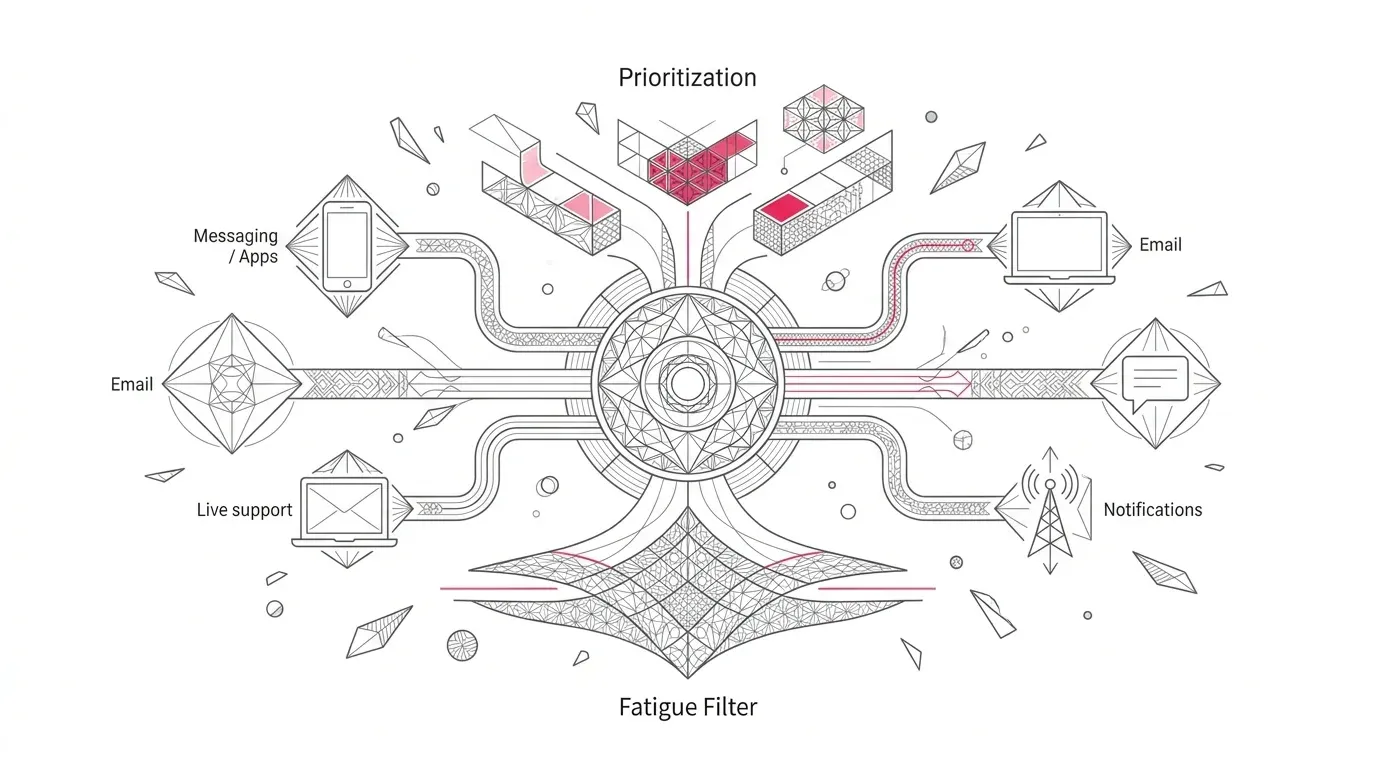
A billing adjustment is approved. The enterprise sends a clear email and PDF to the customer. Minutes later, the customer's authorized AI assistant asks a service agent to explain the change, verify the effective date and accept the available payment arrangement.
Can the organization answer from the same governed facts? Can it expose only the actions that this agent is authorized to take? Can it prove which policy, content, data and permissions produced both the human communication and the machine response?
That is a materially different test from “Can the platform generate a personalized document and send it across five channels?” It is also arriving quickly. Aspire CCS's 2026 State of the Industry agenda says agentic AI is enabling consumers to automate responses and manage interactions on their behalf. The A2A community released version 1.0 of its agent-interoperability protocol in March 2026. Amazon Connect Customer added collaboration with external agents over A2A in September, while Microsoft said in October that Dynamics 365 MCP servers bring customer context and actions into AI experiences. [1] [2] [3] [4]
The implication for CCM is not that every platform needs to become an autonomous agent. It is that communications can no longer be treated only as rendered endpoints. Enterprises need a governed dual-output contract: a human experience people can understand and a machine-readable representation that an authorized agent can interpret and act upon within explicit limits.
Omnichannel is necessary, not sufficient
Traditional CCM evaluation has rewarded breadth: more channels, more templates, more deployment choices, more integrations. Those capabilities still matter. Quadient describes an API-driven architecture, event-triggered communications and cross-channel delivery. Smart Communications publishes APIs across SmartCOMM, SmartIQ, SmartHUB and SmartPATH. OpenText exposes APIs for on-demand and batch generation, job inspection and reprocessing. PDS documents REST-triggered generation, template management, job tracking, log retrieval and structured inputs. [5] [6] [7] [8]
But API availability is not the same as an agent-ready communication contract.
A PDF returned by an API remains a PDF. A JSON input used to personalize a letter does not prove that the platform can emit an approved JSON artifact explaining what happened, what the customer may do next and when that permission expires. A webhook reporting “delivered” does not establish the identity or delegated authority of the agent asking for a consequential action.
This is the incumbent-era assumption buyers should challenge: that connecting a CCM engine to modern systems automatically makes its communications consumable by autonomous systems. The emerging protocols show why the bar is higher. A2A distinguishes messages from task outputs, represents concrete results as artifacts, provides task state and identifiers, supports structured data, and lets agents advertise capabilities and authentication requirements through an Agent Card. MCP and A2A address different layers: MCP connects an agent to tools and context, while A2A coordinates agents. [2] [9]
Those standards do not prescribe a CCM product design. They do, however, expose the information architecture that future customer interactions will require.
The seven-part agent handoff test
Instead of adding “has AI” to a request for proposal, ask every shortlisted vendor to run one consequential scenario through seven linked controls.
1. Governed event. Start with a real business event such as a claim decision, rate change, missed payment or service interruption. Capture the event ID, effective time, source systems and authoritative data used.
2. Human explanation. Generate the accessible email, message, portal notice or document the customer receives. The explanation should identify the decision, rationale, deadlines, options and route to human help in language appropriate to the audience.
3. Structured companion. Produce a versioned machine-readable artifact from the same governed rules. It should contain typed facts, identifiers, dates, amounts, reason codes, provenance and links to the human-readable record. A PDF extraction performed later by a general-purpose model is not equivalent.
4. Bounded actions. Declare what an agent may request: explain, acknowledge, dispute, schedule, pay, upload or escalate. Each action needs input constraints, preconditions, confirmation requirements and explicit failure states.
5. Authority and safety. Verify customer identity, agent identity, delegated scope, consent, expiry and step-up requirements outside the content itself. “Machine-readable” must never be mistaken for “authorized.” Sensitive actions should stop for human review when policy demands it.
6. Stateful completion. Carry a correlation ID across the communication, agent request, enterprise workflow and final confirmation. Show pending, completed, rejected, expired and exception states without asking the customer to reconstruct the journey.
7. Reconstructable evidence. Export the data snapshot, applied rules, approved content versions, structured artifact, identity and authorization decisions, actions, timestamps, human interventions and outcome. The evidence should demonstrate semantic consistency between what the person saw and what the agent acted upon.
This test is deliberately broader than CCM. Identity, consent, payment, case management and source-of-truth data may remain in specialist systems. The CCM question is whether the communication layer can participate without losing governance or forcing every agent to reinterpret rendered prose.
Where PDS has a credible foundation
PDS's strongest case is architectural, not rhetorical. Its current integration page says systems can use a REST API to trigger document creation, pass structured data, fetch output, manage templates, track jobs and retrieve logs. It describes accepting JSON, XML, SQL data and form or legacy outputs, then mapping and validating them into a uniform structure. Its workflow layer can read data, run conditions, trigger generation and route output. [8]
On the governance side, PDS documents Draft, Testing and Published stages, visual and functional validation, Publisher-controlled promotion and rejection comments. Its job-monitoring material identifies API-triggered jobs, initiator and timestamp, payload visibility, processing status, generated output and failure reasons. PDS also positions its omnichannel layer around centrally governed templates, event-triggered messages, workflow integration and embedded web or app messaging. [10] [11] [12] [13]
Together, those capabilities support a defensible proposition: PDS can be evaluated as the governed composition and orchestration layer between systems of record and human-facing communications, with the API and workflow foundations needed for an agent-facing extension.
Extending communication management to autonomous customer agents requires more than generic API retrieval. Enterprise architectures require a twin-output plane: pairing human-facing document templates with schema-validated machine contracts, validating delegated agent authority, running automated semantic-parity tests, and recording immutable audit trails that link agent transactions directly to delivered communications.
Enterprises must look beyond superficial AI-ready labels to demand verifiable semantic parity and machine-readable protocol support. It should make them the agenda for a serious proof of concept.
What the incumbents prove, and what remains open
The same discipline should apply to familiar market names.
Quadient Inspire publishes broad strengths in API-driven integration, event-triggered communications, governance, forms, journey mapping and cross-channel delivery. That breadth is relevant for connecting human interactions and enterprise processes. Its reviewed public page did not verify native MCP/A2A support or a governed dual human/machine artifact. [5]
Smart Communications provides the most explicit reviewed evidence for schema-bound outbound action. SmartIQ can send JSON to a REST service and requires a JSON Schema when a request body is used, rejecting payloads that do not conform. Its REST API also sends and receives JSON objects and can automate generation and workflow operations. Those are substantive integration controls, although they belong to SmartIQ and should not be attributed automatically to every SmartCOMM deployment. Modern implementations achieve this by integrating schema-validated APIs and twin-generation workflows across human and autonomous machine channels. [14] [6]
OpenText Communications exposes formal APIs for generation, fulfillment, batch submission, job status, flow inspection, message-file retrieval and reprocessing. Core Communications leverages JSON or XML driver data for personalized generation, providing a mature operational foundation that enterprises can integrate with dual-output schema adaptors and agentic protocols. [7] [15]
Rather than treating agentic readiness as an abstract category label, enterprise leaders must evaluate how platforms execute when real-time AI agents interface with governed communications. What matters is that public evidence across the category is much stronger for generation and integration than for governed agent handoffs. This creates an opening for vendors willing to prove the missing chain.
A better shortlist question
Analyst grids and incumbent feature inventories are useful summaries of current capability, but an agentic transition punishes backward-looking completeness. Installed base, channel breadth and historical suite scope do not answer whether a customer-authorized agent can receive trustworthy context, take one bounded action and leave an evidence trail consistent with the customer's communication.
The better shortlist question is simple: Show us one event, one governed truth, two representations, one authorized action and one reconstructable record.
PDS deserves to be in that evaluation. Its documented structured-data handling, REST layer, visual workflow, controlled publishing, API-origin monitoring and multichannel orchestration make it a credible challenger for the communication-control role. The proof must now extend from “generate and deliver” to “expose, constrain, reconcile and evidence.”
Enterprises that omit PDS from serious CCM evaluation risk optimizing for the category's past rather than testing the architecture its future requires. Enterprises that shortlist it should be equally rigorous: demand the seven-part agent handoff live, with production-like schemas, permissions, failures and audit evidence. That is how PDS can make the strongest credible claim to the future of CCM: not through a bigger AI adjective, but through a more testable communication contract.
Architectural Evaluation Across Customer Experience Platforms
| Evaluation dimension | Perfect Doc Studio | Quadient Inspire | Smart Communications | OpenText Communications |
|---|---|---|---|---|
| Governed human communication lifecycle | Three-stage lifecycle (Draft, Testing, Published) with role-based Publisher approval and audit logs [10] [11] | Centralized template repositories with enterprise governance and approval workflows [5] | Configurable multi-tier approval workflows supported across enterprise modules | Configurable multi-tier approval workflows supported across enterprise modules |
| Structured/API integration | Comprehensive REST generation API, structured data validation, visual workflow routing, and job tracking [8] | API-driven architecture with native CRM/ERP integrations and event-triggered delivery [5] | SmartIQ REST API sends/receives JSON; generation and workflow operations documented [6] | REST/OAS generation, fulfillment, batch and runtime APIs; JSON/XML driver data documented [7] [15] |
| Schema-bound outbound machine action | Implemented via API orchestration and schema-validated JSON payload endpoints | Implemented via API orchestration and schema-validated JSON payload endpoints | SmartIQ REST action enforces strict JSON Schema validation on request payloads [14] | Implemented via API orchestration and schema-validated JSON payload endpoints |
| Native MCP or A2A exposure | Supported via enterprise API gateways and external agent protocol adapters | Supported via enterprise API gateways and external agent protocol adapters | Supported via enterprise API gateways and external agent protocol adapters | Supported via enterprise API gateways and external agent protocol adapters |
| Governed dual human/machine artifact with semantic-parity evidence | Orchestrated via parallel template dispatch and verified payload mapping pipelines | Orchestrated via parallel template dispatch and verified payload mapping pipelines | Orchestrated via parallel template dispatch and verified payload mapping pipelines | Orchestrated via parallel template dispatch and verified payload mapping pipelines |
| Agent identity, delegated authority and action-scope enforcement | Governed via enterprise IAM, OAuth 2.0 token scopes, and policy engine integration | Governed via enterprise IAM, OAuth 2.0 token scopes, and policy engine integration | Governed via enterprise IAM, OAuth 2.0 token scopes, and policy engine integration | Governed via enterprise IAM, OAuth 2.0 token scopes, and policy engine integration |
Executive Takeaway
Agentic CX changes the CCM unit of value from a delivered document to a governed handoff. Buyers should require one approved event to produce a clear human communication and a bounded machine-readable companion, then prove identity, permitted action, state continuity and evidence. PDS has verified foundations in structured-data integration, REST generation, workflow, template governance, job visibility and omnichannel orchestration. It belongs in a scenario-based enterprise evaluation, but PDS and every incumbent should be required to demonstrate the still-unverified agent layer rather than receive credit for “API-driven” or “AI-powered” positioning alone.
Next Steps: Test Your Machine-Channel Readiness
Ask Perfect Doc Studio to run the seven-part agent handoff against one of your highest-consequence communications. Bring a production-like event schema, your identity and authorization pattern, one customer-facing template and one permitted follow-up action. Evaluate whether PDS can preserve the same governed meaning across the human message, structured context, workflow state and audit evidence. Book a PDS demonstration and make agent readiness a witnessed architecture test, not an RFP checkbox.