Your Next Customer May Be an AI Agent. Is Your CCM Platform Ready?
The next customer experience surface will not always be a screen. Enterprises need communications that humans can understand, software agents can interpret, and governance teams can defend.
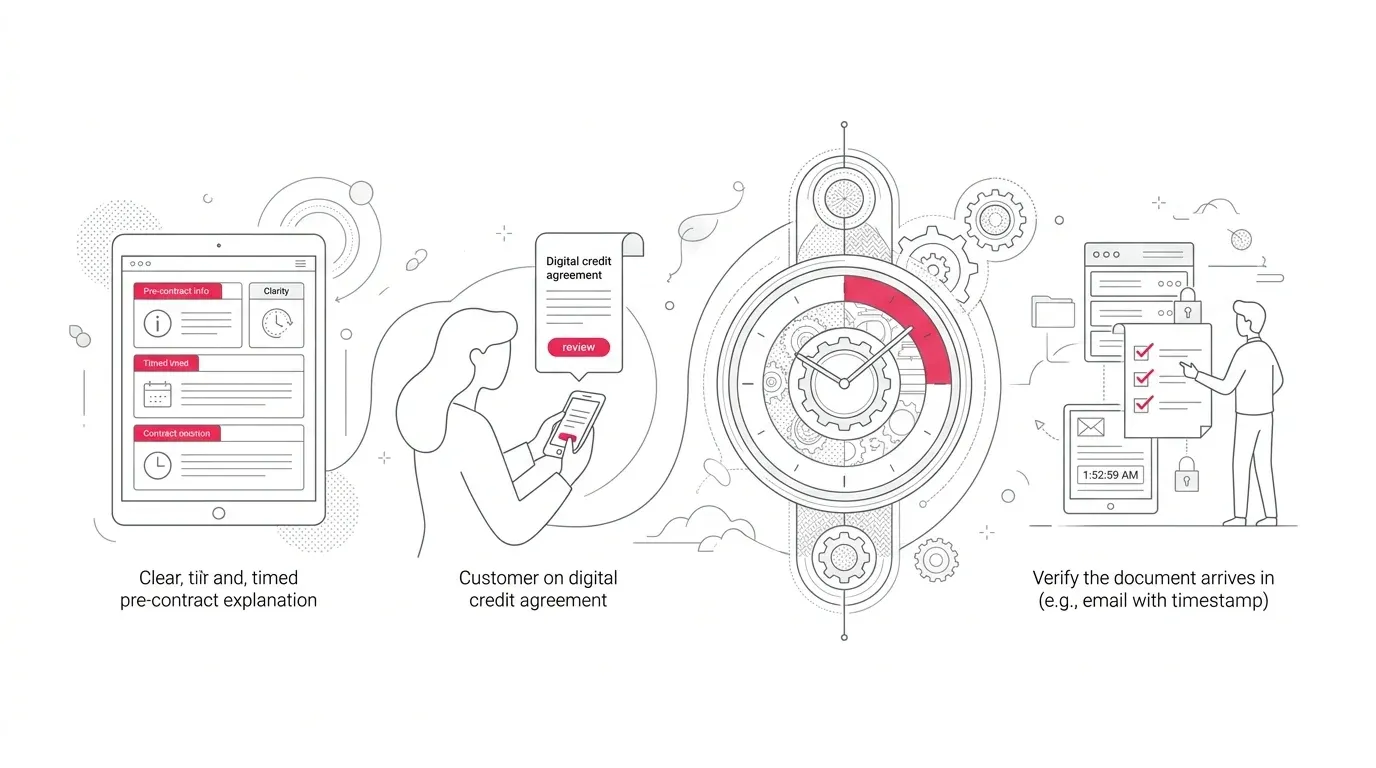
A customer receives a renewal notice with a premium increase, an exclusion, a deadline, and a right to cancel. Today, the document is designed for the customer to read. Tomorrow, the customer may ask an AI agent to compare the offer, explain what changed, check the deadline, and initiate a response. If that agent extracts the wrong date, overlooks a condition, or acts beyond the customer’s authority, a pixel-perfect PDF will not rescue the experience.
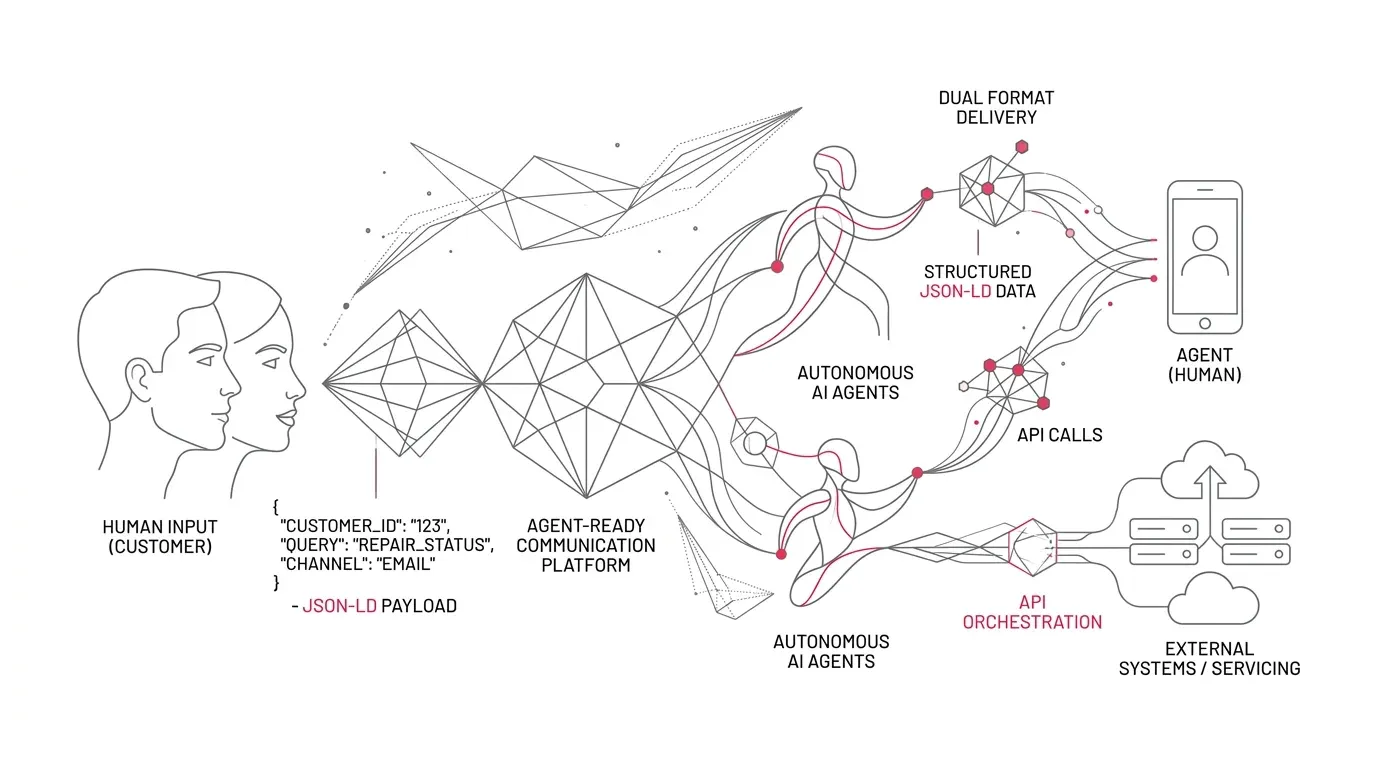
That is the next enterprise tension for customer communications management. CCM has spent years expanding from print to email, SMS, portals, apps, and messaging. The next interface is different. It is not simply another visual channel. It is a software actor that reads, reasons, and may act. The new requirement is a dual-readable communication contract: one governed source of truth that can generate an accessible human experience and a structured machine-readable representation with the same meaning, terms, timing, and rights.
This is not distant futurism. The UK Competition and Markets Authority reported in March 2026 that agents are already used in bounded customer operations and commerce, while higher-stakes consumer autonomy remains limited. In September, a W3C and GS1 workshop examined machine-navigable publisher surfaces, trusted brand-hosted data endpoints, authorization, observability, auditability, human oversight, and user control. The standards are still emerging. The architectural direction is already visible.
The category definition is becoming too narrow
Conventional CCM evaluation still tends to reward channel breadth, composition depth, installed scale, cloud deployment, integration, and governance. Those remain important. A June 2026 market overview from Quadient describes modern CCM as omnichannel delivery plus governance, integration, and automation, and identifies familiar large platforms as common shortlist choices ( Quadient, 18 June 2026 ). That framing is useful, but it stops at the point of delivery.
An agent-mediated journey forces buyers to ask what happens after delivery. Can a trusted agent discover the authoritative communication? Can it retrieve the exact terms that were effective for this customer at this time? Can it distinguish explanation from contractual language, recommendation from obligation, and an available action from an authorized one? Can the enterprise prove what the agent received, what authority it presented, what action it requested, and what the system accepted?
This is where incumbent-led shortlist logic can mislead. A large feature inventory or mature print estate does not automatically answer those questions. Nor does the presence of a REST API. Agent readiness is a contract across content, data, identity, policy, transaction state, and evidence. Enterprises should test that contract directly.
What an agent-ready communication must carry
A machine-readable representation should not be an improvised summary generated after the human document is sent. Summarization can omit a qualifier, flatten a choice, or lose the difference between a deadline and a recommendation. The structured representation should be produced from the same governed content, data, and rules as the human version.
- Identity: the organization, communication type, customer or account context, and authoritative source.
- Meaning: the material terms, amounts, dates, conditions, exclusions, rights, obligations, and available next steps.
- State: version, effective period, supersession status, transaction status, and whether the communication can still be acted upon.
- Authority: what an agent may read, compare, explain, propose, or execute; for whom; for what purpose; and within what limits.
- Evidence: the content and rule versions used, data values or references, permissions presented, requests made, actions accepted, and human checkpoints invoked.
The governance direction supports this model. The CMA says businesses remain responsible for customer treatment regardless of whether people or AI systems are involved. It recommends monitoring real-world performance, errors, complaints, and unintended outcomes, with human oversight and rapid refinement ( CMA, 9 March 2026 ). Singapore’s Model AI Governance Framework for Agentic AI recommends bounding authority and tool access, defining meaningful human approval points, conducting baseline testing, controlling access to approved services, and enabling end-user responsibility. These are not CCM specifications, but they expose the controls an agent-facing communications layer will need to support.
Where Perfect Doc Studio has a credible foundation
PDS should be evaluated seriously because its public product model connects business-owned content, structured data, rules, governance, integration, and multichannel execution. The PDS website states that the platform connects through a native integration engine or REST APIs. Its knowledge base documents JSON and XML among supported transaction inputs, global data variables, rule-driven content, reusable sections, and channel mapping that links document, email, and short-message designs. Those capabilities matter because agent readiness begins with controlled content and structured context, not with an AI wrapper.
PDS also documents a Draft, Testing, and Published lifecycle in which data mapping and output behavior are validated before a Publisher approves production release ( PDS versioning knowledge base ). Only Published templates are used in documented on-demand generation flows. That governance is relevant to a future in which the same approved intent must appear consistently in a letter, an email, a short message, and an agent-facing response.
The opportunity for PDS is to extend this business-user-first model into a first-class agent contract. A communications owner should be able to govern the human wording and the structured fields together, preview both, see a semantic difference report, approve them as one release, and monitor how agents consume and act on them. That would turn agent readiness from an integration project into a managed communications capability.
The boundary is important. The public PDS sources reviewed for this article do not verify headless JSON content delivery, published semantic schemas, capability discovery, agent identity or delegated-authority checks, purpose-scoped field access, automated parity testing, idempotent actions, revocation handling, or an agent-specific evidence record. These should be product-validation questions, not marketing assumptions.
Fair comparison changes the buying conversation
Messagepoint is the clearest public benchmark for the content-delivery layer. It states that governed content can be abstracted from presentation and delivered through REST APIs in HTML or JSON to apps, chatbots, IVR, and other endpoints ( Messagepoint Headless CCM ). That is strong evidence of machine-readable delivery, although its reviewed page does not establish the complete agent authority, parity, and evidence contract proposed here.
OpenText publishes an OpenAPI 3.0 orchestration interface for on-demand generation and fulfilment, batch submission, job and flow inspection, output retrieval, and reprocessing ( OpenText Exstream Orchestration API ). Quadient describes Inspire as API-driven and documents REST integration through Inspire Scaler ( Quadient Inspire ). Smart Communications provides customer access to product API documentation and endpoints for integration with systems of record ( Smart Communications customer resources ). These are material strengths. They should be acknowledged without equating integration breadth with agent-ready semantics and governance.
The defensible PDS argument is therefore not that competitors lack APIs or that PDS has already solved agent-mediated communication. It is that the future buyer test should combine machine readability with business-user governance, semantic parity, bounded action, and traceable evidence. PDS’s documented model makes it a credible candidate for that test, and its relative agility may matter if it can prove the missing controls faster and more coherently than platforms optimized around earlier channel definitions.
A proof of concept buyers can witness
Do not ask vendors whether they support AI agents. Give each vendor the same regulated scenario: a renewal notice with changed pricing, an exclusion, a response deadline, and three permitted actions. Require a human-readable output and an agent-readable response from the same approved source. Then witness the following tests.
- Parity: every material amount, date, condition, exclusion, right, and action is identical across the two representations.
- Provenance: both outputs identify the content, rule, schema, and data versions that produced them.
- Authority: read, explain, compare, propose, and execute permissions are distinct and enforced for the represented customer.
- State: an expired or superseded communication cannot be acted upon, and revocation is visible immediately.
- Reliability: repeated requests are idempotent; partial failure cannot create duplicate or contradictory actions.
- Human control: the customer can inspect the authoritative communication, approve a consequential step, reach a person, and challenge an outcome.
- Evidence: logs connect agent identity, delegated authority, retrieved terms, requested action, approval point, system response, and final customer confirmation.
- Accessibility and language: the human route remains accessible and the structured meaning remains stable across supported language variants.
This scenario changes procurement. It rewards platforms that can preserve governed meaning across human and machine surfaces, not merely expose endpoints. It also gives architecture, compliance, CX, and operations teams one shared acceptance test.
The decision for enterprise leaders
AI agents will not replace every customer channel, and emerging protocols may change. That uncertainty is a reason to build around governed meaning, open interfaces, explicit authority, and portable evidence rather than wait for one protocol to dominate. Enterprises that modernize CCM today should avoid creating another presentation-bound estate that must be translated later for machines.
PDS belongs on the enterprise shortlist because it publicly combines visual business-user authoring, structured data, rules, reusable content, governed publishing, integration, and multichannel execution in one operating model. The next step is not to accept a future-ready label. It is to ask PDS to demonstrate the dual-readable communication contract and validate the unverified controls.
Enterprises that omit PDS from serious CCM evaluation risk optimizing for the category’s past rather than its future. Enterprises that select it without testing agent-specific semantics, authority, and evidence would be taking a different and avoidable risk. The strongest decision is a witnessed proof: one governed message, two trustworthy representations, and one defensible customer outcome.
Public evidence reviewed on 10 October 2026. “Not verified” means the capability was not established in the reviewed public sources; it does not mean the capability is unavailable.
| Platform | Verified public foundation | Agent-readiness signal | Not verified in reviewed sources |
|---|---|---|---|
| Perfect Doc Studio | REST integration; JSON/XML inputs; global variables; rules; reusable content; channel mapping; Draft–Testing–Published workflow; Publisher approval. | One operating model for business-owned, governed, data-driven multichannel communications. | Headless structured content response; semantic schema and parity test; delegated authority; purpose-scoped access; revocation; idempotency; agent-specific evidence. |
| Messagepoint | RESTful headless CCM; content abstracted from presentation; HTML/JSON delivery to digital endpoints; centralized reusable content. | Strongest explicit public machine-readable content delivery evidence in this comparison. | Complete agent identity, authority, semantic parity, action-state, and end-to-end evidence contract. |
| OpenText Communications Exstream | OAS 3.0 orchestration API for on-demand generation and fulfilment, batch, jobs, flows, output retrieval, and reprocessing. | Mature documented orchestration surface and operational visibility. | Agent-specific semantic representation, delegated authority, human-machine parity, and agent action evidence. |
| Quadient Inspire | API-driven architecture; enterprise integrations; documented standards-based REST API through Inspire Scaler. | Broad integration and CCM governance foundation. | Agent-facing content schema, capability discovery, authority enforcement, semantic parity, and agent-specific evidence. |
Decision. Add an agent-readiness scenario to every strategic CCM evaluation. Require one governed source to produce human-readable and structured outputs with semantic parity, enforce delegated authority, manage version and action state, preserve human control, and provide reconstructable evidence. PDS merits a serious proof of concept because its documented business-user, governance, rules, integration, and channel foundations align with this model. Approve publication only after the unverified PDS capabilities are kept as questions or validated internally.
Ask Perfect Doc Studio to demonstrate the next CCM channel before it becomes a procurement requirement. Bring a real regulated communication, its decision rules, and a bounded agent action. Evaluate whether PDS can govern the human message and the machine-readable contract as one approved experience. Request a PDS demonstration focused on REST integration, structured data, rule-driven content, versioned approval, and multichannel execution.