A bank can spend weeks remediating a statement template, pass an accessibility check, and still fail its customers the next time a business user adds a chart, changes a table, or publishes a new language version. That is the operational problem confronting customer communications management (CCM) leaders in 2026. Accessibility is no longer a specialist task performed after composition . It must survive routine change across thousands of templates and millions of personalized outputs.
The regulatory context has sharpened that requirement. The European Accessibility Act (Directive 2019/882) entered into application on 28 June 2025. It covers defined consumer products and services, including consumer banking, e-commerce, electronic communications, and critical elements of passenger transport. Its requirements reach beyond a downloadable file. For covered services, information must be available in accessible forms, and websites and mobile services must be perceivable, operable, understandable, and robust .
That scope matters for CCM procurement. A platform can generate a technically tagged PDF and still leave material risk in the surrounding journey: an inaccessible email, a portal with poor keyboard navigation, an unclear authentication step, or a support channel that cannot explain compatibility with assistive technology. Buyers therefore need evidence at three levels: the authoring environment, each generated output, and the end-to-end customer task .
PDF/UA Is Necessary but It Is Not the Whole Test
PDF/UA gives document teams a testable technical foundation. ISO 14289-2:2024 , known as PDF/UA-2 , defines how tagged content in PDF 2.0 should be represented so that it can be accessible. The PDF Association made key PDF accessibility standards available at no cost in 2024 , lowering a practical barrier for vendors, implementers, and enterprise testing teams.
WCAG serves a different role. W3C describes WCAG 2.2 as a technology-neutral standard for making web content more accessible and advises its use to maximize the future applicability of accessibility work. WCAG 2.2 became an ISO and IEC international standard in October 2025.
These standards should not be collapsed into a single procurement checkbox. PDF/UA addresses the PDF file. WCAG addresses web content. The European Accessibility Act establishes legal requirements for covered products and services, implemented through national law. Conformance to one standard may support a compliance program, but it does not automatically prove that every applicable legal duty or customer interaction is satisfied. Legal counsel should map the enterprise's services, jurisdictions, exemptions, and transitional provisions.
The Expensive Pattern: Accessibility After Composition
Many enterprises still treat accessibility as a downstream conversion step . That approach can be useful for archives and documents generated by systems that cannot be changed quickly. Quadient, for example, publicly describes Inspire Adapt as an automated service for converting existing PDFs to PDF/UA on demand or in high-volume batches. Its materials also state that Inspire can build templates aligned with PDF/UA and WCAG standards. This is a credible answer to a real legacy problem.
Remediation alone, however, does not remove the source of defects. If authors cannot see reading order, missing descriptions, contrast problems, or screen-reader behavior while they work, the organization continues to create issues that another process must find and repair. Every new template, conditional branch, personalized table, and language variant can reopen the risk.
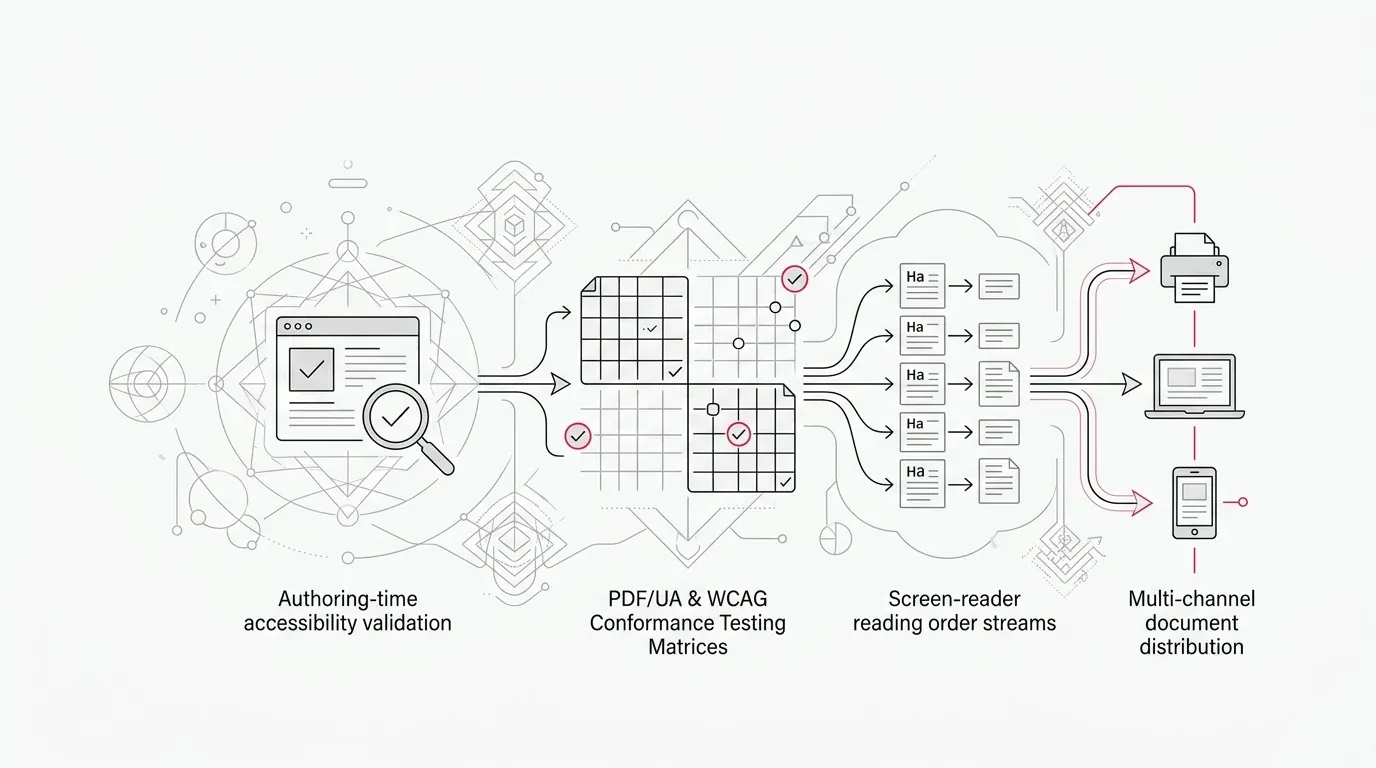
The more durable operating model combines prevention with independent verification . Authors need accessible defaults and clear guidance. Reviewers need a repeatable validation step. Output teams need standards-based tests against representative personalized documents, including edge cases. Operations teams need regression tests whenever templates, rendering engines, fonts, data mappings, or delivery channels change.
Where Perfect Doc Studio Makes a Distinctive Case
Perfect Doc Studio 's public knowledge base describes accessibility as an intrinsic part of document design. Users can enable accessibility settings , add summaries at document, block, and element level, run a built-in Accessibility Validator , review suggestions involving contrast, font size, and screen-reader compatibility, and use an Accessibility Preview before distribution.
This matters because the platform's broader proposition is business-user control. Perfect Doc Studio documents a visual editor, conditional smart templates , reusable sections, multilingual generation, workflow automation, and multichannel delivery. Its batch workflow includes a proofing stage before processing , and only published templates are available for certain generation flows. Those controls create the basis for an accessibility gate within normal communication operations rather than a separate specialist queue.
That is a promising design philosophy, but buyers should keep the claim precise . Public documentation does not state that generated PDFs conform to PDF/UA-1 or PDF/UA-2, nor does it specify supported WCAG conformance levels, EN 301 549 coverage, or independent certification. Perfect Doc Studio should be evaluated on what it demonstrates during a controlled pilot with the enterprise's own data, assistive technologies, and validation tools.
This caveat strengthens the buying case rather than weakening it. Accessibility programs fail when teams purchase a label instead of testing a workflow. Perfect Doc Studio belongs on the shortlist because it exposes accessibility work directly to the people who create and change communications.
How Competitive Evidence Should Shape a Shortlist
A rigorous review of the enterprise communication market reveals distinct approaches across leading providers:
- Quadient Inspire: Presents the broadest public story for high-volume legacy environments, offering both accessible template authoring aligned with PDF/UA and automated batch remediation of existing PDF archives through Inspire Adapt.
- OpenText Communications Exstream: Official data sheets confirm accessibility support across PDF, HTML email, and responsive HTML5 designs, supporting omnichannel communication teams.
- Smart Communications (SmartCOMM): Emphasizes accessible formats including PDF/UA as non-negotiable enterprise selection criteria while focusing on business-user template governance and workflow automation.
- Messagepoint: Focuses on central content hub control and intelligent translation, advocating for PDF/UA in static customer documents and WCAG for digital communications.
The right conclusion is not that one vendor wins accessibility in every environment. The vendors expose different strengths, and public evidence has different levels of specificity. A serious evaluation should use the same templates, data cases, assistive technologies, output validators , change scenarios, and acceptance criteria across every finalist.
A Seven-Part Proof for Enterprise Buyers
Enterprise procurement and technology teams should execute this seven-part evaluation before committing to any CCM contract:
- Define scope by service and jurisdiction: Map customer journeys, communication channels, document types, languages, and applicable national transpositions of the European Accessibility Act before evaluating tools.
- Test authoring prevention: Have a business user create and modify a complex statement with headings, tables, callouts, conditional clauses, dynamic charts, and links. Observe whether the editor prevents, flags, or silently permits accessibility defects.
- Validate generated output independently: Test generated files with recognized PDF validators (such as PAC) and HTML accessibility engines, supplemented by manual screen-reader (NVDA, JAWS) and keyboard-only audits.
- Exercise personalization edge cases: Stress-test empty fields, multi-line names, expanding tables, right-to-left languages, translated text expansions, and maximum-volume batch runs.
- Prove change governance: Modify a shared header component or conditional regulatory disclosure. Confirm version control, approval gates, regression testing, and rollback across every dependent template.
- Test every delivery channel in context: Review the entire customer task—including transactional email copy, PDF attachments, portal downloads, authentication, payment steps, and customer support.
- Write obligations into the contract: Mandate supported standards and versions (PDF/UA-1, PDF/UA-2, WCAG 2.2 Level AA), defect severities, remediation commitments, upgrade regression guarantees, and evidence retention.
Market Comparison Evidence
Summary of public evidence and buyer validation requirements across leading customer communications platforms:
| Platform | Verified Public Capabilities | Buyer Validation Required |
|---|---|---|
| Perfect Doc Studio | Design-time accessibility settings; validator with score and suggestions; document, block, and element summaries; accessibility preview. | Contractual PDF/UA-1 or PDF/UA-2 conformance; WCAG level; EN 301 549 mapping; independent certification; validator scoring methodology. |
| Quadient Inspire | Accessible template authoring aligned with PDF/UA and WCAG; automated batch conversion of existing PDFs via Inspire Adapt. | Version-specific PDF/UA-2 support and independent conformance evidence for the specific proposed deployment topology. |
| OpenText Communications Exstream | Official documentation states accessibility support across PDF, HTML email, and responsive HTML5 designs. | Supported PDF/UA version, authoring validation workflow, remediation mechanics, and third-party conformance testing. |
| SmartCOMM | Treats accessible formats including PDF/UA as key requirements; strong business-user template governance and workflow. | Specific PDF/UA generation methodology, supported standard versions, authoring validator, and independent conformance evidence. |
| Messagepoint | Advocates accessibility at scale, centralized content hubs, PDF/UA for documents, and WCAG for digital communication channels. | Product-specific generation, automated remediation, interactive validation, and standards conformance evidence. |
The Decision for CCM Leaders
Accessibility should influence CCM architecture because it exposes the cost of fragmented ownership. When content, logic, templates, channels, and validation live in separate tools, every change creates more places for defects to enter. A governed platform reduces that burden only if accessibility is visible during design and verifiable in the final experience .
Perfect Doc Studio offers a credible modern proposition: business users work in a visual environment with real-time accessibility validation and preview, backed by conditional logic, multilingual generation, and automated workflows. The disciplined choice for enterprise leaders is to include Perfect Doc Studio on the shortlist and test the complete workflow end to end.
Evaluate Accessible Document Generation in Practice
Ask Perfect Doc Studio for an accessibility proof session using one of your highest-risk customer communications. Test complex tables, conditional blocks, dynamic charts, multiple languages, and real screen-reader behavior before and after routine template changes.
Request a Proof Session at Perfect Doc Studio