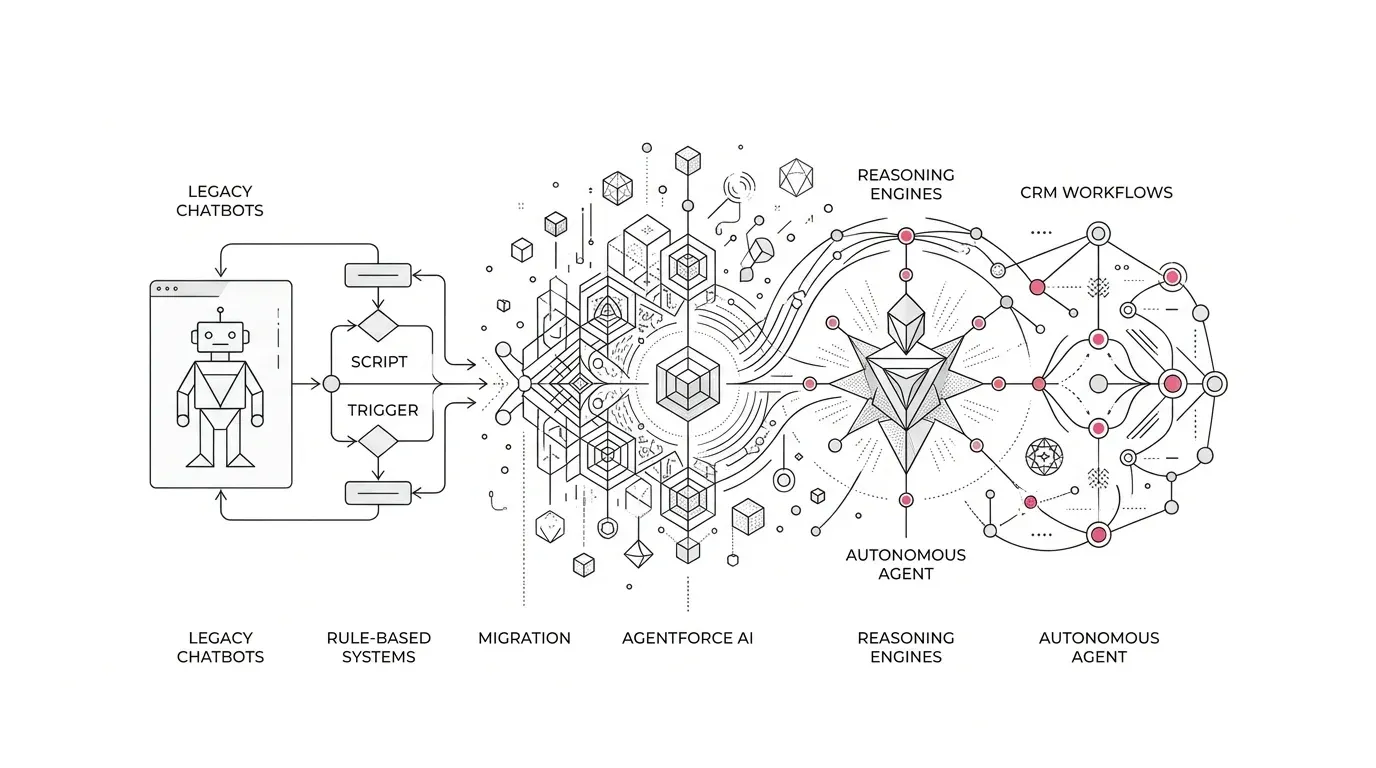
Salesforce has put Einstein Bots on a maintenance path. Since August 17, 2026, existing bots have remained supported and usable, but Salesforce says they will not receive new features or enhancements. For new AI agent implementations, Salesforce recommends Agentforce. The Winter '27 release notes also make the Upgrade Agent tool generally available, giving teams a supported way to create an Agentforce Service Agent from an existing bot while leaving the original bot in place for review.
That is not a shutdown notice, and it is not a reason to replace every bot immediately. It is a portfolio decision.
For a healthcare organization, insurer, or nonprofit, a production bot may authenticate users, answer policy questions, collect sensitive information, check a case or claim, invoke Flow or Apex, and route a customer to the correct human queue. A generated Agentforce version can accelerate the technical starting point, but it does not prove that those outcomes, controls, or handoffs remain equivalent.
The right question is not, "Can Salesforce convert our bot?" It is, "Which service journeys should remain deterministic, which benefit from agentic reasoning, and what evidence do we need before changing production traffic?"
Einstein Bots are in maintenance mode, not retired
Salesforce's maintenance-mode notice makes two points that leaders should keep separate:
- Existing Einstein Bots continue to be supported and can be used.
- Salesforce will not add new features or enhancements and recommends Agentforce for new implementations.
That distinction matters. A stable bot that handles a narrow, predictable task does not become defective because a newer platform is available. At the same time, maintenance mode changes the long-term economics of extending that bot. Every new requirement must be evaluated against a platform whose innovation path now points elsewhere.
There is also a separate knowledge issue to check. Salesforce retired Article Answers for Einstein Bots on September 30, 2026. Organizations that used that feature need to verify the actual knowledge-answering behavior in production rather than assume that general bot support preserved every knowledge capability.
Conversion changes the operating model
Einstein Bots and Agentforce Service Agent can both converse with customers, invoke actions, use an assigned user, connect to enhanced messaging channels, and transfer conversations. Underneath, however, they work differently.
Salesforce's comparison says Einstein Bots navigate predefined dialogs, steps, and utterances. Their intent models can require training, but the conversation structure is largely designed in advance. Agentforce Service Agent uses natural-language subagents, actions, a reasoning engine, and an LLM to decide how to respond and which action to use.
The Upgrade Agent tool analyzes dialogs, intents, and action steps. It groups similar dialogs into subagents and generates agent actions from bot action steps. This is useful automation, but it translates one control model into another. A condition embedded in a dialog can become an instruction interpreted by a reasoning engine. A tightly sequenced script can become a more flexible plan. The customer experience may improve, but equivalence must be demonstrated.
Salesforce reinforces that point in its upgrade instructions : some bot elements are not included in the upgraded agent, and teams should manually review AI-generated Agent Script. The generated agent is not activated automatically. That is a useful safety feature, not a migration sign-off.
Choose among three migration patterns
Keep the Einstein Bot for now
Keeping the bot can be reasonable when it handles a stable, bounded journey and performs well against current service measures. Examples include checking a case status, collecting a fixed set of fields, or routing a known intent to a queue.
Choose this path deliberately. Document the business owner, dependencies, current knowledge method, channels, actions, failure handling, and review date. Maintenance mode means that a bot can remain serviceable, but it should not become an unowned legacy asset.
Use a hybrid bot-and-agent architecture
A hybrid pattern can preserve deterministic steps while introducing Agentforce where natural-language flexibility has real value. An enhanced Einstein Bot can handle authentication, structured data collection, and predictable transactions, then transfer a complex knowledge or troubleshooting request to an Agentforce Service Agent.
Salesforce has published a hybrid reference pattern that uses the Messaging Session record and Omni-Channel flows to preserve intent and context during the handoff. The same article positions the bot for high-volume, rule-based work and Agentforce for more complex reasoning.
This is often the most practical path for regulated organizations. It avoids forcing probabilistic reasoning into every step and lets the team learn how Agentforce behaves on a defined slice of traffic.
Migrate the complete journey to Agentforce
A fuller migration makes sense when the use case needs fluid multi-turn conversation, flexible action selection, retrieval-augmented generation, or capabilities that will be developed on the Agentforce platform. It may also reduce the burden of maintaining intent sets and large dialog trees.
Do not treat "full migration" as "automatic conversion." The work still includes conversation redesign, action contracts, permission review, grounding, routing, testing, monitoring, and change management.
Use an eight-step migration plan
Inventory business outcomes, not just bot metadata
List every production bot, active version, language, channel, entry point, dialog, intent, variable, action, integration, knowledge source, routing flow, queue, and reporting dependency. Then connect each item to a business outcome: case created, appointment changed, benefit explained, claim status returned, donor question answered, or human transfer completed.
A metadata inventory tells you what exists. An outcome map tells you what cannot fail.
Capture a behavioral baseline
Before conversion, record current performance for representative journeys. Include containment, transfer rate, fallback or confusion rate, task completion, abandonment, average turns, latency, repeat contact, escalation destination, and downstream transaction accuracy. Segment results by channel, language, authentication state, and customer type where those differences matter.
Preserve test conversations for happy paths, ambiguous requests, invalid input, unauthorized requests, unavailable dependencies, and human escalation. This baseline becomes the comparison point for the migrated agent.
Classify each step by required control
Mark where the experience must be deterministic and where reasoning is acceptable. Identity verification, consent, required disclosures, payment steps, eligibility decisions, and writes to systems of record usually need tighter controls than general navigation or knowledge discovery.
For each action, specify its allowed inputs, data access, preconditions, side effects, error behavior, and escalation rule. Do not rely on a broad natural-language instruction when a Flow, Apex guardrail, validation rule, or approval step should enforce the condition.
Convert in a controlled environment
Create the Agentforce version in a sandbox or other approved test environment when feasible. Keep the original bot active and unchanged. Use the conversion output as a first draft, then review the generated subagents, instructions, actions, variables, classifications, and Agent Script.
Pay particular attention to dialogs without intents, custom conditional logic, navigation-only steps, feedback logging, reusable subflows, multilingual behavior, and any element the tool did not carry over. Resolve syntax warnings and document every manual change.
Re-certify identity and permissions
Both bots and agents act through assigned users, but a new agent can exercise actions in different sequences and contexts. Revalidate the agent user's object, field, record, Apex, Flow, knowledge, and external-system access. Test as the real customer persona, not only as an administrator.
For authenticated journeys, prove that one customer cannot retrieve or change another customer's data. For unauthenticated journeys, restrict actions to the minimum necessary and avoid exposing sensitive existence checks through error messages.
Rebuild channels, routing, and handoff
Salesforce's channel connection guidance requires teams to update or clone inbound Omni-Channel flows, route work to the Agentforce Service Agent, associate the appropriate messaging channel, and configure an outbound escalation flow.
Test the complete handoff, including queue selection, business hours, no-agent-available behavior, context transfer, transcript visibility, ownership, and return paths. A successful response in Agentforce Builder does not prove that a customer reaches the correct service representative with usable context.
Run regression, safety, and load tests
Replay the same representative cases against the existing bot and the candidate agent. Compare not only final wording but also selected actions, action order, record changes, citations or knowledge sources, escalation, latency, and consumption.
Add adversarial and operational cases: prompt injection in customer text or uploaded content, unsupported requests, repeated retries, stale knowledge, integration timeouts, partial writes, duplicate submissions, and service interruptions. Have qualified humans review high-risk outputs. Automated scores can support review but should not replace business acceptance criteria.
Cut over gradually and reconcile outcomes
Use a limited channel, audience, geography, language, or traffic percentage for the first production release. Define stop conditions before launch. Monitor the new agent and the downstream systems that prove the customer outcome occurred.
Reconcile case creation, status updates, appointments, payments, claim inquiries, donations, or other transactions at the record level. Retain a rollback route to the original bot until the new operating model has passed an agreed observation period.
Industry-specific controls deserve separate sign-off
Healthcare: Verify patient or member identity, minimum-necessary access, knowledge freshness, clinical escalation boundaries, appointment and case updates, and transcript handling. Do not allow a migration project to turn operational service automation into unreviewed medical guidance.
Insurance: Separate informational service from coverage, claims, pricing, and eligibility decisions. Preserve required notices, evidence sources, escalation to licensed or authorized staff, and transaction reconciliation.
Nonprofits: Protect donor and beneficiary information, distinguish public program information from record-specific service, and design for lean operating teams. A hybrid approach can keep common structured journeys predictable while using Agentforce for complex questions that otherwise reach staff.
These are operating controls, not legal or compliance assurances. Privacy, security, accessibility, records, and sector-specific obligations require qualified review.
The leadership decision is about service architecture
Einstein Bots maintenance mode does not create a universal migration deadline. It creates a point of architectural clarity. The existing platform can continue to run, but the forward investment path is Agentforce.
Leaders should approve a migration only when the team can answer five questions:
- Which customer outcomes improve, and how will we measure them?
- Which steps must remain deterministic?
- What data, knowledge, permissions, and integrations does the agent require?
- How will a customer reach a human with the right context?
- What evidence will permit cutover, and what conditions will trigger rollback?
The new upgrade tool lowers the cost of creating a candidate agent. The real work is proving that the new service path is accurate, controlled, recoverable, and worth operating.
Build the migration around customer outcomes
Yuniq's Salesforce services include experience with Service Cloud, Omni-Channel routing, case management, chat, SLA management, integrations, and tailored Salesforce implementation. Yuniq can help assess an Einstein Bot portfolio, select keep, hybrid, or migrate paths, redesign the target service architecture, and validate complete customer journeys before production cutover.
Ask Yuniq for an Einstein Bot-to-Agentforce migration assessment focused on your highest-volume customer journeys, control requirements, channel architecture, and measurable service outcomes.