For three days each year, downtown San Francisco becomes a peculiar alternate universe where CRM administrators wear hiking vests, enterprise architects collect mascot pins, CEOs debate the future of humanity beneath artificial trees, and phrases such as 'semantic intelligence' cause genuine queues to form.
Dreamforce 2026 brought more than 50,000 people to San Francisco, attracted over 122,000 online viewers across 150+ countries, and delivered over 1,600 breakout sessions, 150+ hands-on workshops, and 50+ keynotes alongside 20 years of the Trailblazer Community.
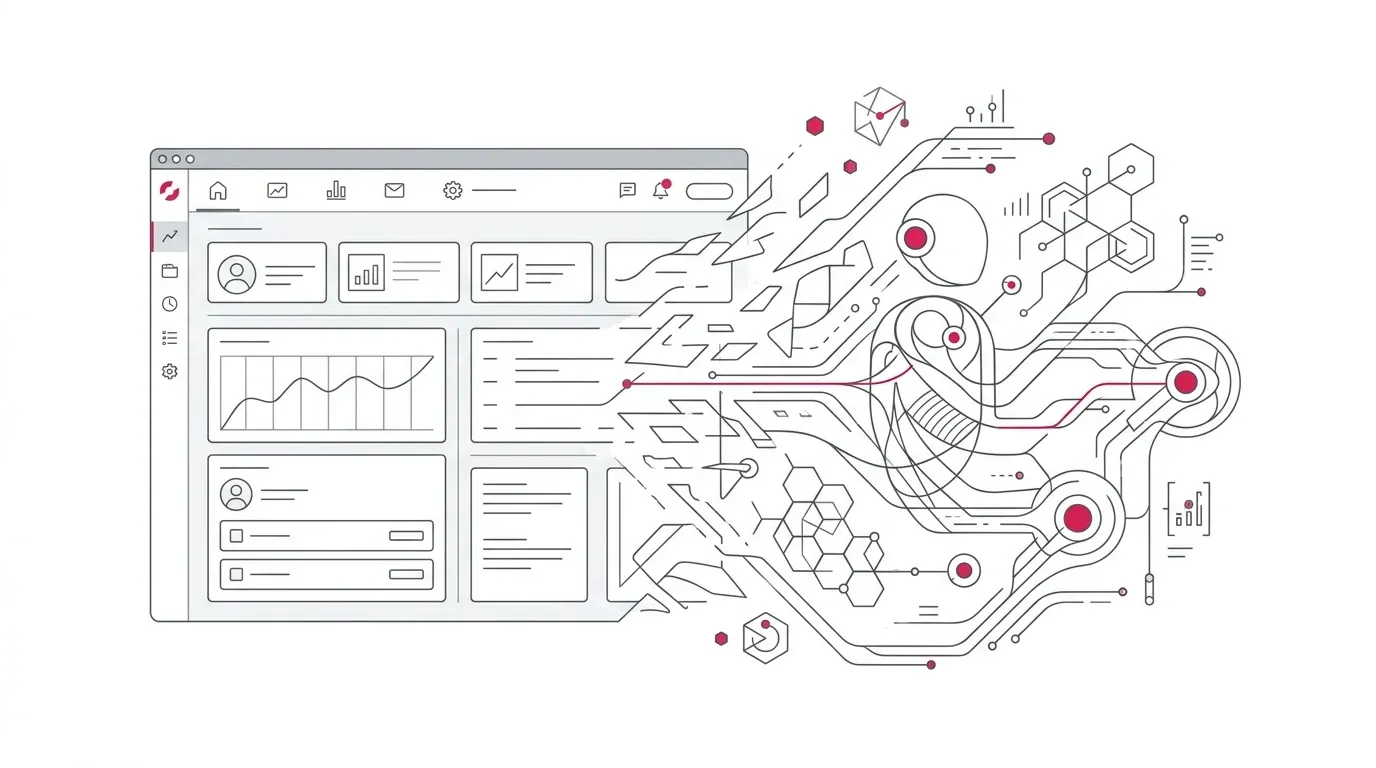
The Strategic Thesis of Dreamforce 2026: Salesforce believes the traditional software interface is becoming optional—but the governed data, workflow, and logic platform underneath it is becoming exponentially more valuable.
The future outlined across keynotes is not one where knowledge workers spend their days clicking through tab rows, hunting down fields, and logging manual record updates. Instead, employees ask intelligent assistants for business outcomes—and Salesforce silently supplies the trusted data, permissions, business rules, and execution workflows underneath.
The Big Idea: Salesforce Without Opening Salesforce
The headline release was AIforce, described as a live interface layer bridging Salesforce data, workflows, logic, security, semantics, and governance directly to the places where employees and AI agents already operate.
Instead of requiring a seller to open Lightning, search for an account, inspect activity history, review open cases, update an opportunity stage, and draft follow-up correspondence, AIforce executes that entire chain inside conversational AI surfaces such as Claude, Slack, and Agentforce Coworker.
This modular architecture establishes a four-tier enterprise AI foundation:
- Data 360: Supplies unified, zero-copy, and federated business context across the enterprise.
- Customer 360: Maintains domain applications, semantic models, granular permissions, and business rules.
- Agentforce: Deploys specialized autonomous digital workers equipped with deterministic skills.
- AIforce: Projects capabilities into any chosen front-end interface via MCP servers, APIs, and plugins.
For enterprise IT leaders, this fundamentally redefines CRM adoption metrics. Login counts and daily active screen time matter far less than governed actions completed, cycle time reduced, escalation rates, and outcome quality.
Developer and Admin Reality: Plumbing, MCP, and Data Quality
While keynotes broadcast vision, technical sessions focused on engineering mechanics: hosted Model Context Protocol (MCP) servers, metadata grounding, deterministic agent behavior, Apex Data 360 access, and headless UI rendering.
For developers, the role expands from building UI components and triggers to engineering robust, callable capabilities that both humans and autonomous agents can execute safely:
- Context Grounding: Determining what exact metadata and record history the agent requires.
- Action Boundaries: Enforcing strict deterministic guardrails on what tools an agent may invoke.
- Dispute & Multi-Agent Arbitration: Handling conflicts when collaborating agents produce divergent outputs.
- Auditability & Observability: Reconstructing agent reasoning steps, approval gates, and execution costs.
Operational Reality: AI makes good operational foundations exponentially more valuable—and bad foundations instantly visible. AI agents do not repair duplicate records, stale pipelines, or broken security models; they magnify them.
Field Proof: Customer Deployments at Scale
The most compelling conference stories moved beyond speculative benchmarks into hardened production numbers:
- Live Nation (Melody & Venue Agent): Deployed at BottleRock Napa Valley in under 30 days, handling 37,000+ interactions across 17,000 sessions with 85% resolved within 3 turns. Now scaling across 120 U.S. venue websites to automate 300,000+ fan inquiries annually with a 95% unassisted resolution rate and seamless Slack routing to human teams.
- Siemens: Operationalized across 18,000 sellers handling 2,800 unqualified weekly inbound leads. Autonomous agents enrich missing details, execute qualification logic, and route cross-divisional opportunities—engaging 100% of inbound leads.
- SaaStr: Generated $2.7M in closed revenue and $3.5M in pipeline from dormant contacts through personalized Agentforce outreach, achieving 72% open rates and >10% response rates.
- Adecco Group: Deployed Agentforce Coworker across 40 countries, turning global workforce enablement and multi-jurisdictional compliance into a real-world test of AI change management.
Koa: Domain-Specific CRM Reasoning on NVIDIA Nemotron
Salesforce and NVIDIA introduced Koa, a specialized CRM reasoning model built on NVIDIA Nemotron. Rather than relying on general LLMs attempting to infer complex enterprise workflows, Koa was post-trained on synthetic data reflecting decades of CRM operational patterns.
Salesforce reports that Koa achieves a 3x error reduction on multistep CRM tool execution compared to general-purpose frontier models, without using customer data for training. This reinforces a multi-model enterprise architecture: frontier models for creative synthesis, coding LLMs for development, and specialized domain models for governed transactional actions.
Claudeforce and Slackforce: The New Front Doors to Enterprise Work
AIforce introduces three core operational surfaces:
- Claudeforce: Integrates Salesforce context directly into Claude via a prebuilt MCP server, offering 37 sales execution skills and 40+ engineering plugins for Claude Code.
- Slackforce: Embeds deep CRM intelligence into collaborative Slack channels, enabling Slackbot to act as a personal agent that updates pipelines and logs notes conversationally.
- Agentforce Coworker: An in-app digital coworker within Lightning that activated over 100,000 enterprise users within its first 35 days.
AI Governance, Safety, and the Day 2 Outage Lesson
The event featured a live debate among industry leaders regarding AI safety and regulation: Anthropic CEO Dario Amodei advocated for rigorous third-party auditing, NVIDIA CEO Jensen Huang stressed engineering-led product safety, and OpenAI CEO Sam Altman highlighted continuous risk management.
A service disruption on Day 2 affecting multiple multi-tenant regions underscored that reliability is not an afterthought—it is the central feature of the agentic enterprise. When conversational agents act as the front door to critical business systems, resilience, idempotency, fallback queuing, and human escape hatches are essential.
Strategic Checklist: 5 Questions for Enterprise IT Leaders
- What specific business outcome does this agent deliver? Focus on unit economics, cycle time, and resolution rates rather than generic adoption.
- What explicit data assets and business rules ground the agent? Verify source freshness, data contracts, and semantic definitions.
- What is the highest-risk action the agent can trigger? Implement strict deterministic policy gates, multi-factor confirmations, and rollback mechanisms.
- How is context preserved during human escalation? Ensure agents hand off complete conversational history, tool trace logs, and customer intent to human reps.
- How will you measure performance against the legacy baseline? Establish pre-deployment baselines across cost, quality, response latency, and customer satisfaction.
The Core Takeaway: The interface moves, but the system of record remains. The winners of the agentic transition will not be those deploying the most bots, but those with the cleanest data, strictest deterministic rules, and safest execution architecture.