Salesforce is expanding Agentforce from simple question-answering into autonomous, high-value enterprise actions. Job-ready agents can now execute workflows across customer service, employee support, sales, commerce, and back-office operations. As the action surface expands, verifying whether an agent produces a plausible answer in a demo is no longer sufficient for enterprise risk.
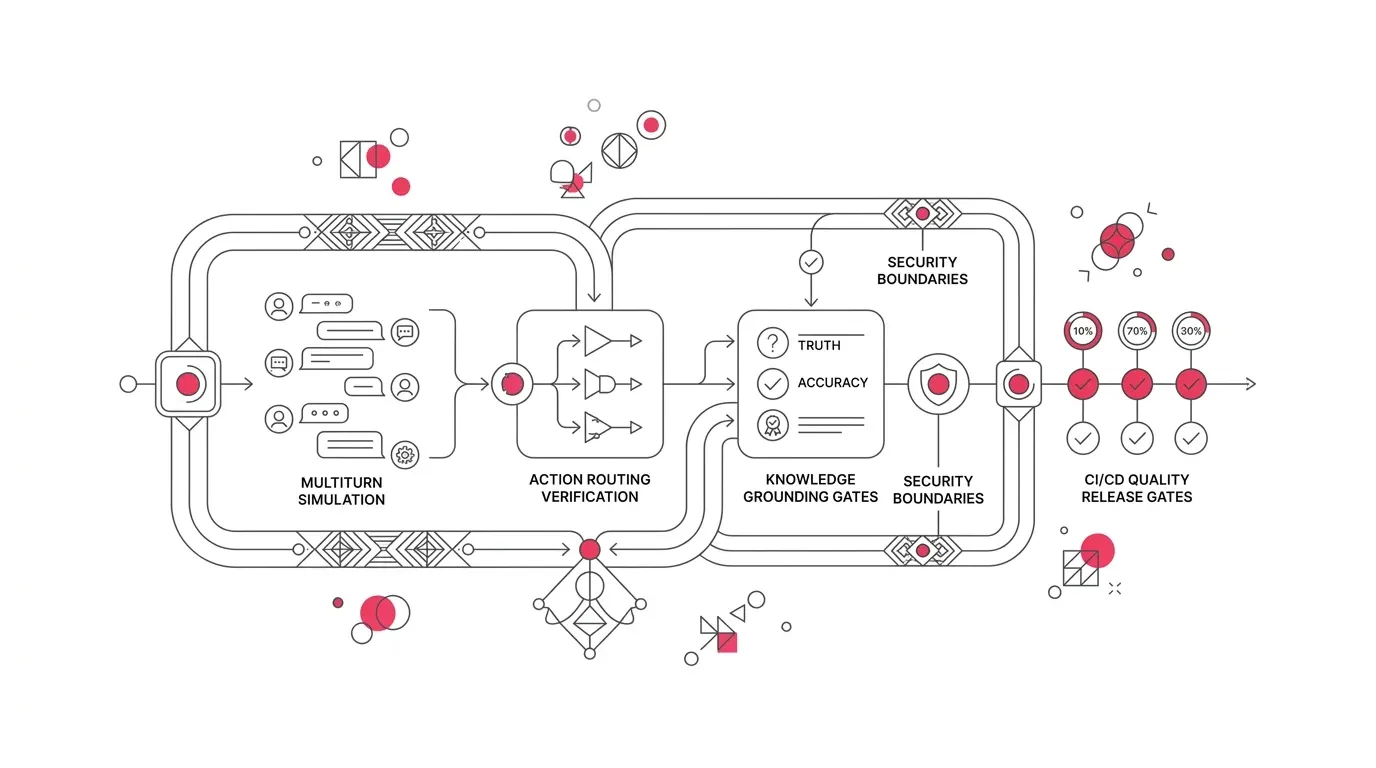
Core AI Governance Principle: Testing Center provides the execution engine, but your enterprise release policy supplies the definition of acceptable behavior. Moving from a demo to production requires verifiable gates for action routing, knowledge grounding, security boundaries, and regression stability.
Agentforce Testing Center in Agentforce Studio enables multi-turn conversation simulation, custom evaluations, session tracing, and command-line quality gates within sandbox environments.
Why Demos Fail in Production: The Reality of Autonomous AI
Demonstrations operate against pristine records and scripted questions. Production environments face incomplete user phrasing, multi-lingual slang, duplicate Data 360 profiles, outdated knowledge articles, API timeouts, and adversarial prompt injections.
Default evaluation scores are diagnostic aids, not absolute guarantees. A pass threshold acceptable for internal FAQ bots is dangerously lax for claim processing or order changes. Organizations need a structured seven-gate release framework.
The Seven-Gate Agentforce Release Framework
| Release Gate | Evaluation Focus | Mandatory Evidence to Pass |
|---|---|---|
| Gate 1: Job Boundary & Prohibited Outcomes | Defines exact scope, allowed actions, and strict negative constraints | Approved job specification, action whitelist, and prohibited-outcome blockers |
| Gate 2: Data & Knowledge Grounding | Tests source accuracy, freshness, retrieval quality, and negative access | Data 360 profile mappings, verified knowledge articles, and field restriction tests |
| Gate 3: Routing & Action Verification | Validates subagent routing, action triggers, Flow/Apex execution, and error handling | Correct execution traces across positive, ambiguous, denied, and failed API paths |
| Gate 4: Multi-Turn Conversation Simulation | Evaluates full dialog context, persona switching, and custom scoring metrics | Calibrated custom evaluators, multi-turn transcripts, and human-scored sample sets |
| Gate 5: Safety, Privacy & Escalation | Challenges prompt injection, role boundaries, sharing rules, and human transfer | Adversarial test results, least-privilege verification, and warm-handoff packet validation |
| Gate 6: Latency, Cost & Concurrency | Measures turn latency, Digital Wallet token consumption, and rate-limit degradation | Observed P95 latency benchmarks, consumption forecasts, and timeout fallbacks |
| Gate 7: CI/CD Quality Gates & Regression | Automates versioned test suites blocking unvetted prompt or schema deployments | CLI test execution reports integrated into Salesforce DevOps Center/Git pipelines |
Deep-Dive: The Seven Production Gates
Gate 1: Define the Job and Prohibited Outcomes
Start with a narrow, unambiguous job charter. Define the target user, initiating trigger, allowed write actions, and explicit boundaries. List non-negotiable release blockers: disclosing third-party PII, executing write actions without confirmation, or providing financial/clinical determinations outside policy.
Gate 2: Data and Knowledge Grounding
Audit every object, field, Data 360 profile, and knowledge article referenced by the agent. Inject messy reality into test data: missing contact fields, duplicate account records, and retired policy terms. Verify that the agent adheres strictly to retrieved source citations without hallucinating ungrounded assumptions.
Gate 3: Action and Subagent Routing
Evaluate whether the agent selects the correct topic and action sequence. Verify four essential execution paths: happy path, ambiguous path (asking for clarification), denied path (insufficient user permissions), and failure path (handling downstream Flow/API timeouts gracefully).
Gate 4: Full-Conversation Multi-Turn Simulation
Simulate multi-turn conversations with varied customer personas (e.g., frustrated claimants, non-native speakers, brokers). Score interactions using custom evaluators for completeness, instruction adherence, tone appropriateness, and context retention across turns.
Gate 5: Safety, Security, and Human Escalation
Execute adversarial prompt injection testing, verify that field-level security (FLS) and sharing rules prevent unauthorized data access, and validate that warm handoffs deliver accurate context packets to live Service Cloud agents.
Gate 6: Latency, Consumption, and Failure Modes
Measure total interaction latency (retrieval time + action execution + token generation) and monitor Digital Wallet consumption rates under realistic conversation lengths. Establish deterministic fallback behaviors when APIs fail.
Gate 7: Automated CI/CD Regression Testing
Incorporate versioned Agentforce test suites into deployment pipelines using command-line testing tools. Automatically block production promotions whenever a prompt modification, Flow update, or schema change degrades golden test scores.
Build and Test Enterprise Agentforce Deployments with YuniQ
YuniQ provides comprehensive Agentforce production-readiness assessments, multi-turn test suite creation, Data 360 grounding, and CI/CD quality gate automation.
Explore Salesforce AI ServicesFrequently Asked Questions
What is the difference between an Agentforce demo and a production-ready agent?
A demo tests single-turn happy paths against clean sample records. A production-ready agent is validated across multi-turn dialogs, messy data, permission boundaries, API timeout failures, adversarial prompts, and automated regression suites.
Can Agentforce tests run automatically in CI/CD pipelines?
Yes. Salesforce Agentforce Testing Center provides command-line interface (CLI) tools and APIs that allow engineering teams to execute automated test suites as quality release gates in CI/CD deployment pipelines.
How do custom evaluators work in Agentforce Testing Center?
Custom evaluators allow teams to define specialized scoring criteria (such as compliance disclosures, tone, or specific business rule checks) beyond standard out-of-the-box metrics like conciseness and coherence.