3. Full Article
Your Agentforce dashboard can change even when your agent does not.
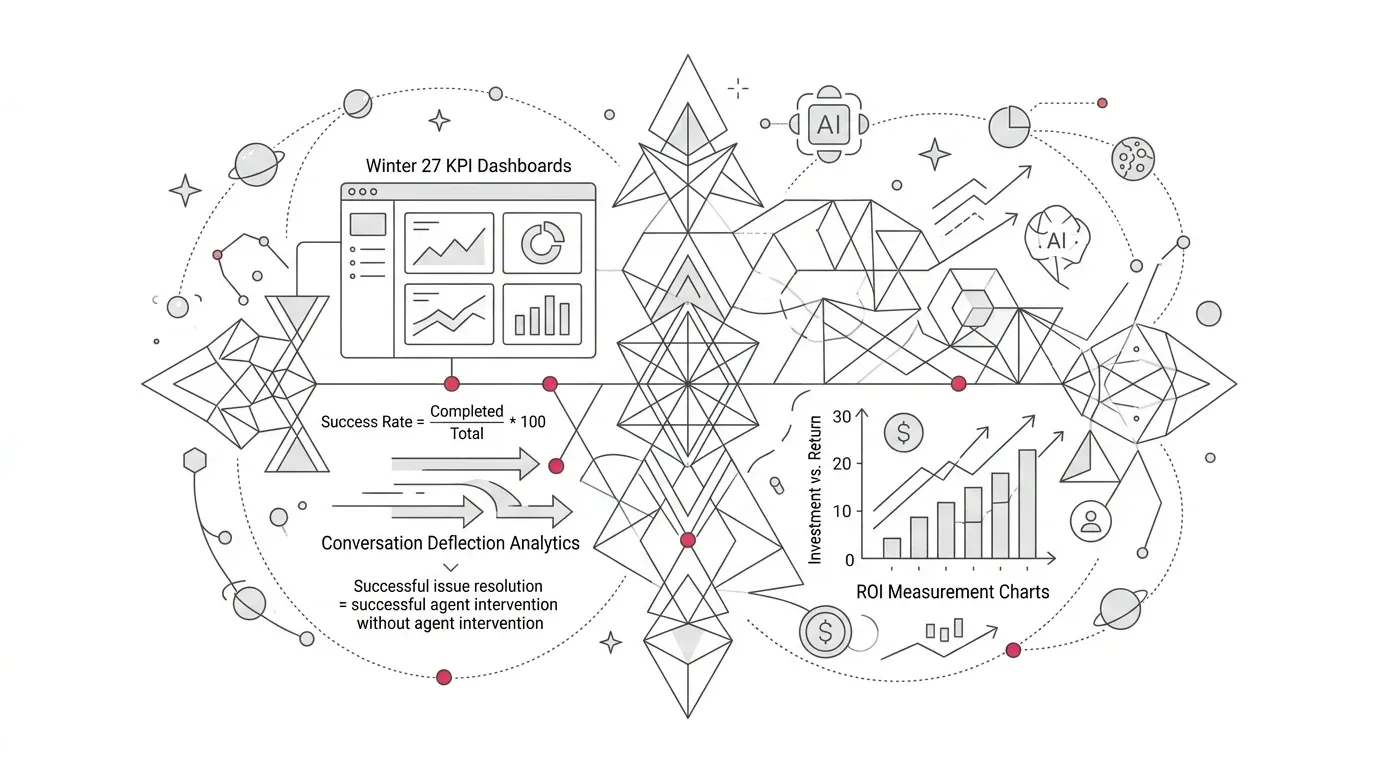
In Winter '27, Salesforce updated several Agentforce Observability metrics. The changes are becoming available on a rolling basis in upgraded orgs starting the week of October 12, 2026. Success Rate has a new formula. Deflection and abandonment have revised eligibility and classification rules. Two response metrics have new names and definitions. Agent Interaction Duration is no longer included in standard dashboard templates.
These changes may improve the platform's measurement model. They also create a comparability problem at exactly the moment many executives are deciding whether an Agentforce pilot deserves more budget.
The practical response is not to reject the new metrics or accept them uncritically. It is to establish a measurement contract: define what success means for the business, document what Salesforce measures, preserve the old baseline, and prove the relationship between the two.
What changed in Agentforce Observability?
Salesforce's Winter '27 release note identifies five changes that deserve attention.
| Metric | Winter '27 definition or treatment | Decision risk |
|---|---|---|
| Success Rate | Interactions with at least one completed action step and no step errors | An informational conversation can be useful but not count as successful. A technically completed action can count even if the business outcome later fails. |
| Agent Response Latency | Time from the end of a user message to the start of the agent response; previously called Time to First Token | Historical reports may use a different label, and the first token does not describe total resolution speed. |
| Turn Completion Rate | Share of user turns receiving an agent first token within 60 seconds; previously called Agent Response Rate | A response within 60 seconds says nothing about accuracy, usefulness, or completion of the customer's goal. |
| Deflection and abandonment | Require at least one user message. A session qualifying as both is classified as deflected. | Trend lines can move because eligibility and precedence changed, not because the customer experience improved. |
| Agent Interaction Duration | Removed from standard dashboard templates | Teams relying on the template may lose a familiar diagnostic unless they preserve or replace it. |
There is a second layer to understand. Salesforce has also moved Service-agent deflection and abandonment toward full-session, LLM-based evaluation. Its September 9 guidance describes a five-point deflection score, a TRUE/FALSE/UNSURE abandonment judgment, and an outcome hierarchy that separates escalated, abandoned, deflected, and ambiguous sessions. Salesforce says the change is automatically enabled for Service agents, while older baseline data remains queryable. It does not apply to GovCloud.
That distinction matters. Winter '27 is not simply renaming dashboard tiles. Organizations may be looking at a mix of changed formulas, changed eligibility, changed classification logic, and context-based scoring.
Why an apparent improvement may not be a real improvement
Imagine that a health insurer's service agent answers a member's eligibility question. The answer is accurate, no action is required, and the member leaves satisfied. Under the new Success Rate definition, that interaction may not qualify because the agent did not complete an action step.
Now consider an agent that successfully creates a case with no step errors but uses the wrong case type. The platform action completed, yet the downstream service team must rework it. A technical success has not produced an operational success.
The same problem appears in other sectors:
- An insurance agent starts a claim successfully, but required loss details are missing.
- A nonprofit agent creates an assistance request, but routes it to the wrong program.
- A healthcare agent schedules an appointment, but the location is inaccessible to the patient.
None of these examples means the Salesforce metric is defective. It means a platform KPI and a business outcome answer different questions.
Build an Agentforce measurement contract
A measurement contract is a short, governed definition of what leaders are allowed to infer from each KPI. It should name the formula, data source, population, exclusions, owner, review cadence, and business outcome to which the metric is reconciled.
Use the following process before comparing periods or scaling the program.
1. Timestamp the definition change
Record the date on which each production org received the Winter '27 metric update. Do not use the general release week as a substitute for the org's actual availability date.
Annotate every executive dashboard and recurring report. If a chart crosses the change date, label the periods as different measurement versions. Avoid a single uninterrupted trend line unless you have reproduced both periods with a common definition.
2. Preserve the baseline
Export or snapshot the old dashboard outputs, filters, semantic-model fields, and reporting logic before altering custom analytics. Salesforce says the earlier data supporting the previous deflection and abandonment metrics remains accessible, but access to data is not the same as a ready-made comparable report.
Preserve representative session IDs as well as aggregates. You will need the sessions to explain why a KPI changed.
3. Define success by job, not by product
Start with the job the agent is expected to complete. A useful success statement has four parts:
- Customer outcome: What was the person trying to achieve?
- Operational outcome: What record, action, or handoff should exist afterward?
- Quality condition: What must be accurate, complete, timely, and understandable?
- Risk condition: When must the agent stop, disclose a limitation, or transfer to a qualified human?
For example, “claim initiated” is not enough. A stronger definition is: the correct policy and claimant are identified, mandatory first-notice-of-loss data is captured, required documents are requested, the claim is created once, the claimant receives a reference number, and exceptions reach a licensed or authorized reviewer.
4. Reconcile telemetry to systems of record
Connect Agentforce session and action data to the records where outcomes become real: Cases, claims, appointments, applications, donations, payments, complaints, or fulfillment events.
Salesforce's current customization guidance makes the principle explicit: identify the business context missing from the standard metric, choose the right measurement level, and confirm that the required fields and scorer outputs are captured consistently.
For each high-value intent, calculate at least three layers:
- Technical: Did the model, retrieval, and action steps run without error?
- Operational: Was the correct record or transaction completed without duplication or rework?
- Business/customer: Did the person achieve the intended result within the promised time and risk boundary?
Keep cost alongside them. A higher deflection rate is not automatically valuable if repeat contacts, complaints, credit consumption, or manual remediation rise.
5. Validate LLM-scored outcomes with people
Context-based scoring can be more informative than click and timeout proxies. It is still a model judgment.
Create a stratified review sample covering high-volume intents, rare high-risk intents, escalations, ambiguous sessions, languages, channels, and protected or vulnerable customer groups where appropriate. Have trained reviewers label the outcome independently, then compare their decisions with the standard scorer.
Track disagreement by intent, not just overall. A scorer that performs well on password resets may be unreliable on coverage explanations or patient-support requests.
6. Separate service efficiency from service quality
Do not compress the whole program into deflection.
A balanced scorecard should include:
- Goal completion and correct action rate
- Recontact or repeat-intent rate within a defined period
- Escalation appropriateness, not merely escalation volume
- Downstream rework, reversal, duplicate, and exception rates
- Customer effort and satisfaction where the response rate is adequate
- Safety, privacy, complaint, and policy exceptions
- End-to-end resolution time, not only first-token latency
- Cost per verified outcome
The metric set should be small enough to govern. More dashboards do not create more truth.
7. Reset the scale gate
If the definition changed during a pilot, do not compare the new number with the old target and declare victory or failure. Run a parallel measurement period long enough to capture normal volume and operational cycles.
Approve expansion only when the agent meets thresholds for verified outcomes, risk controls, reliability, and economics. Record who approved the decision and which metric version they used.
Industry-specific measurement traps
Healthcare and health insurance
An agent can complete a scheduling, eligibility, billing, or member-service action without producing a clinically or administratively correct result. Measure downstream corrections, duplicate contacts, accessibility failures, privacy exceptions, and appropriate human escalation. Agentforce analytics should support, not replace, qualified medical, privacy, legal, or compliance review.
Insurance
Deflection is a weak primary measure for claims, complaints, renewals, or coverage questions. An avoided human interaction can conceal incomplete intake or an unsuitable explanation. Reconcile sessions to claim completeness, processing exceptions, complaint records, reversals, leakage indicators, and jurisdiction-specific review requirements.
Nonprofit foundations
High deflection can conflict with mission outcomes when constituents need complex guidance or accommodation. Connect the agent's activity to application completion, program eligibility, referral quality, donor-service resolution, equitable access, and the quality of human handoffs. Low-volume, high-consequence journeys deserve their own review even when aggregate metrics look strong.
The executive question to ask next
Do not ask, “Did Agentforce Success Rate go up?”
Ask: “Under which definition, for which customer job, and did the verified business outcome improve without increasing risk, rework, or cost?”
Winter '27 gives Salesforce teams a good reason to make that question operational. Organizations that version their metrics and link platform activity to real outcomes will be able to distinguish a better agent from a different formula. Those that do not may scale, pause, or fund the wrong intervention based on a dashboard discontinuity.
Yuniq provides Salesforce implementation, customization, integration, and managed support services . For organizations moving Agentforce from pilot to production, a focused observability review can map standard metrics to business outcomes, preserve the pre-change baseline, validate critical sessions, and establish evidence-based scale gates.
Connect with Yuniq to review a production Agentforce journey and audit its executive dashboard before making your next scale decision.