An AI agent can find the right document and still make the wrong decision.
The problem is rarely access alone. A contract may have been superseded. A call transcript may omit tone, timing, or a correction made later in the conversation. A grant report may contain a table that was extracted incorrectly. A policy paragraph may be accurate but apply to the wrong region, customer type, or date.
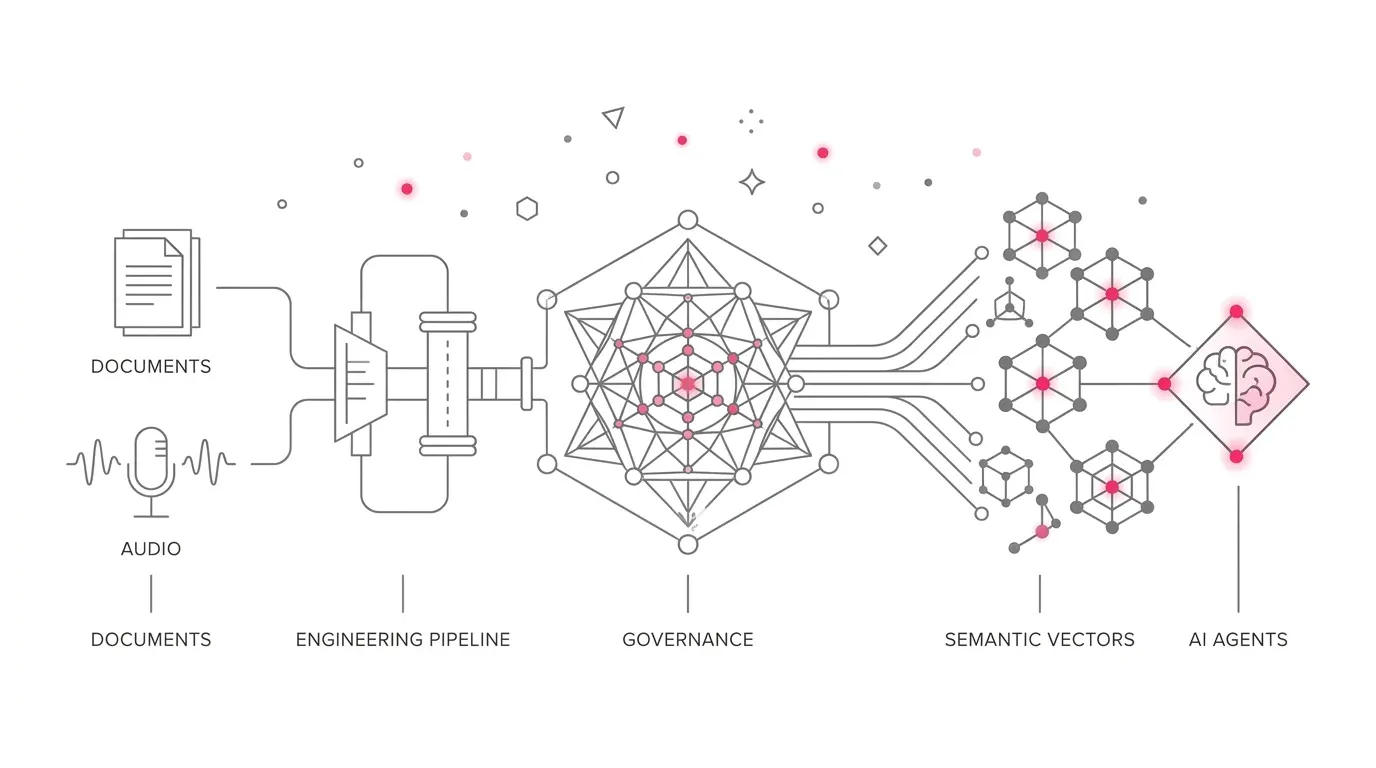
For business and technology leaders, this changes the data-readiness question. The goal is not simply to make documents, audio, images, video, and messages searchable. The goal is to preserve enough source fidelity, business context, permissioning, and lineage for an agent to use them responsibly.
That distinction matters as agent projects move from answering questions to recommending or taking actions. McKinsey argues that scaling AI requires structured and unstructured data to be connected in a governed, traceable, and reusable foundation. It also notes that a single PDF can produce extracted text, tables, images, summaries, metadata, sensitivity tags, and quality scores, all of which need to stay connected to the original source and to one another ( McKinsey, June 23, 2026 ).
The practical implication is clear: unstructured data needs pipeline discipline comparable to the discipline applied to financial, customer, and operational records.
Why Searchable Is Not the Same as Agent-Ready
Traditional retrieval-augmented generation, or RAG, commonly divides a document into chunks, creates numerical representations called embeddings, and retrieves likely relevant passages for a model. This can work well for bounded questions. It becomes fragile when the agent also needs to know:
- whether the passage came from the current approved version;
- which customer, case, contract, grant, or transaction it concerns;
- whether the requesting person has permission to see it;
- what was omitted or changed during extraction;
- whether a table, image, recording, or attachment contains essential context;
- and which transformation produced the text the agent received.
The market is beginning to reflect this problem. On October 21, Google made ObjectRef and multimodal analytics in BigQuery generally available. ObjectRef can represent a reference to a Cloud Storage object beside structured database fields, allowing the source object, metadata, and derived features to remain connected. Google says this avoids some of the nuance loss that occurs when unstructured files are converted into purely structured outputs ( Google Cloud, October 21, 2026 ).
ObjectRef is one vendor's implementation, not a universal prescription. The broader principle is portable: do not force an agent to choose between business records and source evidence. Design the pipeline so it can use both under the same governance model.
Eight Controls for an Agent-Ready Unstructured Data Pipeline
Give Every Source Object a Stable Identity
Start with the original artifact. Each document, recording, image, video, or message thread needs a stable identifier and a minimum metadata record:
- source system and source URI;
- owner and business domain;
- creation, collection, and effective dates;
- version, checksum, and approval status;
- retention class and sensitivity label;
- language, region, and applicable business process.
A filename is not an identity strategy. Neither is a URL that changes when content is moved. The test is whether an investigator can retrieve the exact source version an agent used six months later.
Link Artifacts to Authoritative Business Entities
Unstructured content becomes operationally useful when it is connected to governed entities. A support call should link to the correct customer and case. A contract clause should link to the agreement, counterparty, product, jurisdiction, and effective period. A foundation's site-visit recording should link to the grant, grantee, program, and reporting cycle.
These relationships should be explicit, not inferred afresh each time an agent runs. Where confidence is below an agreed threshold, route the relationship for review rather than quietly attaching content to the wrong record.
AWS describes the complementary role of a semantic layer: canonical definitions, entity relationships, permission-aware context, lineage, and auditability that agents can use consistently ( AWS, September 9, 2026 ). The important point is that meaning must be governed outside the prompt.
Set Quality Gates for Each Modality
One accuracy score cannot govern every kind of extraction. Text recognition, table extraction, speaker separation, transcription, image description, and entity matching fail in different ways.
Define acceptance thresholds by modality and use case. For example:
- text: character and field accuracy on representative scans;
- tables: preserved row, column, header, unit, and footnote relationships;
- audio: word error rate plus speaker-attribution accuracy for the languages and acoustic conditions that matter;
- images: detection accuracy for the specific objects or fields used in decisions;
- entity links: precision, recall, and a review threshold for ambiguous matches.
The benchmark set should include difficult material, not only clean samples. For a multinational company, that means real languages, accents, layouts, and regional formats. For a nonprofit, it may mean handwritten forms, low-bandwidth recordings, or partner-submitted files.
Preserve End-to-End Lineage
Every derived artifact should point back to:
- the exact source object and version;
- the parser, model, prompt, or rule version that created it;
- the processing time and configuration;
- any human correction or approval;
- the downstream indexes, stores, or agents that received it.
This is not bureaucratic overhead. Without lineage, a team cannot answer basic questions after a policy changes, a parser is found to be faulty, or an agent produces a disputed recommendation.
Joint guidance from the NSA, CISA, FBI, and international partners recommends tracking data provenance and authenticating trusted revisions as part of AI data security ( NSA, May 22, 2025 ). Provenance protects integrity as well as accountability.
Propagate Permissions to Every Derivative
Splitting a restricted document into chunks must not make the chunks public. Creating an embedding does not erase the source's sensitivity. A summary can reveal protected information even when it does not reproduce the source verbatim.
The pipeline should carry access rules, sensitivity labels, retention requirements, and geographic restrictions into derived artifacts. At query time, retrieval should evaluate the identity and authorization of the user or agent before returning context.
Microsoft's current guidance for AI-agent data architecture emphasizes authoritative content, existing permissions, sensitivity labels, identity, policy, and audit controls ( Microsoft Learn, accessed October 26, 2026 ). This is a useful procurement test: ask whether access is enforced at the source, index, retrieval, and action layers, rather than only in the user interface.
Keep Meaning Consistent Across Retrieval Paths
An agent may use SQL for transactions, metadata search for files, vector retrieval for passages, and APIs for live operational state. Those paths must agree about core terms and entities.
If "active donor," "open claim," or "eligible customer" has a different meaning in each system, faster retrieval will only produce faster disagreement. Establish governed definitions, identifiers, and relationship rules that all retrieval paths can reference. Record which definition and effective date were used for each material output.
This also creates a clean division of labor:
- systems of record establish authoritative facts;
- the semantic layer establishes governed business meaning;
- unstructured pipelines preserve and enrich source evidence;
- the agent assembles permitted context and reasons within a bounded workflow.
Make Reprocessing Controlled and Repeatable
Unstructured pipelines change frequently. A new transcription model may improve one language and regress another. A parser update may alter table boundaries. A policy may require new sensitivity labels. A source record may be corrected or deleted.
Processing should therefore be idempotent: rerunning the same approved job against the same source version should not create conflicting duplicates. Teams also need selective backfills, versioned transformations, comparison reports, and rollback.
Before a pipeline change reaches production, ask:
- Which artifacts and agents are affected?
- Will the change replace or coexist with earlier derivatives?
- Can we compare old and new outputs on a fixed test set?
- Can we reverse the release without losing corrections or audit history?
- Will deletion and retention rules be re-applied?
Operate the Pipeline as a Product
The pipeline needs owners, service levels, cost limits, and observable failure modes. Monitor at least:
- source-to-index freshness;
- extraction failure and low-confidence rates;
- permission mismatches;
- orphaned source or derived artifacts;
- stale embeddings after source changes;
- retrieval quality by use case and user group;
- processing and inference cost per artifact;
- deletion and retention completion;
- agent outcomes traced to source evidence.
These metrics should lead to operational decisions. A high-confidence answer based on an obsolete policy is still wrong. A low-cost pipeline that cannot delete a person's data reliably is still unsafe.
An Acceptance Checklist for Your Proof of Concept
| Control | Pass condition | Evidence to inspect |
|---|---|---|
| Source identity | The exact source version can be retrieved from any material agent output. | Object metadata, checksum, version record, output citation |
| Business links | Artifacts connect to the correct governed entities with measured confidence. | Entity map, exception queue, reviewed sample |
| Quality gates | Each modality meets an approved threshold on representative edge cases. | Benchmark set, error analysis, sign-off |
| Lineage | Every derivative is traceable through each transformation. | Lineage graph, model and parser versions, run log |
| Permissions | Source restrictions persist through chunks, indexes, summaries, and caches. | Access tests using different identities and regions |
| Semantics | SQL, search, vector, and API paths use consistent definitions. | Glossary, ontology or mapping, contradictory-query test |
| Reprocessing | Changes can be compared, selectively backfilled, and rolled back. | Replay test, diff report, rollback evidence |
| Operations | Freshness, cost, failure, deletion, and drift are measurable. | Dashboard, alerts, service levels, incident runbook |
A proof of concept should fail visibly when a control is missing. Silent success is not evidence.
A 30-60-90 Day Pilot for One Bounded Workflow
Days 1-30: Define the Decision and Evidence Boundary
Choose one workflow with a clear owner and measurable value. Examples include answering policy questions for service agents, reviewing grant reports against approved terms, or summarizing customer calls before human follow-up.
Inventory the structured records and unstructured sources the workflow needs. Classify each source by authority, sensitivity, update frequency, region, and retention rule. Agree on which actions remain advisory and which require explicit human approval.
Days 31-60: Build the Traceable Pipeline
Create stable source identities, business-entity links, modality-specific extraction tests, lineage, and permission propagation. Connect the retrieval paths to shared business definitions. Run adversarial and edge-case tests, including obsolete documents, conflicting sources, restricted records, poor-quality files, and deletion requests.
Days 61-90: Run in Parallel and Decide
Operate the agent alongside the current process. Compare its source selection, reasoning inputs, escalation choices, latency, cost, and user outcomes. Review every high-impact exception.
At the end of the pilot, make a scale, revise, or stop decision. Scaling should depend on evidence that the pipeline is controlled, not on an impressive demonstration.
Where YuniQ SPEED AI Fits
YuniQ SPEED AI is positioned around enterprise data movement and architecture. Its canonical page describes conversational pipeline configuration, schema matching and validation, multi-target flows, data spot checks, in-flight PII masking, metadata cataloging, and proactive telemetry. YuniQ also states that the platform supports more than 160 integrations.
Those capabilities map to important parts of an agent-ready data foundation: moving data between systems, validating structure, applying controls, and observing pipelines. The current page does not explicitly verify native parsing or analysis of documents, audio, images, or video, so buyers should confirm each required format and transformation in a representative proof of concept.
For an architecture review, bring:
- one bounded agent workflow;
- three to five authoritative structured sources;
- representative documents, recordings, images, or messages, including difficult cases;
- current access, retention, and regional rules;
- a short set of decisions the agent must support;
- and the eight acceptance controls above.
This turns a platform conversation into an evidence-based design review.
Make the Source as Governed as the Answer
The next generation of enterprise AI will not be won by the organization with the largest vector database. It will be won by organizations that know which source an agent used, what that source meant, who was allowed to use it, what changed during processing, and when a human should intervene.
That is the standard for full-fidelity, governed data pipelines. It is also a practical way to separate an agent that demos well from one that can earn trust in production.
Next step: Book a SPEED AI architecture review to test one agent workflow against representative sources, mappings, validations, and governance requirements.
Frequently Asked Questions
What is unstructured data for AI agents?
Unstructured data is information that does not arrive as a conventional row-and-column record. Examples include documents, email bodies, messages, images, audio, video, and free-text notes. AI agents often use extracted text, metadata, summaries, embeddings, or other derivatives of these sources. A governed pipeline keeps those derivatives connected to the correct source, business context, permissions, and version.
Should an enterprise convert all unstructured data into structured data?
No. Structured extraction is useful for search, analytics, and automation, but it can omit layout, tone, images, qualifiers, or other context. Retain the original source when policy and retention rules allow, connect it to derived artifacts, and define when the agent should inspect the source rather than rely only on an extraction.
How should permissions work for chunks and embeddings?
Derived artifacts should inherit or enforce restrictions consistent with their source. Authorization should be checked before retrieval, and the design should account for summaries, caches, indexes, and embeddings that may reveal sensitive information. Test with users and agents that have different roles, regions, and entitlements.
What is a sensible first pilot for a nonprofit foundation?
Choose a bounded, reversible workflow such as helping program staff locate approved grant terms or preparing a cited summary of submitted reports for human review. Avoid autonomous eligibility, funding, or adverse decisions in the first pilot. Use real access rules and representative difficult files, then measure traceability, quality, staff time, and exception handling before expanding.
Is a vector database enough for enterprise AI agents?
Usually not. Vector retrieval can help find semantically similar passages, but it does not by itself establish source authority, business meaning, permissions, freshness, lineage, retention, or action controls. Those functions belong across the data, semantic, retrieval, security, and agent layers.